
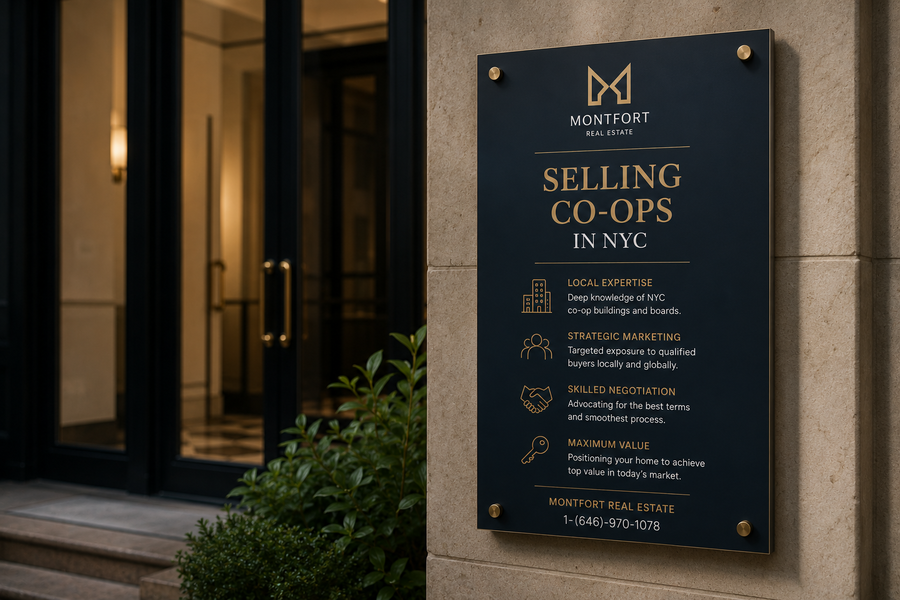
We’ll help you navigate the co-op sales process, maximize your property’s value, and avoid unnecessary delays, board-related issues, and costly mistakes.
Smooth transaction with limited risk
No pressure to over pay and buy within a certain time period
A team of people that will be with you even after the transaction is complete
Selling a co-op in NYC involves selling shares in a corporation rather than real property - and that single distinction changes everything about how you prepare, price, market, and close the deal. I'm Stanley Montfort, and I've built my business around helping co-op owners in Manhattan and Brooklyn navigate the complexities that make these transactions unlike any other in New York City real estate.
From strategic pricing and apartment preparation to buyer qualification screening and co op board approval management, I guide sellers through every stage so nothing gets left to chance. Whether you own a pre-war one-bedroom on the Upper West Side or a sun-filled three-bedroom in Park Slope, the goal is the same: maximize your selling price, attract qualified buyers who will pass the board, and close without unnecessary delays.
One of the biggest mistakes I see co-op sellers make is assuming the process works like selling a condo or a house. It doesn't - not even close.
When you sell a co op, you're transferring shares of a cooperative corporation and a proprietary lease to the buyer. That means the co op board has authority over who can purchase your unit - and their approval can significantly dictate the transaction timeline. Board members evaluate the buyer's finances, employment, references, and sometimes even lifestyle. No other type of residential property sale in New York City involves this level of scrutiny.
Here's why co op sales demand specialized expertise:
Real estate agents specializing in co-ops can navigate the specific regulations and procedures involved. As a listing agent, my job is to protect your interests at every step - from preparing the property and building documentation to screening potential buyers and managing the board approval process.
I provide specialized service for co-op sellers across the Upper East Side, Upper West Side, Midtown, and downtown Manhattan. Whether your apartment is in a luxury doorman building, a classic pre-war cooperative, or a post-war development, I understand the nuances that determine how each building's board operates and what buyers in each neighborhood expect.
Manhattan co-ops represent the largest share of the NYC co-op market, and each building has its own culture. One question I always discuss with sellers is how their building's board history - its track record of approvals, rejections, and interview expectations - will shape our marketing and buyer-screening strategy.
Brooklyn's co-op market has its own character. I work with sellers in Park Slope, Brooklyn Heights, Cobble Hill, and Fort Greene, where buyer preferences and board cultures differ meaningfully from Manhattan. Brooklyn co-op boards tend to have their own documentation standards and financial thresholds, and understanding those differences is essential to a successful sale.
Before listing a co-op, I review ten factors that determine whether a sale will close smoothly - or stall. Here's what experienced buyers and their agents evaluate:
One of the first things I review with every seller is a comprehensive evaluation of three things: your apartment's condition and appeal, your building's financial health, and recent comparable sales.
I pull closed transactions in your building and neighborhood, review the building's financial statements and maintenance fee history, and assess what prospective buyers in today's market will see as strengths or concerns. I also research the board's recent approval history and any policies - subletting restrictions, pet rules, gifting policies - that could affect buyer interest. Many co-ops have strict policies on subletting, for example, and that's something we need to be aware of and communicate clearly.
When preparing a co-op for market, I provide strategic recommendations for repairs, cosmetic improvements, and staging. Not every apartment needs a full renovation - but every apartment needs to look its best. Many homeowners assume they need to invest heavily in upgrades, when often minor fixes (fresh paint, good lighting, decluttering, fixture repairs) deliver a higher return than a costly kitchen remodel.
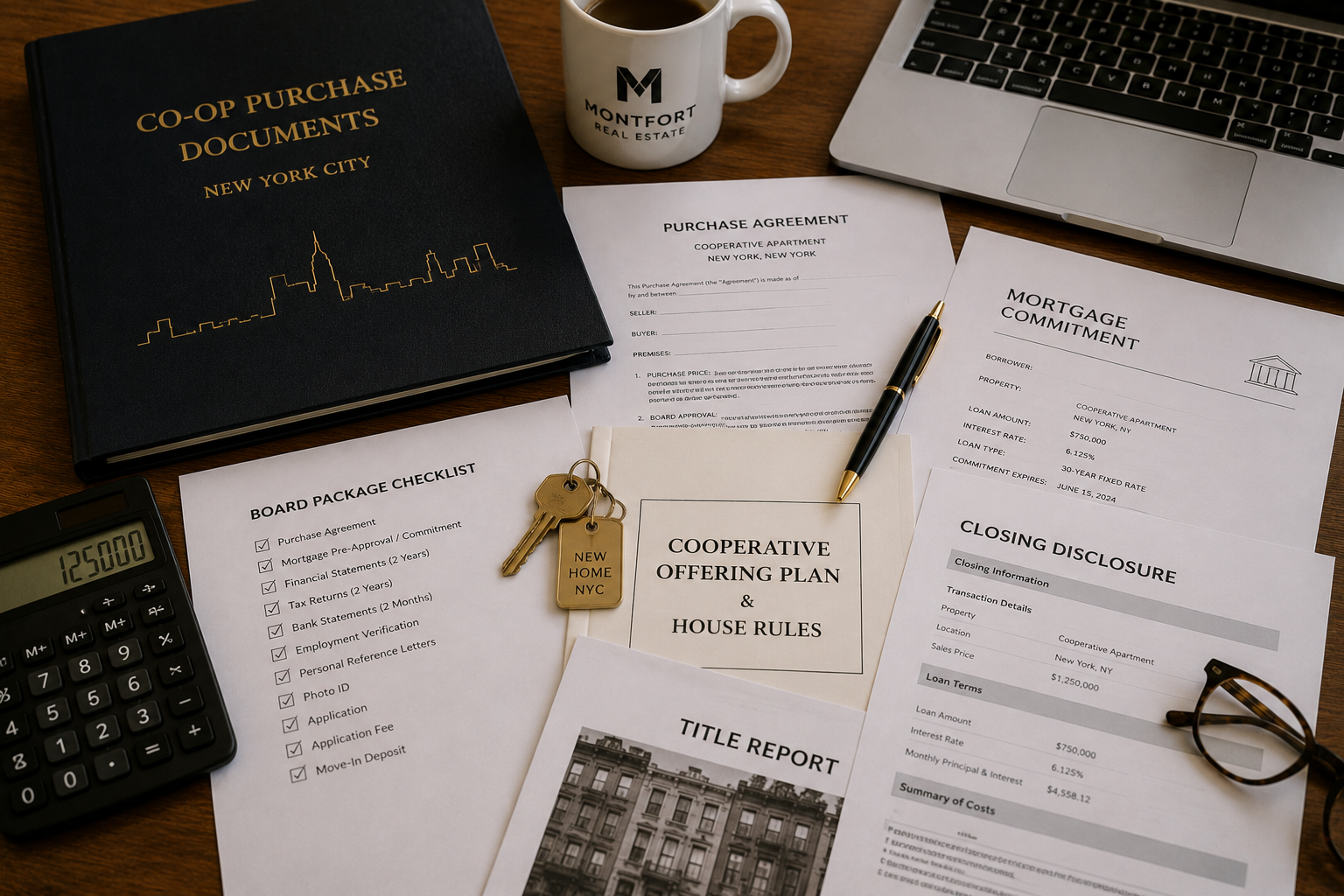
I also assemble all required building documents: financial statements, the proprietary lease, house rules, board application requirements, and any recent assessment or capital improvement notices. Under the New York City Council's Local Law 58 of 2026, cooperatives with 10 or more residential units are now required to maintain and publicize a list of all required documents for board applications. Having these materials prepared before listing prevents delays once a buyer is interested.
My marketing approach goes beyond professional photography and listing optimization. I target marketing toward qualified buyers - people who can meet your building's financial requirements, will present well in a board interview, and are prepared to move efficiently through the process.
I screen potential buyers early. Co-op board applications often require financial disclosures, and I want to see those financials before we're deep into contract negotiation. An open house brings foot traffic, but what matters is identifying the buyer whose offer will actually close. Real estate agents navigate complex co-op board requirements - and that screening happens well before the board package is submitted.
Offer evaluation in a co-op sale isn't just about the highest price. A slightly lower offer from a cash buyer or one who clearly meets all financial thresholds may be far more valuable than a higher offer from a marginally qualified person who might be rejected by the board.
I negotiate contract terms, manage contingencies, and coordinate the board application process. Buyers typically submit co-op applications within ten days of contract signing. From there, I work with the buyer's agent and attorney to ensure the board package is complete and submitted correctly. Co-op sales typically take longer than condo sales due to the board approval process - and experienced agents understand co-op board expectations and processes well enough to minimize friction.
Agents assist in preparing necessary documentation for co-op sales, and I stay involved through the board interview, approval, and closing coordination. Co-op sales often require in-person attendance at closing, and I make sure all parties are prepared for that final step.
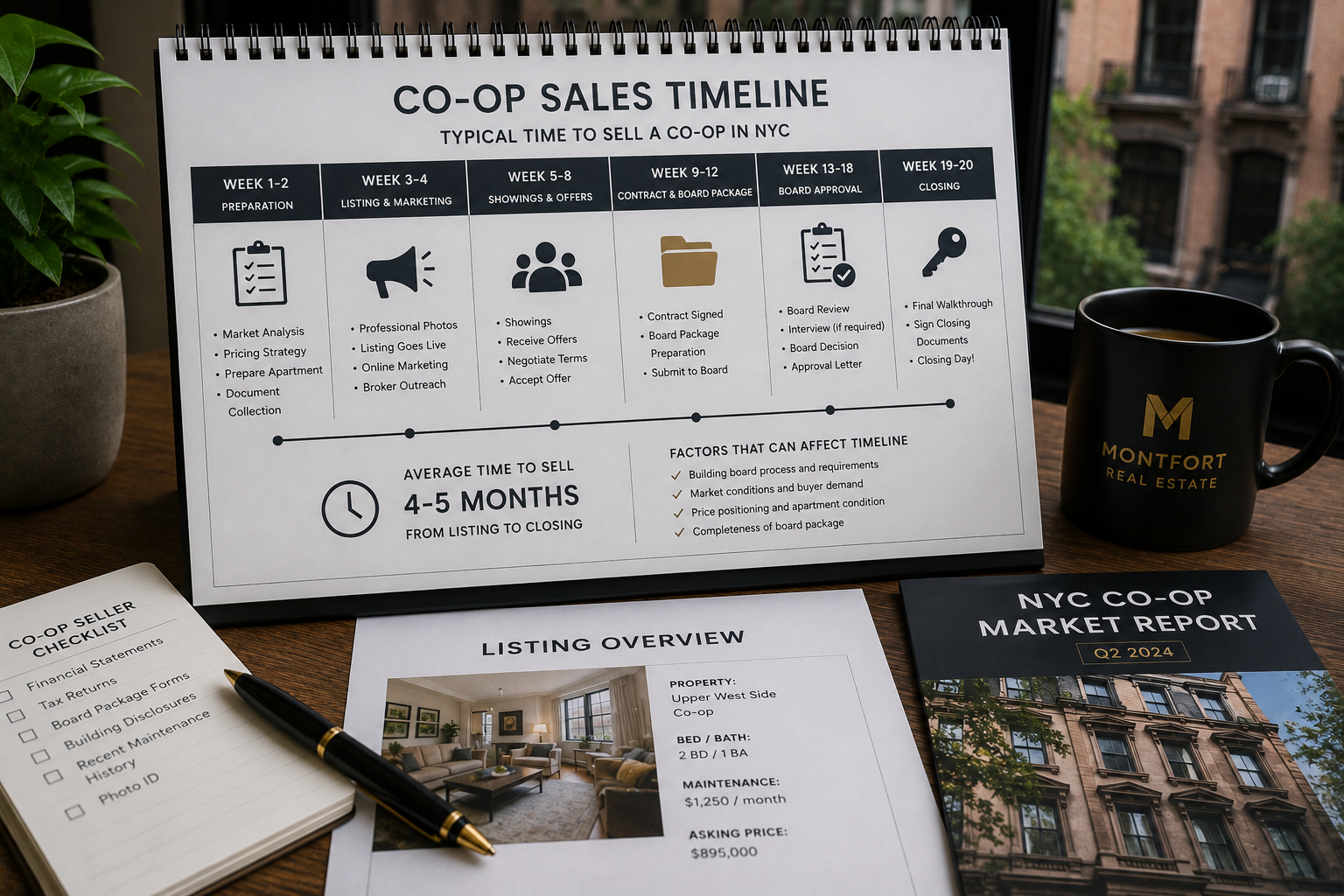
Co-op sales typically take longer than condo sales due to the board approval process. From listing to closing, a typical timeline ranges from three to six months, depending on market conditions, pricing accuracy, buyer pool, and how quickly the board acts. Note that under the New York City Council's Local Law 58 of 2026, effective July 28, 2026, co-op boards must acknowledge receipt of a complete application within 15 days and issue a decision within 45 days. Co-op boards can delay sales by slow responses to applications, but this new law establishes enforceable timelines for the first time.
Before listing, I recommend assembling the following:
Having these resources prepared before the first open house signals professionalism and avoids delays once a buyer signs a contract.
Co-op boards can require specific buyer qualifications and have significant authority over unit renovations, subletting, and ownership transfers. Financial evaluation typically includes review of tax returns (2–3 years), bank and brokerage statements, employment verification, and reference letters. Board members look at debt-to-income ratios, down payment amount, and post-closing liquidity. The board interview is usually the final step - and while co-op boards can reject buyers for various reasons without explanation, a well-prepared buyer with strong financials rarely encounters problems.
This depends on your apartment's current condition, your building's style, and what buyers in your market expect. In my experience, cosmetic improvements - fresh paint, clean fixtures, updated lighting, decluttered rooms - deliver the best return. Over-renovating is a real risk if your building has a traditional aesthetic or if comparable units are selling at a price point that doesn't justify a major kitchen or bathroom investment. One of the first things I review with clients is which improvements will move the needle on offers versus which will just cost money.
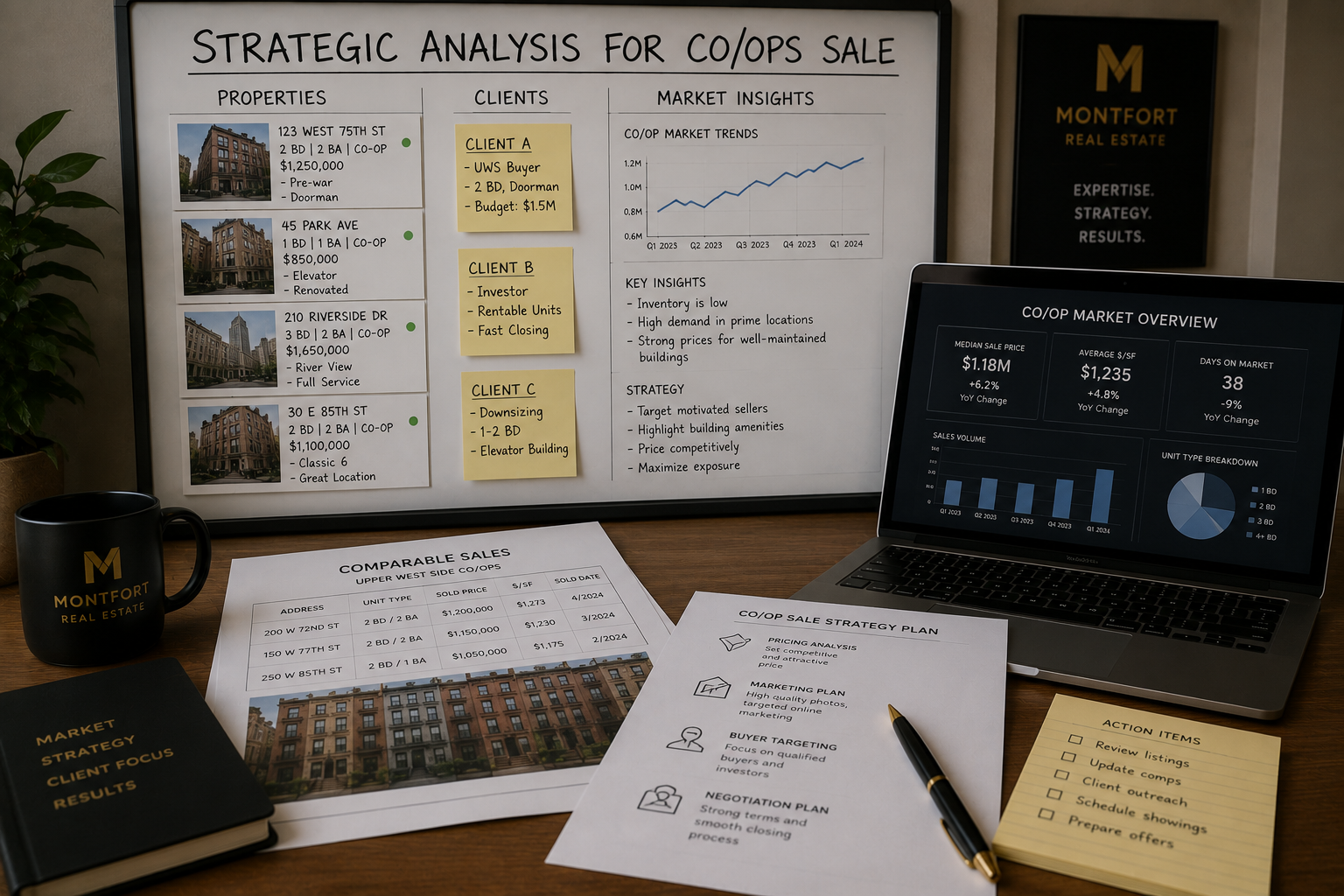
Pricing a co-op requires more nuance than pricing a condo or house. Co-op boards influence the selling price of units because they control who can buy, what financial standards apply, and how quickly the sale can close. I determine the right asking price by analyzing recent closed sales in your building and comparable buildings, adjusting for maintenance fees, floor level, exposure, view, and building amenities. Assuming you can price based solely on per-square-foot comparables without accounting for maintenance costs, board strictness, and building financial health is one of the most common mistakes sellers make. The goal is a price that attracts multiple interested, qualified buyers - not one that sits on the market and forces price cuts.
Selling a co-op in New York City is a complex transaction - but with the right preparation, the right pricing, and the right real estate agent, it doesn't have to be stressful.
I offer an educational consultation focused entirely on your situation: your apartment's condition, your building's financials, your board's expectations, and the current market. There's no pressure and no listing agreement required upfront - just honest advice from someone who does this every day.
Hire a real estate attorney experienced with co-ops for legal guidance, and let me handle the strategy, marketing, negotiation, and board management. Whether your property is worth five hundred thousand or several million dollars, every co-op deserves a plan built around its unique strengths and challenges.
Phone: (646) 970-1078 Email: sm@montfortre.com Address: 8 West 126th Street, New York NY 10027

 Posted on Google
Stanley Montfort represented me in the sale of my home in Hamilton Heights. He is professional in his approach and brings his warm, personable demeanor into all his interactions. I selected Stanley to represent me after doing a thorough analysis of realtors in the Hamilton Heights area looking at number of closed tra…
 Posted on Google
Stanley was great to work with. He worked with our schedule, took the time to understand our priorities, showed us a range of properties in different areas that could suit our needs and helped us strategize our approach. He was also a great resource in helping us find local connections for inspections, repairs, etc.…
 Posted on Google
Thank you for a streamlined process from start to finish ensuring the right place was found and secured without haste!
 Posted on Google
We had a great experience working with Stanley. He taught us a lot about the specific market we were looking in, which enabled us to make a very good decision on purchase of a new home.
 Posted on Google
Stanley was the dream real estate agent we didn’t know we deserved! From the beginning he was attentive to our curiosity to help us figure out what type of property we wanted - and could afford. Throughout the process he was a calm and patient presence in our lives, offering us sincere and sage perspectives to keep u…
 Posted on Google
Stanley is amazing! No one knows the Harlem market better than him, and his deep expertise was a tremendous resource. He taught me along the way how to spot 'red flags' and talked me out of making an offer on a place that seemed amazing but had, upon his close inspection, evidence of poor workmanship and lots of cut co…
 Posted on Google
Stan is extremely knowledgeable and professional. He also has the utmost patience! He helped me sell my home and purchase a condo at the same time. My home had all types of special contingencies but he was able to find me a buyer and get me very close to the price I wanted. I was very specific in terms of the property…
 Posted on Google
Stanley is the consummate professional! He made sure my listing has excellent and consistent foot traffic and quality candidates for our showings. This sale had some challenges, but Stanley never wavered. Ultimately we were successful and I’ll use him again and again for future real estate transactions.
Practical guides from Stanley Montfort on buying, selling, and pricing NYC homes.
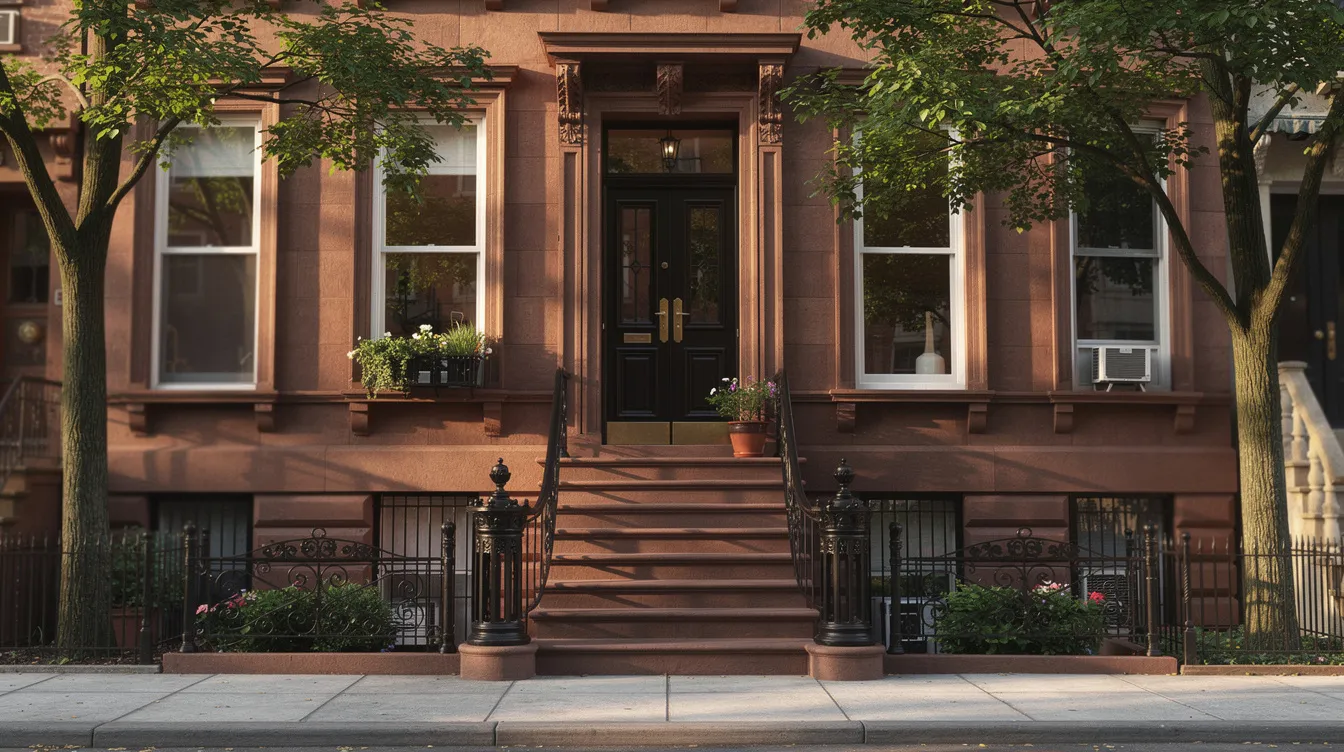
A step-by-step guide to inspections, renovation planning, and pricing a brownstone.

Request a free valuation that considers board requirements, building trends, and the market.
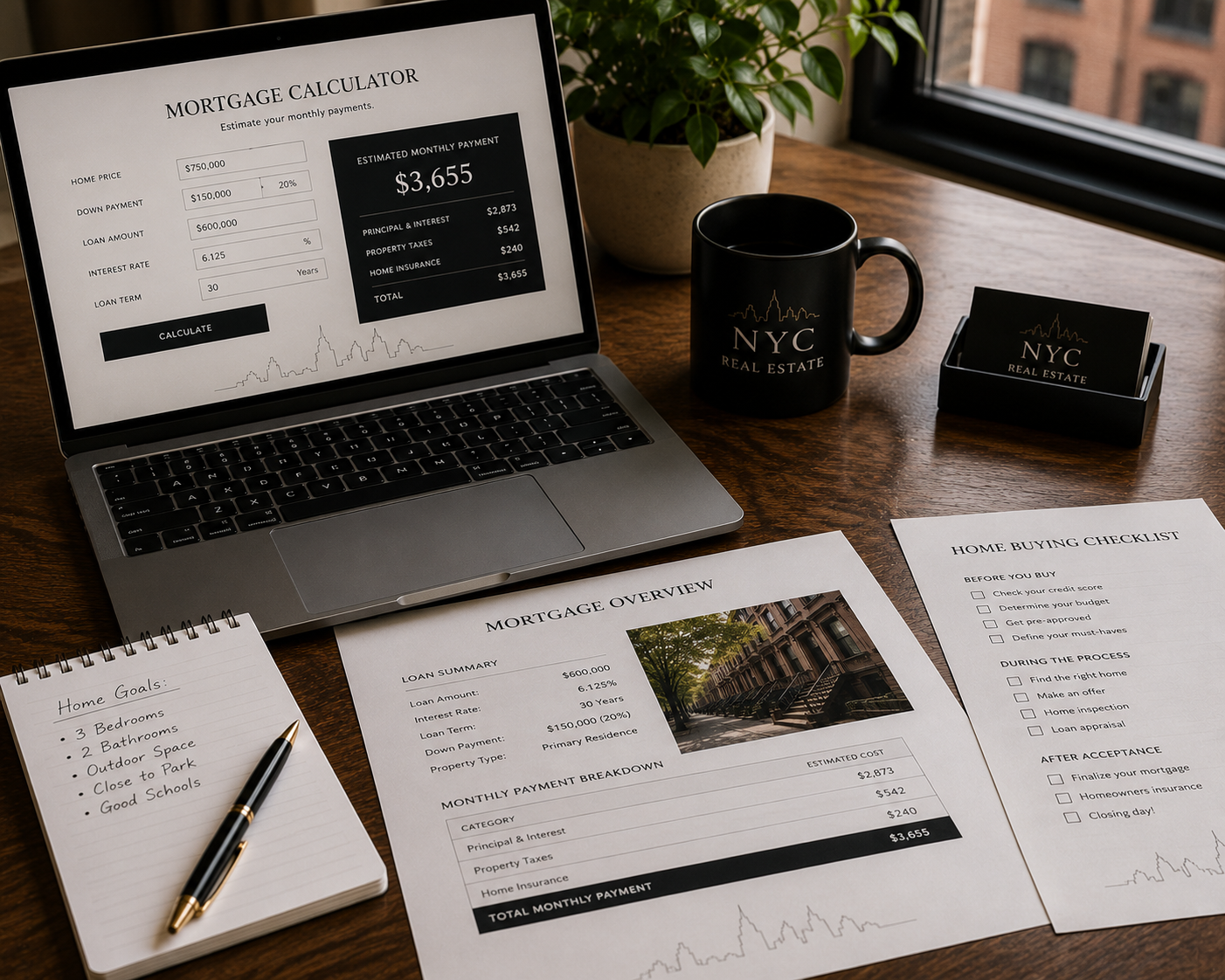
Estimate monthly payments and closing costs before you start your search.
Reach out for buyer representation, listing strategy, or a confidential valuation with Stanley Montfort.