
Mortgage Calculator — Plan Your Home Purchase with Confidence
Use our mortgage calculator to understand your financing costs, plan ahead, and avoid surprises throughout the home-buying process.
SMOOTH TRANSACTION
With limited risk throughout the buying process.
NO PRESSURE
No pressure to overpay or purchase within a specific timeframe.
ONGOING SUPPORT
A dedicated team that remains available even after the transaction is complete.
NYC Mortgage Calculator: Complete Guide for New York City Home Buyers
Expert NYC Mortgage Calculator and Home Buying Guidance
Calculating your true monthly mortgage payment in New York City requires far more than plugging numbers into a standard calculator. Between co-op maintenance fees, condo common charges, property taxes that vary dramatically by borough, and closing costs averaging $13,738—the second highest in the nation—NYC home buyers face a complexity that generic tools simply cannot address.
Calculate accurate monthly payments for condos, co-ops, and townhouses in NYC with expert guidance. Get precise estimates including maintenance, common charges, and reserve funds that reflect your actual housing costs.
[Calculate Your NYC Mortgage Payment Now]
Why NYC Home Buyers Need a Specialized Mortgage Calculator
Standard mortgage calculators fail NYC buyers because they only account for principal and interest. In New York City, those two numbers represent just a fraction of your actual monthly cost.
NYC has unique property types with different fee structures that standard calculators miss entirely. When you purchase a co-op, you’re buying shares in a corporation rather than real property—which means your monthly maintenance fees bundle property taxes, building operating costs, and sometimes the building’s underlying mortgage debt into a single payment. A condo purchase means you own real property outright, but your common charges cover only building operations while property taxes arrive as a separate bill from the city.
Co-op maintenance fees can add $1,000-$3,000+ to monthly housing costs depending on the building’s amenities, staff levels, and location. These fees often surprise first-time homebuyers who assumed their mortgage payment was their total housing expense.
Condo common charges and special assessments require separate calculations from your mortgage payment. When a building needs major repairs—façade work required by Local Law 11, boiler replacement, or elevator modernization—you may face one-time assessments of $5,000 to $50,000 or more.
Townhouse buyers need emergency reserves since there are no shared maintenance costs. Without a building superintendent or reserve fund to draw from, every roof leak, HVAC failure, and plumbing emergency comes directly from your pocket.
Property taxes vary dramatically between Manhattan, Brooklyn, Queens, and the Bronx. New York City’s Class 2 property tax rate sits at 12.439% for 2026, but assessed values differ significantly by neighborhood. Manhattan apartments are valued—and taxed—much higher than comparable units in outer boroughs, even when market prices are similar.
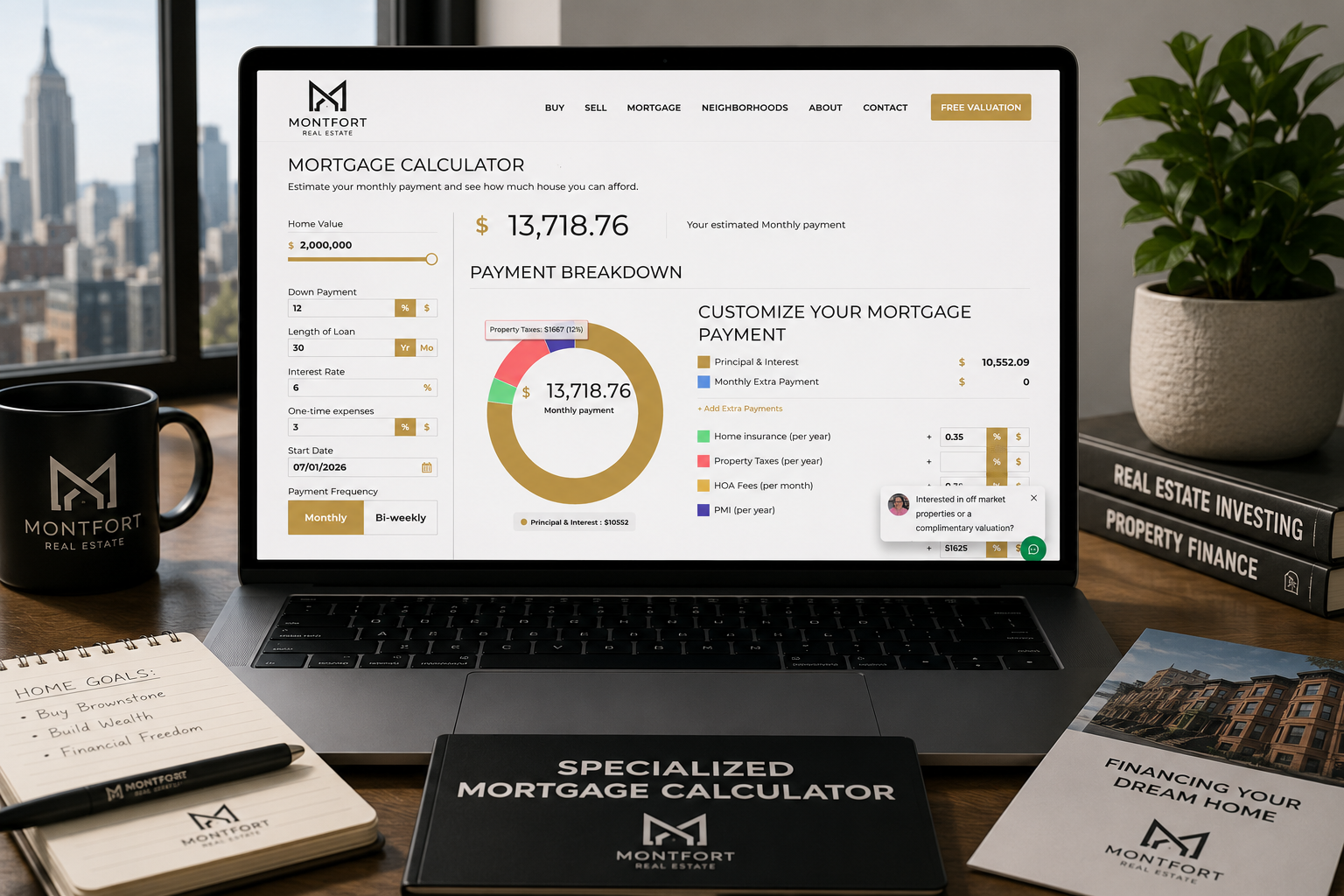
NYC Mortgage Calculator Services
Residential Property Calculations
This calculator provides detailed payment breakdowns for condos, co-ops, and townhouses that account for every dollar leaving your account each month. It includes maintenance fees for co-ops, common charges for condos, and recommended reserve amounts for townhouse owners.
When calculating co-op payments, the building’s underlying mortgage is factored in if applicable. Well-funded co-ops with paid-off mortgages have lower maintenance fees, while buildings carrying significant debt pass those costs through to shareholders monthly.
NYC property tax rates by borough and neighborhood are incorporated, using current assessment data to estimate your actual tax burden. Since the median property tax bill in New York is $6,542 with an effective rate of 1.45%, getting this number right dramatically affects your monthly payment estimate. New York City specifically has an average effective property tax rate of about 1.64%, though this varies considerably by property type and location.
Investment Property Analysis
Investors need different calculations. Investment property analysis calculates rental income potential versus monthly carrying costs, helping determine whether a property will generate positive cash flow.
Flip tax implications for co-op investors are included. Most NYC co-ops charge sellers a transfer fee ranging from 1-3% of the sale price, though HDFC co-ops—designed to preserve affordable housing—may charge 10-30% or higher. This significantly affects exit strategy and overall return on investment.
Investment properties typically require higher down payment requirements, often 25-30% for conventional loans. The calculator shows how these larger down payments affect your monthly mortgage payment and overall financing costs.
Top 10 NYC Mortgage Cost Factors to Consider
Understanding these ten factors separates informed buyers from those facing budget shock at closing or monthly payment surprises.
Co-op Maintenance Fees: Monthly maintenance ranges from $800-$4,000+ depending on building amenities and location. This payment includes your share of property taxes, building staff salaries, insurance, utilities (often heat and hot water), and any underlying building mortgage. A luxury doorman building in Manhattan will have maintenance far exceeding a walk-up in Brooklyn—but remember that maintenance fees include expenses you’d pay separately in a condo.
Condo Common Charges: These monthly fees run $300-$2,000+ for shared building expenses like staff, elevator maintenance, common area upkeep, and reserve fund contributions. Unlike co-op maintenance, common charges do not include property taxes—you’ll receive a separate bill from the city for those.
Property Taxes: Calculated based on your assessed value and various local considerations including school district taxes, property taxes vary by borough and often run $500-$2,500+ monthly for NYC condos. In Erie County, the median property tax bill is $4,630 with an effective rate of 1.76%, while Westchester County has some of the highest property taxes in the nation, with median payments significantly above the state average. New York homeowners may qualify for exemptions including the school tax relief (STAR) program and exemptions for seniors, veterans, and disabled individuals.
Flip Tax: When you sell a co-op, the board typically collects a resale fee of 1-3% of the sale price. Some buildings calculate this as a percentage of profit or use sliding scales based on how long you’ve owned. Understanding flip tax structures before buying helps you project true net proceeds at resale.
Mansion Tax: Purchases of $1 million or more trigger New York’s mansion tax, starting at 1% and scaling up to 3.9% for properties priced at $25 million or above. This is paid by the buyer at closing and applies to the entire purchase price, not just the amount above the threshold. For a $1.5 million apartment, expect to pay 1.25% or $18,750 at closing.
PMI Avoidance: A 20% down payment eliminates private mortgage insurance on most loan types, saving you 0.3% to 1.5% of your loan amount annually. For first-time homebuyers, payment assistance programs exist that can help you reach this threshold or qualify for programs with lower PMI costs. Co-op boards often require 20-25% down regardless of lender requirements, with some demanding 50% or more.
Interest-Only Loans: These offer lower initial payments but no principal reduction during the interest-only period, typically lasting 3-10 years. A $1,000,000 loan at 6.5% interest would cost approximately $5,417 monthly during the interest-only period versus $6,324 for a fully amortizing 30-year loan. After the interest-only period ends, payments spike significantly because you must repay the entire principal over the remaining loan term.
Townhouse Reserves: Without shared building maintenance, townhouse owners should save $500-$1,500+ monthly for roof replacement, HVAC systems, structural repairs, and emergency plumbing issues. Financial advisors recommend setting aside 1-3% of your townhouse’s market value annually—for a $2 million property, that’s $20,000-$60,000 per year.
Building Assessments: Special one-time fees for major building improvements can catch buyers off guard. Façade repairs required by Local Law 11, environmental compliance for Local Law 97, boiler replacements, and elevator modernizations generate assessments ranging from a few thousand to tens of thousands of dollars per unit.
How to Use the NYC Mortgage Calculator
Step 1: Property Type Selection
Choose between condo, co-op, or townhouse to access property-specific calculations. Each property type has fundamentally different cost structures that affect your total monthly payment.
Input your purchase price and desired down payment percentage. Remember that closing costs in New York average $13,738, so factor this into your available cash. The Mortgage Recording Tax alone adds 1.8% for loans under $500,000 and 1.925% for loans of $500,000 or more—though co-op purchases typically avoid this tax since you’re buying shares rather than real property.
Select your target neighborhood for accurate tax estimates. A condo in Manhattan faces different assessed values than an identical unit in Queens, directly affecting your monthly property tax burden.
Step 2: Building Cost Analysis
Enter monthly maintenance fees for co-ops or common charges for condos. Monthly maintenance fees for co-ops include a share of property taxes and building operating costs, while condos have separate common charges for upkeep. This distinction matters enormously when comparing total monthly costs between property types.
Add any known special assessments or upcoming building improvements. Request the building’s financial statements and board meeting minutes to identify planned capital projects that could generate assessments during your ownership.
For townhouses, factor in recommended emergency reserve amounts. Since there are no shared maintenance costs or building reserves to draw from, you must self-fund every repair.

Step 3: Loan Terms Configuration
Compare conventional, jumbo, and interest-only loan options. As of May 2, 2026, mortgage rates in New York are 6.166% for a 30-year fixed mortgage, 5.361% for a 15-year fixed mortgage, and 6.293% for a 5-year adjustable-rate mortgage (ARM). Jumbo loans—required when loan amounts exceed conforming limits—often carry higher rates and stricter qualification requirements.
Adjust down payment to see PMI elimination thresholds. Conventional loans typically require 20% down to avoid private mortgage insurance, which ranges from 0.3% to 1.5% annually in NYC. FHA loans allow buyers to put only 3.5% down while having less strict credit requirements, making them popular for first-time homebuyers. VA loans allow active duty military and veterans to purchase homes with no money down and no PMI requirement.
Review different loan terms and their impact on monthly payments. A 15-year loan term carries a lower interest rate (5.361% versus 6.166% for 30-year) and builds equity faster, but requires a higher monthly payment.
Step 4: Complete Payment Breakdown
Review your total monthly housing costs including all fees and taxes. To calculate your total monthly mortgage payment accurately, consider principal, interest, property taxes, homeowners insurance, and any private mortgage insurance if applicable. The formula is straightforward: Principal + Interest + Insurance + Taxes + Maintenance/Common Charges = Total Monthly Payment.
Homeowners insurance in New York has an average annual premium of $1,683, though this varies based on location and specific risks such as hurricanes and flooding. Tools that factor in local costs like maintenance fees can help avoid underestimating overall monthly housing expenses.
In New York County, the typical monthly mortgage payment for a median-priced home was $6,907 in Q1 2025, compared to the national median monthly payment of $2,120 for a median-priced single-family home. The median home value in New York is approximately $449,800, but this varies significantly across the state—Buffalo’s median home value sits around $262,500.
Download your detailed payment schedule and closing cost estimates to review with your mortgage lender.
Customer Success Stories
“The calculator showed me that a co-op’s maintenance fees—which included property taxes and heat—made total monthly costs nearly identical to a condo when I added common charges plus separate tax payments. Understanding this helped me choose the right property type for my situation.”— Jennifer M., Upper East Side Buyer
“I learned about the mansion tax implications before bidding, which saved me from budget shock at closing. For my $1.2 million purchase, that 1% tax meant an extra $12,000 I needed at closing.”— Robert K., Chelsea Purchaser
“As a veteran, I didn’t realize VA loans could help me purchase with no money down and no PMI. The calculator showed how much this saved me monthly compared to a conventional loan with 10% down.”— Marcus T., Brooklyn Heights Buyer
Frequently Asked Questions
What’s the difference between co-op maintenance and condo common charges?
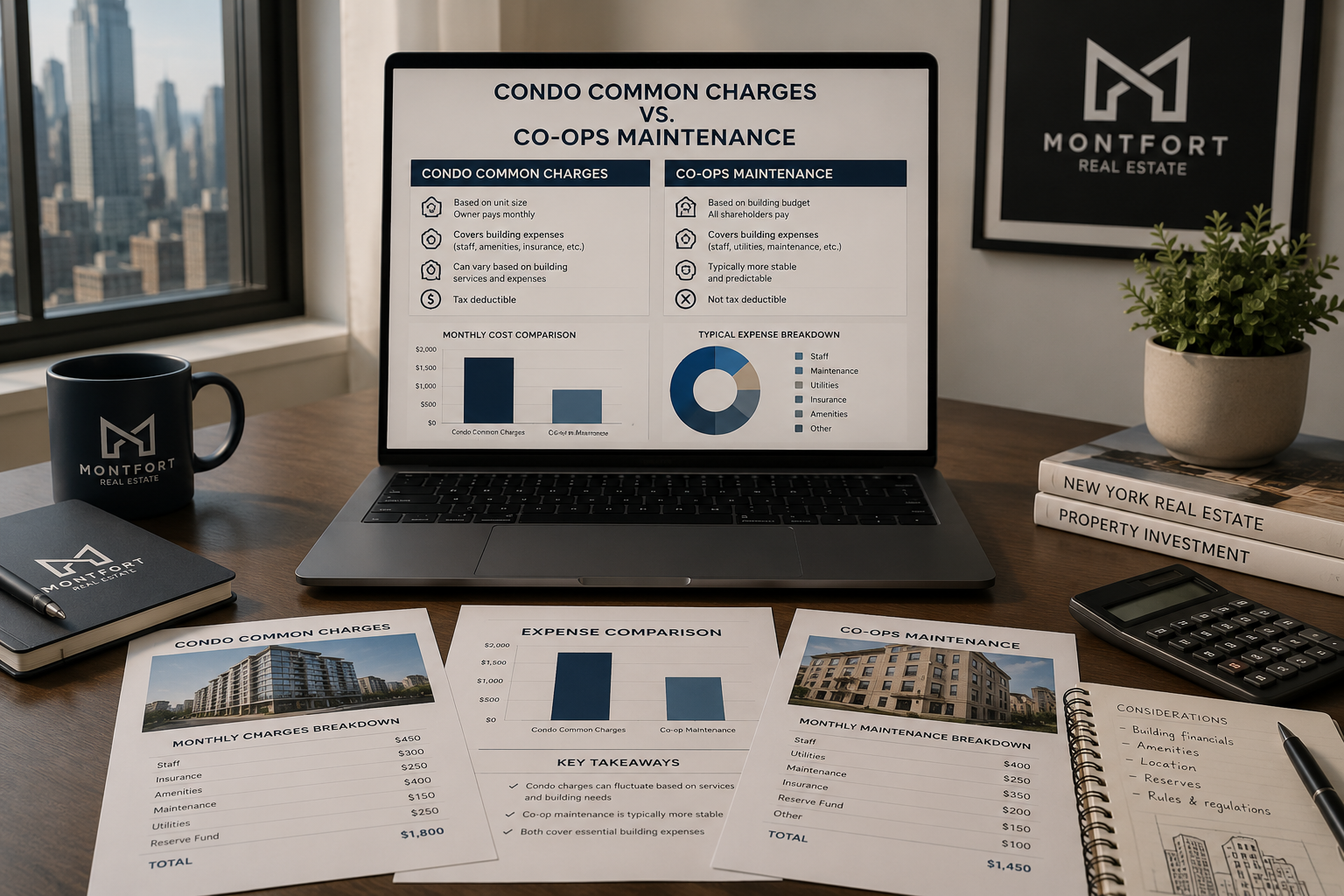
Co-op maintenance includes property taxes within the monthly fee, while condo common charges are completely separate from your tax bill. When you pay co-op maintenance, a portion goes toward the building’s property tax bill—your share is based on the number of shares you own. Co-op maintenance also covers any underlying mortgage payments the building carries, which can be substantial in buildings that haven’t paid off their debt.
Condo common charges fund only building operations: staff salaries, elevator maintenance, common area cleaning, insurance, and reserve fund contributions. You receive a separate property tax bill from New York City based on your unit’s assessed value. This distinction affects both monthly cash flow and tax deductibility—only the property tax and mortgage interest portions of co-op maintenance are tax-deductible, similar to how condo owners deduct only their property taxes and mortgage interest.
How much should I put down to avoid PMI in NYC?
The standard 20% down payment eliminates PMI on most conventional loan types. For a $1 million purchase, that means $200,000 down to avoid monthly PMI costs that could range from $250 to $1,250 depending on your credit score and lender.
Co-op boards often require even larger down payments—20-30% minimum, with some luxury buildings demanding 50% or more in liquid assets. These board requirements exist independently of lender requirements.
Alternative loan programs offer different PMI thresholds. FHA loans require only 3.5% down but include mortgage insurance for the life of the loan. VA loans require no down payment and no PMI for qualifying veterans. USDA loans, available for eligible rural areas within New York State, allow low-income borrowers to purchase with no down payment and have loose credit requirements.
First-time homebuyers should explore payment assistance programs that can help bridge the gap to PMI-free down payment levels.
Are interest-only loans a good option for NYC buyers?
Interest-only loans make financial sense in specific situations: buyers who plan to sell or refinance before the interest-only period ends, those with irregular income expecting significant future earnings, or investors holding property short-term.
The monthly payment savings are real. On a $1.2 million loan at 6.5%, interest-only payments run approximately $6,500 monthly versus $7,600 for fully amortizing—saving $1,100 per month initially. However, investing involves risk, and you build zero equity during the interest-only period unless the property appreciates.
Qualification requirements are stricter. Most lenders require larger down payments (often 20-25%), higher credit scores, substantial cash reserves, and proof you can afford the fully amortized payment when the interest-only period ends. The payment increase after year 5, 7, or 10 can be 25-40% higher than your initial payment—a shock that has caused financial distress for unprepared borrowers.
How much should townhouse owners save for maintenance?
Financial experts recommend saving 1-3% of your townhouse’s property value annually for major repairs. For a $2 million Brooklyn townhouse, budget $20,000-$60,000 per year—roughly $1,700-$5,000 monthly—into a dedicated reserve fund.
Typical townhouse maintenance costs by system include: roof replacement ($15,000-$50,000 every 20-30 years), HVAC system replacement ($10,000-$25,000 every 15-20 years), structural foundation work ($5,000-$50,000+ as needed), plumbing overhauls ($3,000-$15,000), and electrical upgrades ($5,000-$20,000). Façade requirements under Local Law 11 may also apply to townhouses, requiring periodic inspections and repairs.
Without building reserves to draw from, every emergency comes directly from your savings. A burst pipe in January or a failed boiler in February requires immediate payment—there’s no superintendent to call or building fund to tap.
Get Started with Your NYC Mortgage Calculation
Calculate Your True Monthly Payment Today
Use a specialized New York mortgage calculator to understand your complete housing costs before you bid on a property. Using a dedicated mortgage calculator for NYC can improve the accuracy of cost assessments by including local taxes, maintenance fees, and closing costs that generic calculators miss entirely.
Get accurate estimates that include all NYC-specific fees and taxes. In New York City, higher property taxes and unique closing costs significantly influence mortgage calculations—understanding these before you commit protects your budget and your purchase.
Make informed decisions about condo versus co-op versus townhouse purchases. Each property type carries different monthly obligations, financing options, and long-term cost structures. A specialized calculator displays these differences clearly so you can choose wisely.
Phone: 1-646-970-1078 Email: [email protected] Address: 8 West 126th Street, New York NY 10027
Mortgage Calculator
Estimate your monthly payment and see how much house you can afford.
Recent News & Realtor Advice
Stay in the loop on the latest events, news, & happenings in and around our community!
Read MoreUpper West Side Townhouse Q2 2024 Market Report
On the Upper West Side, we observed a distinct trend that diverges from the citywide patterns. Speci…
Harlem Brownstone Q2 2024 Market Report
The Harlem brownstone market has seen an increase in sales activity since this time last year. In Q2…
Discover Your Dream Home: Explore Apartments for Sale on the Upper West Side
Are you searching for your dream home in one of New York City’s most sought-after neighborhoods? Loo…