
NYC First-Time Home Buyer Mortgages — Your Guide to Affordable and Confident Home Financing
We'll help you secure the right mortgage for your first home in NYC, avoiding costly financing mistakes and ensuring you buy within a budget that supports your long-term financial goals
SMOOTH TRANSACTION
With limited risk throughout the buying process.
NO PRESSURE
No pressure to overpay or purchase within a specific timeframe.
ONGOING SUPPORT
A dedicated team that remains available even after the transaction is complete.
NYC First Time Home Buyer Mortgages: Complete Guide for New York City
If you're buying your first home in New York City, the mortgage process will shape every decision you make, from which neighborhoods you can afford to how competitive your offer looks to a seller. First-time home buyers in New York City have specialized mortgage and assistance options that can reduce your upfront costs by tens of thousands of dollars, but only if you understand them before you start touring apartments. I'm Stanley Montfort, and over the past 11 years as a licensed NYC buyer's agent, I've walked hundreds of first-time buyers through this process. This guide covers what I tell every new buyer before they begin.
Why NYC First-Time Buyers Trust Stanley Montfort
Licensed New York State buyer's agent specializing in first time homebuyers since 2015
Successfully guided 200+ first-time buyers through mortgage pre-approval to closing across all five boroughs
Partnered with top NYC mortgage lenders who specialize in first-time buyer loan programs, including SONYMA and HomeFirst participants
Average client saves $15,000+ through strategic mortgage planning, assistance program enrollment, and negotiation
Why NYC First-Time Buyers Choose Stanley Montfort for Mortgage Guidance
One of the first conversations I have with first-time buyers is about what they don't know yet. NYC's mortgage landscape differs from every other market in the country: co ops have board financial requirements that can exceed your lender's standards, closing costs run 4-6% of the purchase price, and the difference between a conventional loan and an FHA loan can determine which buildings will even consider your application.
Plain-language mortgage education before you house hunt. I break down principal, interest, taxes, insurance, maintenance charges, and co-op requirements so you understand your true monthly payments before you fall in love with a listing.
Realistic affordability analysis. Qualifying for a mortgage loan amount and being able to comfortably afford a home are two different things. I help you account for property taxes, common charges, homeowner's insurance, reserves, and the closing costs that surprise most first time buyers.
Lender connections tailored to your financial profile. I connect buyers with lenders experienced in NYC's first-time buyer programs, whether that's the HomeFirst down payment assistance program, SONYMA products, or VA loans for veterans.
Offer timing strategy. In NYC's competitive market, a slow mortgage application can cost you a home. I help you align financing deadlines with offer contingencies so you don't lose deals to avoidable delays.
Understanding NYC First-Time Home Buyer Mortgages
How Mortgages Work for First-Time Buyers
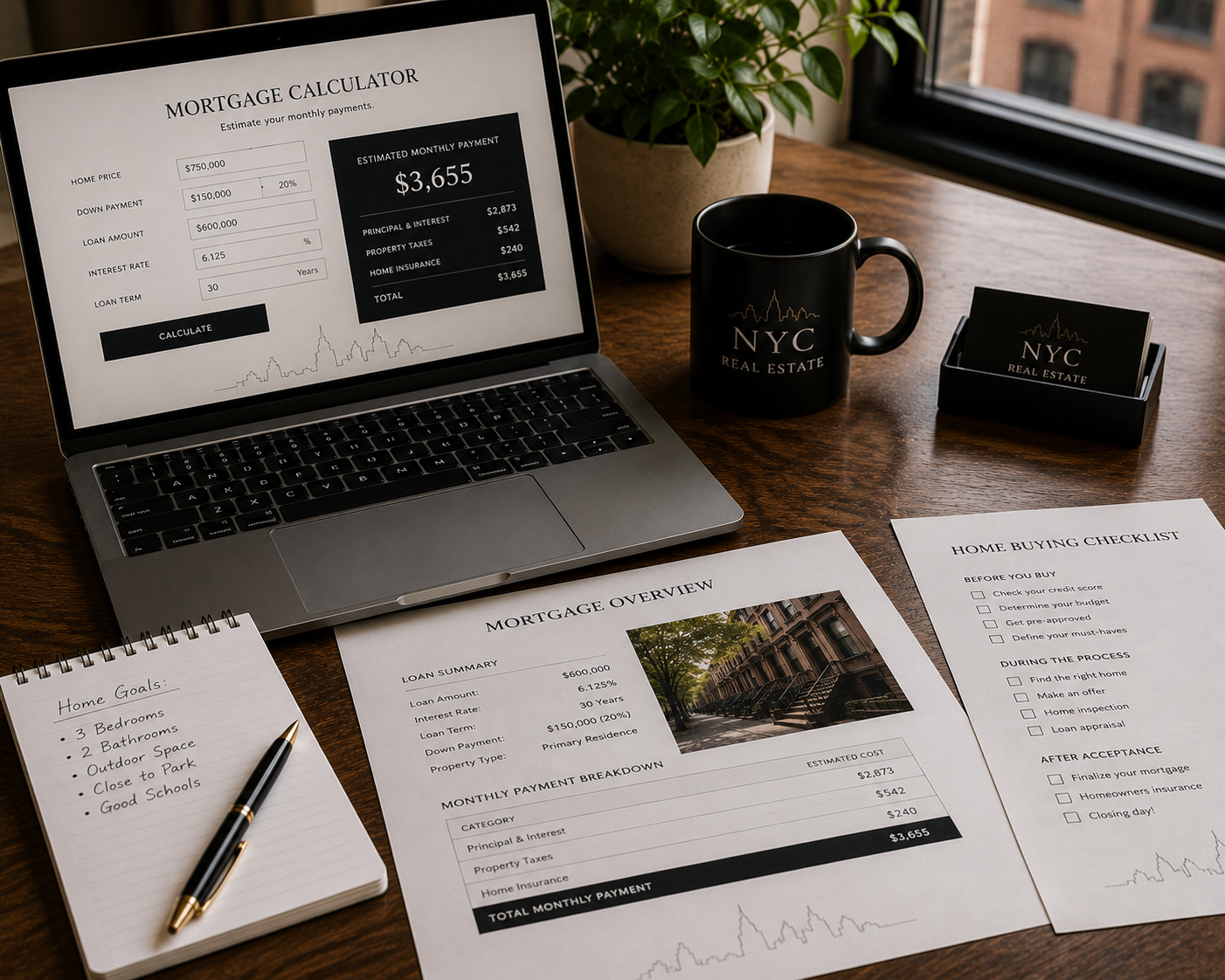
Your mortgage payment has four components: principal (paying down the loan amount), interest (the lender's charge for lending), property taxes, and insurance. In a co-op, you'll also pay monthly maintenance; in a condo, common charges. Many buyers are surprised to learn that these carrying costs can add 30-50% on top of the principal and interest portion of their monthly payments.
NYC property values push many buyers toward larger loan amounts. The 2026 conforming loan limit for New York County and the other NYC boroughs is $1,209,750 for a one-unit property. Any mortgage above that threshold becomes a jumbo loan with stricter credit requirements and larger down payment expectations.
The relationship between down payment, loan amount, and monthly cost is straightforward but consequential. A larger down payment reduces your loan principal, lowers your monthly payments, and can eliminate the need for mortgage insurance (PMI). A smaller down payment preserves your savings for closing costs and reserves but increases your monthly obligation and adds PMI if you put down less than 20%.
Before you begin viewing properties, you need mortgage pre approval. A pre-approval letter tells sellers you have verified financing capacity. In a city where multiple offers on the same property are routine, showing up without pre approval puts you at a disadvantage against buyers who already have one.
Pre-Approval vs Pre-Qualification
Prequalification helps determine how much you can borrow, but it relies on unverified information. A lender reviews your stated income, assets, and debts and gives you an estimate. No documents are checked.
Pre-approval is different in substance and weight. Your lender examines verified W-2s or tax returns, bank statements (typically 2-3 months), pay stubs, credit history, and asset documentation. The resulting letter carries real credibility with sellers and their agents.
One question I always encourage buyers to ask their lender: "How long is this pre-approval letter valid?" Most are good for 60-90 days. If your search extends beyond that, you'll need to update your documentation and potentially re-qualify.
In NYC specifically, some co-op boards require that your lender be on an approved list. Getting pre approved early reveals whether your chosen lender can actually finance the type of property you want to buy.
NYC Mortgage Types for First-Time Buyers
Conventional Loans
Conventional loans conform to guidelines set by Fannie Mae and Freddie Mac. For 2026, the baseline conforming limit nationally is $832,750; in NYC's high-cost counties, the limit is $1,209,750 for a one-unit home.
Most lenders require a minimum credit score of around 620 for conventional loans. To access the lowest interest rate tiers, you'll typically need a score of 740 or above. Down payments start at 3-5% for first-time buyer conventional products, though putting down less than 20% triggers PMI until you reach roughly 20-22% equity.
When do conventional loans make sense in NYC? When the purchase price falls below the conforming limit, the borrower has a strong credit score, and the building accepts conventional financing. Many co ops prefer conventional loans over government-backed options because FHA and VA loans carry additional requirements that boards find burdensome.
FHA Loans
FHA loans open the door for buyers with lower credit scores and smaller savings. FHA loans require a minimum 3.5% down payment for borrowers with credit scores of 580 or higher. Borrowers with scores between 500-579 face a 10% down payment requirement.
The 2026 FHA loan limit in NYC's high-cost areas reaches $1,249,125 for a single-unit property, giving buyers access to a wide range of condos and qualifying co ops.
The trade-off is mortgage insurance. FHA requires an upfront mortgage insurance premium (typically 1.75% of the loan amount) plus an annual MIP divided into monthly payments. Unlike conventional PMI, FHA mortgage insurance remains for the life of the loan unless you refinance into a non-FHA product. That's a long-term cost worth factoring into your plan.
Credit score flexibility is the primary draw. Borrowers who don't yet qualify for conventional financing often find FHA loans more accessible, though individual lenders may impose stricter overlays on top of FHA minimums.
VA Loans
For eligible veterans, active-duty service members, reservists, and surviving spouses, VA loans may offer up to 100% financing for qualified borrowers. That means no down payment required when you have full entitlement.
VA loan limits in NYC mirror the conforming loan limit of $1,209,750. A funding fee applies unless the borrower has a service-connected disability exemption. You'll need a Certificate of Eligibility (COE), obtainable through the VA's eBenefits portal or your lender.
SONYMA's "Homes for Veterans" program adds another layer: a 0.40% interest rate reduction compared to standard SONYMA mortgages, with minimum cash contribution of just 1% from own funds.
VA appraisals must confirm the property meets VA Minimum Property Requirements, and the home must serve as the borrower's primary residence.
Jumbo Loans
When NYC property prices exceed the $1,209,750 conforming loan limit, buyers enter jumbo territory. A $1.5 million condo requiring financing above $1,209,750 triggers jumbo underwriting standards.
Jumbo loans typically require 20-30% down, credit scores of 720 or higher, lower debt-to-income ratios, and liquid cash reserves. Interest rates can run higher and shift more with market volatility.
Strategies to avoid jumbo requirements include increasing your down payment to bring the loan amount below the conforming threshold, choosing a less expensive property, or adding a co-borrower with additional income.
NYC First-Time Buyer Financial Preparation
Down Payment Strategies
Down payment expectations vary by property type in New York City. Condos generally require 10-20% down. Co ops often demand 20-30% down with additional cash reserves covering 12-24 months of maintenance. These requirements are set by building boards, not lenders, and they can exceed what your mortgage requires.
Several payment assistance programs reduce the upfront cash you need:
| Program | Maximum Assistance | Key Requirements |
|---|---|---|
| HomeFirst (NYC HPD) | Up to $100,000 toward the down payment and closing costs | Household income up to 120% of Area Median Income (AMI); completion of an approved homebuyer education course required |
| SONYMA DPAL | Up to $15,000 | 0% interest loan, forgiven after 10 years if occupancy requirements are met |
| SONYMA RSL | Up to 5% of the purchase price | Interest-free loan, repaid upon sale, refinance, or transfer of the property |
| Homebuyer Dream Program | Forgivable grants of up to $30,000 | Federal Home Loan Bank program for eligible first-time homebuyers who meet income requirements |
Down payment assistance can be in the form of grants or loans, depending on the program. HomeFirst provides up to $100,000 for down payment assistance, and SONYMA's Down Payment Assistance Loan offers up to $15,000. These can be combined where program requirements allow.
HomeFirst requires buyers to occupy the home for 10-15 years (10 years if assistance is $40,000 or less; 15 years if above $40,000). The home must be the buyer's primary residence. Income limits apply based on the property's location for HomeFirst, with maximum household income capped at 120% of area median income (for example, $236,160 for a six-person household).
Gift funds from family members are common, but lenders require documentation: a gift letter, bank statements showing the transfer, and verification that the borrower is contributing at least a portion from own funds. HomeFirst, for example, requires a minimum 3% contribution from the buyer's own savings.
When helping first-time buyers, I always emphasize the balancing act: a larger down payment lowers your monthly payments and can eliminate PMI, but draining your savings leaves nothing for closing costs, moving expenses, and the maintenance emergencies that come with homeownership.
Credit Score and Debt-to-Income Requirements
Your credit score determines which loan programs you can access and what interest rate you'll receive. Here's how minimum credit score thresholds break down:
Conventional loans: 620 minimum; best rates typically at 740+
FHA loans: 580 for 3.5% down; 500-579 requires 10% down
HomeFirst program: 620 minimum, with FHA lender exception down to 580
SONYMA programs: Varies by product; generally 620+
Improving your credit before applying involves paying down credit card balances, making all payments on time, reviewing your credit reports for errors, and avoiding new credit applications in the months leading up to your mortgage application.
Lenders prefer a debt-to-income ratio below 43% to 45%. Loan approval is based on creditworthiness and stable income verification. The HomeFirst program allows a total DTI up to 55% and housing expense ratio up to 50%, which is more generous than most conventional guidelines.
Student loan debt affects many first time homebuyers in NYC. Lenders may calculate your student loan obligation differently depending on whether you're on an income-driven repayment plan or standard repayment. Ask your lender how they'll treat those payments in your DTI calculation; it can shift your qualifying loan amount by tens of thousands of dollars.

The NYC Mortgage Process: What to Expect
The homebuying process includes getting pre-approved for a mortgage, searching for a home, negotiating a contract, completing underwriting, and closing. Many NYC first-time buyers face longer closing times due to legal review, co-op board approvals, and the volume of documentation involved. Here's what the whole process looks like step by step.
Step 1: Financial Assessment and Pre-Approval
During my initial consultation with buyers, I ask about income, savings, monthly obligations, credit score, target neighborhoods, and property type preferences (co-op, condo, or 1-4 family). Before connecting you with a lender, I want to understand what you're comfortable paying monthly, not just what a lender will approve.
Your lender will request your two most recent pay stubs, W-2s or 1099s, tax returns (typically two years), bank statements, identification, and documentation of any gift funds. For assistance programs, you'll also need proof of completing a homebuyer education course and evidence of program eligibility.
Pre-approval typically takes 1-2 weeks if your documentation is organized. Delays almost always stem from missing paperwork, self-employment income complexity, or credit issues that require resolution.
Step 2: House Hunting with Mortgage Considerations
Your mortgage type affects which properties you can buy. Some co-op boards do not accept FHA or VA financing. Certain assistance programs restrict eligible properties; HomeFirst, for example, requires the purchase price not to exceed 95% of HUD's Homeownership Value Limits.
I help buyers understand how these credit requirements and program restrictions narrow or expand their search. A buyer using SONYMA financing and the HomeFirst program will have a different universe of eligible properties than someone using a conventional loan with 20% down.
Homebuyers must negotiate a contract of sale with the seller, and financing contingency deadlines within that contract need to align with your expected underwriting timeline. In NYC, that's typically 30-45 days for condos and co ops. Missing that deadline can mean losing your deposit.
Step 3: Mortgage Application and Underwriting
After your offer is accepted and the contract is signed, your lender files the formal mortgage application, orders an appraisal, initiates a title search, and reviews co-op or condo association documents.
NYC appraisals for condos and co ops depend on recent comparable sales within the building. Newer construction or units with custom renovations can complicate this. If the appraisal comes in below the purchase price, you may need to renegotiate with the seller, increase your down payment, or walk away.
Underwriting for conventional or agency-backed loans typically takes 2-4 weeks. Self-employment income, co-op board reviews, or title issues can extend this. Your real estate lawyer will coordinate with the lender's attorney to clear conditions and prepare for closing.
Preparing for closing means having your remaining down payment and closing costs ready to wire. You'll also confirm title insurance, attorney fees, recording fees, and any building-specific charges like co-op move-in deposits.
NYC First-Time Buyer Assistance Programs
First-time homebuyers must not have owned a home in three years to qualify for most NYC and New York State programs. SONYMA defines first-time homebuyers as those without a primary residence for three years.
SONYMA (State of New York Mortgage Agency) SONYMA offers 30-year fixed-rate mortgages tailored for first-time buyers on owner-occupied one- to four-family homes, condos, and co ops. Add-on programs include the Down Payment Assistance Loan (DPAL) at 0% interest with no monthly payment, forgiven after 10 years of residency, and the Repayable Second Lien (RSL) covering up to 5% of the purchase price for down payment or closing costs. SONYMA offers a 3% down payment requirement for first-time buyers.
NYC HomeFirst Down Payment Assistance Program The HomeFirst program, administered by NYC Housing Preservation and Development (HPD), offers up to $100,000 for down payment assistance on 1-4 family homes, condos, or co ops in any of the five boroughs. Program eligibility requires income up to 120% of area median income, completion of a homebuyer education course through an HPD-approved provider, and a minimum 3% contribution from the buyer's own funds. HomeFirst requires buyers to occupy the home as their primary residence.
Federal Home Loan Bank Programs The Homebuyer Dream Program, offered through the Federal Home Loan Bank of New York, provides forgivable grants up to $30,000 toward the down payment or closing costs. Qualified borrowers must work with a participating member institution and meet income requirements.
NYS HOME Program Available to homebuyers at or below 80% AMI, this program provides up to $80,000 for purchase assistance or $100,000 if the purchase includes rehabilitation. No first-time buyer requirement, but you cannot currently own a home.
Combining Programs Several of these assistance programs can be layered together. A buyer might use a SONYMA mortgage with the DPAL, add HomeFirst assistance, and access the Homebuyer Dream Program. I help buyers map out which combinations their income, credit, and property type allow.
Homebuyer Education classes are required for some assistance programs, including HomeFirst. These classes cover budgeting, mortgage options, the home buying process, and long-term financial health of homeownership. Completing the course also strengthens your understanding of program requirements and eligibility requirements.
Upcoming Legislation Int 0862-2026, recently passed by the NYC Council, requires the city to provide financial assistance to at least 600 first-time homebuyers annually for down payment or closing costs on covered homes, starting in fiscal year 2027. This signals growing commitment from government agencies to expand financial resources for new yorkers entering homeownership.
Closing Costs and Additional Expenses
One mistake I frequently see: buyers budget for the down payment and forget about closing costs. In NYC, buyers should expect 4-6% of the purchase price in closing costs, sometimes more for new construction.
NYC-specific fees include:
Mansion Tax: Applies when the purchase price exceeds $1,000,000, ranging from approximately 1% to 3.9% depending on the price tier
Mortgage Recording Tax: Required for recording mortgages in NYC, with rates varying by borough and loan amount
NYS Transfer Tax: Approximately 0.4% of purchase price
NYC Transfer Tax: Additional percentage above state transfer tax, varying by price
Additional closing cost components:
Title insurance
Attorney fees (buyer's attorney and lender's attorney)
Appraisal and inspection fees
Lender origination fees
Credit report fees
Co-op or condo board fees, flip tax, or move-in deposits where applicable
Beyond closing, plan for ongoing costs: property taxes (which vary by borough and neighborhood), homeowner's insurance, co-op maintenance or condo common charges, utilities, and a reserve fund for repairs. Many buyers are surprised to learn that co-op maintenance fees in some buildings exceed their mortgage payment.
Common First-Time Buyer Mortgage Mistakes
Getting pre approved for too much and spending it all. Your maximum pre-approval amount doesn't account for property taxes, maintenance charges, insurance, or the savings buffer you'll need after closing. I help buyers set a comfortable purchase price that leaves room for the costs that show up after move-in day.
Not comparing rates and terms from multiple lenders. Two lenders can quote the same interest rate but charge different origination fees, points, and closing costs. The difference in total cost over 30 years can reach five figures. Get at least three mortgage loan quotes and compare the APR, not just the rate.
Making financial changes during the mortgage application process. Switching jobs, financing a car, opening new credit cards, or co-signing a loan between pre-approval and closing can derail your underwriting. Lenders re-verify your financial profile before closing, and changes that shift your DTI or credit score can result in denial.
Underestimating total monthly homeownership costs. Your mortgage payment is one piece. Property taxes, maintenance or common charges, insurance, and utilities form the rest. I've seen buyers qualify for a $5,000 monthly mortgage only to discover $2,500 in additional monthly carrying costs they hadn't planned for.
Rushing the process without understanding long-term implications. Choosing a 30-year mortgage versus a 15-year, accepting an adjustable rate to lower initial payments, or skipping an inspection to make an offer more competitive are decisions with consequences that last decades.
NYC Areas I Serve for First-Time Buyer Guidance
I work with first time buyers across all five boroughs of New York City, each with distinct mortgage considerations:
Manhattan: Higher purchase prices frequently push buyers toward jumbo loan territory above the $1,209,750 conforming limit. Co-op buildings dominate much of the inventory, with strict board financial requirements.
Brooklyn: Neighborhoods like Bed-Stuy, Crown Heights, and East New York offer entry points for first-time buyers using assistance programs. Mixed inventory of co ops, condos, and 1-4 family homes.
Queens: Communities in Astoria, Jackson Heights, Flushing, and Jamaica provide a range of affordable options. Strong demand for FHA-eligible condos and single-family homes.
The Bronx: Neighborhoods with growing homeownership program participation, particularly through HomeFirst and SONYMA. Purchase prices often fall within assistance program limits.
Staten Island: More single-family homes than the other boroughs, with purchase prices that frequently stay within conforming loan limits. VA loans are well-suited here.
Frequently Asked Questions About NYC First-Time Buyer Mortgages
How much should I save for a down payment in NYC?
For condos, expect to need 10-20% down. Co-op boards often require 20-30% plus 12-24 months of reserves in liquid savings. If you qualify for assistance programs, the math changes: HomeFirst provides up to $100,000 for down payment assistance, and SONYMA's DPAL covers up to $15,000. Budget an additional 4-6% of the purchase price for closing costs. Your total savings target should cover the down payment (minus any payment assistance), closing costs, moving expenses, and at least three months of carrying costs as a buffer.
What credit score do I need for a mortgage in NYC?
For conventional loans, 620 is the floor, though you'll access better rates at 740+. FHA loans accept scores as low as 580 for 3.5% down. The HomeFirst program requires a 620 minimum credit score, with an exception to 580 when using an FHA lender. If your score is below these thresholds, spending six months improving it before applying can save thousands over the life of your mortgage through a lower interest rate.
How long does the mortgage approval process take?
From pre-approval to closing, plan for 45-60 days for condos and co ops. Simpler transactions (single-family homes without board approval) can close in 30-45 days. Co-op board interviews and document reviews add time. Common delays include appraisal issues, title problems, and income verification for self-employed borrowers. Having your documentation organized from the start is the single most effective way to avoid delays.
Should I get pre-approved before looking at homes?
Yes. Pre-approval defines your realistic budget, shows sellers you have verified financing, and helps you include the right contingencies in your offer. In NYC's competitive market, an offer without pre approval often gets passed over. Pre-approval also reveals whether your chosen lender can finance the specific property types (co-op, condo, new construction) you're considering.
What if I'm self-employed or have irregular income?
Lenders will request two or more years of tax returns, profit-and-loss statements, 1099 forms, and bank statements. They typically average your income over two years, so a single strong year won't fully count unless the prior year supports it. Some first-time buyer assistance programs have rigid documentation requirements that match FHA or Fannie Mae underwriting standards. I help self-employed buyers organize clean, consistent documentation before submitting their mortgage application, which reduces back-and-forth with underwriters.
Start Your NYC Home Buying Journey
Before you attend a single open house, let's build your purchasing strategy. A 30-minute consultation covers your financial health, identifies which assistance programs you may qualify for, and creates a realistic timeline for your home purchase. Every successful first-time buyer I've worked with started with a plan, not a listing.
Phone: 1-646-970-1078 Email:[email protected] Address: 8 West 126th Street, New York NY 10027
Recent News & Realtor Advice
Stay in the loop on the latest events, news, & happenings in and around our community!
Upper West Side Townhouse Q2 2024 Market Report
On the Upper West Side, we observed a distinct trend that diverges from the citywide patterns. Speci…
Harlem Brownstone Q2 2024 Market Report
The Harlem brownstone market has seen an increase in sales activity since this time last year. In Q2…
Discover Your Dream Home: Explore Apartments for Sale on the Upper West Side
Are you searching for your dream home in one of New York City’s most sought-after neighborhoods? Loo…