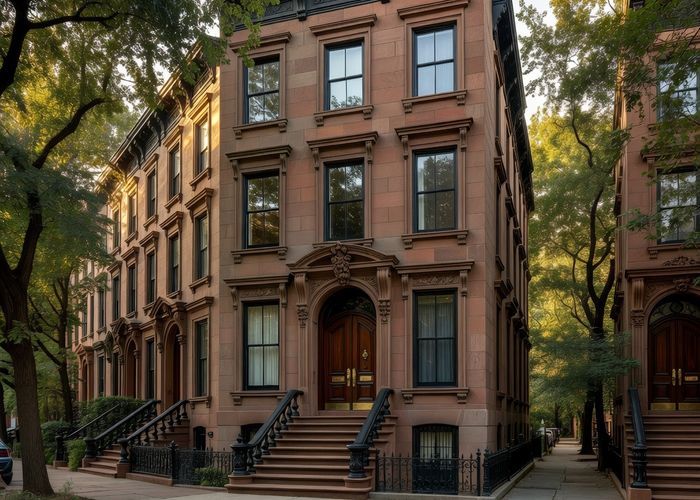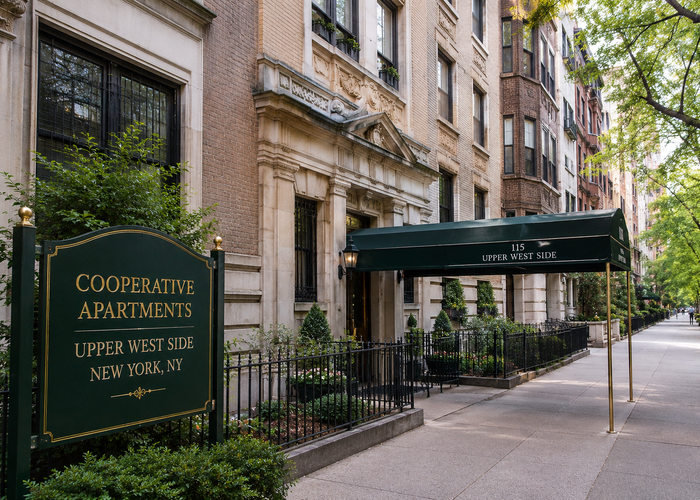
Prewar co-ops, condos and townhouses between the Park and the River, guided by an agent who knows every block.
Smooth transaction with limited risk
No pressure to over pay and buy within a certain time period
A team of people that will be with you even after the transaction is complete
Live listing data provided by OLR IDX. Need help? Contact us or log in to your customer account.
If you are buying or selling real estate on the Upper West Side, the agent you work with needs to understand how property values, building financials, and buyer expectations shift from one block to the next across this Manhattan neighborhood. The Upper West Side is not a single market. It is a collection of micro-markets defined by building type, avenue, floor level, proximity to Central Park or Riverside Park, co-op board requirements, and monthly carrying costs. Stanley Montfort has worked in real estate since 2017, including Upper West Side transactions, representing buyers and sellers across co-ops, condos, townhouses, and multifamily properties from Lincoln Square north through Manhattan Valley. Whether you are searching for a pre-war apartment on Central Park West or preparing to list a brownstone on a landmarked Riverside Drive block, his work starts with the specific building and block, not neighborhood-wide averages.
The individual agent's experience matters more than the brokerage name in Upper West Side transactions. A realtor at Brown Harris Stevens, Compass, or any other firm may know Manhattan broadly, but the Upper West Side requires block-by-block pricing knowledge that only comes from years of closing deals in these buildings.
One of the first things Stanley reviews when evaluating an Upper West Side property is its monthly carrying cost structure. In a co-op, the maintenance payment typically bundles property taxes, building staff salaries, insurance, and sometimes utilities. In a condo, common charges cover building operations, but the owner receives a separate property tax bill. Two apartments with identical asking prices can differ by $1,000 or more per month in total carrying costs depending on building type, underlying mortgage, and recent assessments.
Real estate agents should know how to dissect financial statements for co-ops. Stanley analyzes two to three years of audited building financials before advising a client on any co-op purchase: reserve fund balance, delinquency rates, capital improvement plans, and whether the building carries an underlying mortgage that could trigger future assessment increases. This analysis directly affects what a unit is worth and what a buyer should offer.
For sellers, the process is different. Stanley builds a pricing strategy around recent comparable sales in the same building and on the same block, competing inventory in the immediate area, the unit's condition, and the financial profile of the most likely buyer pool. Sellers should look for agents who provide a strategic pricing strategy and marketing plan rather than simply quoting a neighborhood median.
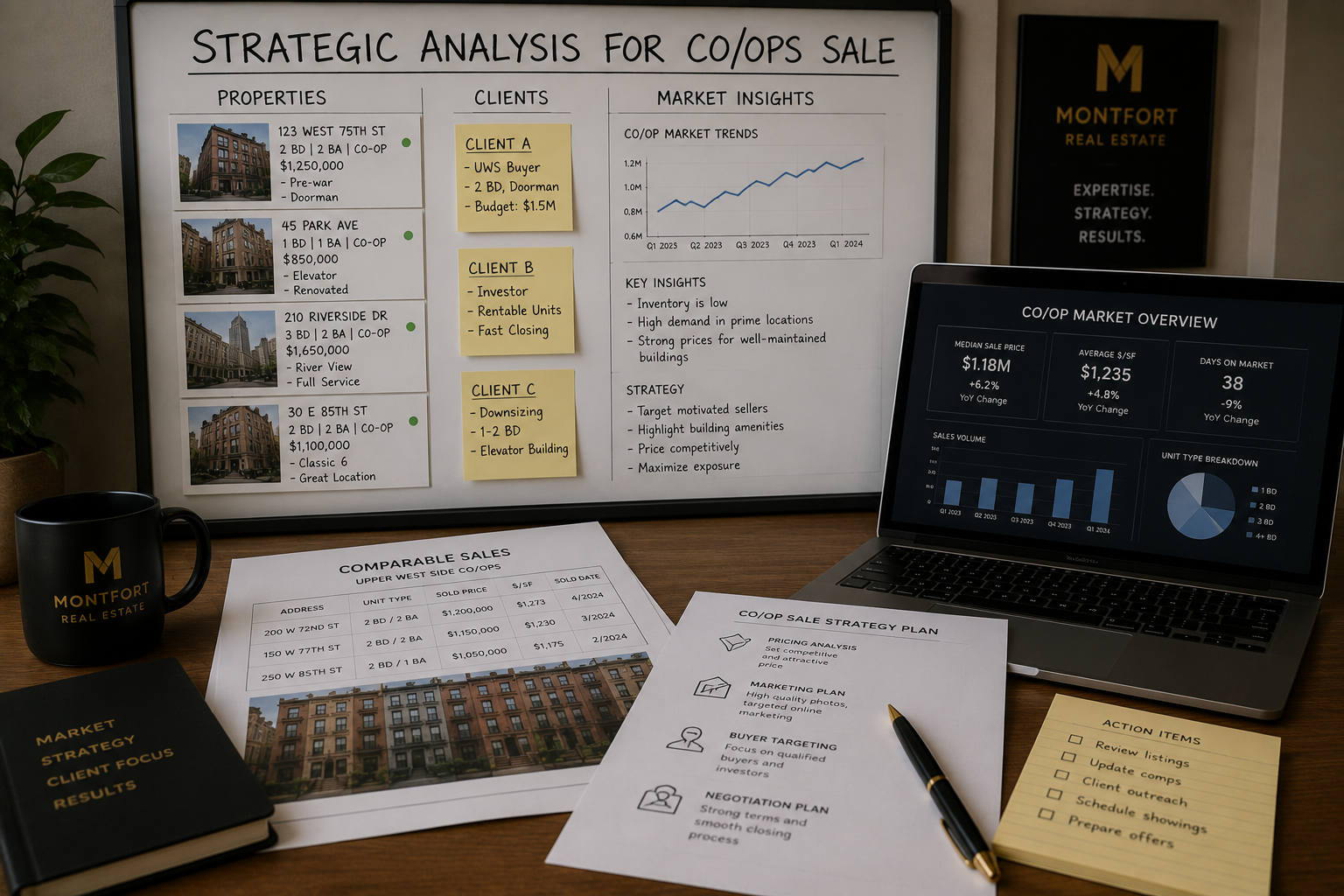
Communication style and responsiveness of realtors are critical in the fast-paced Upper West Side market. When a well-priced listing appears, buyers may have 48 hours or less to schedule a viewing and prepare an offer. Stanley's approach to buyer representation emphasizes preparation: pre-qualifying financially, assembling board package documents in advance, and maintaining relationships with listing agents and building managers across the neighborhood.
Discussing agent compensation and representation is critical before signing agreements. Typical commission rates run about 5% to 6% of the sale price, though rates are negotiable between sellers and real estate agents and depend on property price and market conditions. Dual agency is recognized in New York, with agents representing both buyers and sellers, but Stanley discusses representation structure and any potential conflicts before entering any transaction.
The Upper West Side median listing price is $1.8M, a year-over-year increase of 4.55%. About 1.1K homes are currently listed for sale, which represents a decline of roughly 13% in inventory compared to the prior year. Median days on market for homes is 75 days, though that figure varies widely by property type, building, and price point.
Homes in Upper West Side sell for 99% of asking price on average, which tells you that pricing accuracy matters more than aggressive negotiation in most transactions. Overprice by 5% and you sit on the market; price correctly and you close near ask.
Real estate values in the Upper West Side can vary based on proximity to parks and subway lines. Central Park West commands the highest price per square foot, driven by park frontage, protected views, and architectural prestige. Pre-war co-ops along CPW regularly trade above $1,800 per square foot for larger units with direct park exposure.
Riverside Drive carries a different premium: quieter streets, river and park views, and some of the neighborhood's most elegant townhouses. Units facing Riverside Park often match or exceed mid-CPW stack pricing, depending on floor and exposure.
The Broadway corridor is more variable. Mixed-use buildings, higher foot traffic, and greater noise exposure create a wider range of price per square foot, sometimes $300-$500 below comparable units two blocks west. For buyers, this represents opportunity; for sellers on Broadway, it means marketing strategy needs to emphasize access, convenience, and building-specific amenities rather than views.
West End Avenue and Amsterdam/Columbus Avenues offer a middle ground: pre-war co-ops with family-friendly layouts, reasonable maintenance, and PPSF that falls between CPW and Broadway. Many buyers searching for three-bedroom apartments with good public schools access concentrate their search here.
Inventory on the Upper West Side follows Manhattan's broader seasonal pattern, with spring and fall producing the most new listings and buyer activity. Mid-April is the best time to sell homes; selling in mid-April nets $27,000 more than January. Mid-April listings have 17.7% more views and homes sell nine days faster in mid-April. Competition is 13.2% lower in mid-April because fewer sellers list at that exact window.
In the rental market, the median rent in Upper West Side is $5,000 per month, which rose by 1.01% year-over-year. Upper West Side rental counts decreased by 3.77% month-over-month and fell 22.22% year-over-year, reflecting tightening supply across the neighborhood.
Many buyers are surprised by how much values can change from one block to the next on the Upper West Side. A two-bedroom on West 79th Street between Columbus and Amsterdam may price at $1,500 per square foot while a comparable unit three blocks east, facing Central Park, trades at $2,100 or more. The difference comes down to light, views, noise, and building prestige.
One mistake buyers frequently make is focusing only on asking price and square footage without factoring ongoing fees. Buyers should budget for property taxes and homeowners insurance on top of monthly maintenance or common charges. In a co-op with $3,500/month maintenance (which includes taxes), the true monthly housing cost on a $1.5M purchase with 25% down and a mortgage could exceed $9,000. In a condo with $1,800/month common charges plus $1,200/month in property taxes, the structure differs but the total may land in the same range.
Stanley reviews building financials before recommending any purchase. Key items include:
Understanding board package requirements is crucial for buyers in the UWS. Co-op boards typically require two to three years of tax returns, W-2s, bank and investment account statements, employment verification letters, personal and professional references, and a credit report. Many boards expect post-closing liquidity of 6 to 24 months of maintenance and mortgage payments. Some boards also conduct in-person interviews.
Co-op boards meet monthly. If your package misses a submission deadline, approval waits until the next meeting, adding two to six weeks. This means co-op transactions typically close in 60-90+ days, compared to 30-60 days for condos with clear title and financing in place. If you must move by a specific date, condos tend to be safer bets.
Pricing strategy and knowledge of market data are critical when buying real estate in the UWS. Stanley uses recent comparable sales within the same building and on the same block, not neighborhood-wide averages, to determine accurate offer pricing.
Before recommending an asking price, Stanley analyzes closed sales in the same building (or comparable buildings on the same block), current competing inventory, the unit's condition and renovation quality, monthly carrying costs relative to competitors, and the financial profile of the buyer pool most likely to purchase.
Using recent comparable sales helps agents determine accurate property pricing in the UWS. A two-bedroom co-op at 200 West 79th Street and a two-bedroom co-op at 211 Central Park West may share a zip code but exist in entirely different pricing universes. Floor level, exposure (north vs. south, park vs. courtyard), building amenities (doorman, gym, parking, storage), board reputation, and maintenance cost all affect what a buyer will pay.
One question Stanley always discusses with sellers: what does your competition look like right now? With roughly 1.1K properties currently for sale on the Upper West Side, your listing competes directly with similar units in nearby buildings. If three comparable two-bedrooms in your price range are already sitting at 90+ days on market, pricing aggressively from day one becomes more important than testing a higher number.
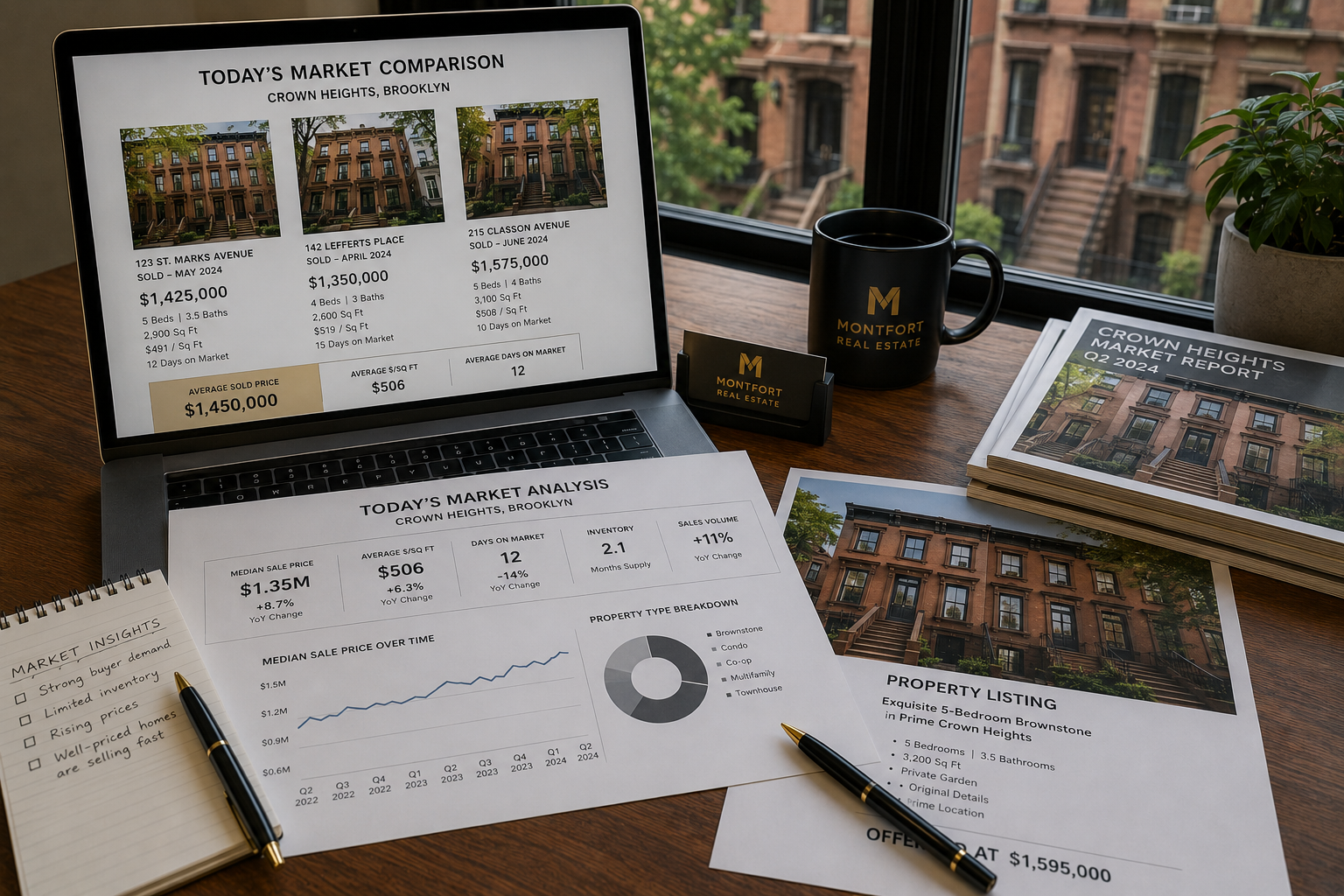
Agents should provide high-end marketing and staging capabilities for Upper West Side listings. For pre-war co-ops, modernizing kitchens and bathrooms before listing can yield outsized returns. For townhouses, curb appeal, roof condition, and compliance with historic district requirements matter to the buyer pool evaluating those properties.
Marketing approach depends on property type and target buyer demographic. Co-ops appeal primarily to long-term owner-occupants; marketing should emphasize building stability, community, and neighborhood integration. Condos attract a broader pool including investors, foreign buyers, pied-à-terre purchasers, and second-home users; marketing should highlight flexibility, amenities, and rental potential. Townhouse marketing targets families and buyers seeking private homes with outdoor space and rental income potential.
The UWS housing stock is dominated by co-ops that have strict financial requirements. In a co-op, you purchase shares in a corporation rather than a deed to a unit. A proprietary lease grants you occupancy rights. The board of directors controls admissions, renovation approvals, sublet policies, and sometimes resale terms including flip taxes.
Down payments in co-ops often range from 25% to 50% of the purchase price, depending on building prestige and board requirements. Post-closing liquidity expectations vary from 6 months to 24 months of combined maintenance and mortgage payments.
| Co-op Consideration | What to Evaluate |
|---|---|
| Maintenance | Monthly fees typically include property taxes, building staff, insurance, and other shared expenses; costs can range from approximately $800/month for studios to $5,000+ for larger units. |
| Board Approval | Requires a detailed financial package and typically an interview; the approval process may take 60–90+ days. |
| Sublet Policy | Many buildings limit subletting to 1–2 years within a five-year period, while some prohibit it entirely. |
| Flip Tax | Often 1–3% of the sale price and commonly paid by the seller, reducing net proceeds at closing. |
| Reserve Fund | Review audited financial statements and reserve levels; inadequate reserves may indicate a higher risk of future assessments. |
Experience with co-op and condo boards is essential for Upper West Side real estate transactions. Stanley prepares buyers' board packages to anticipate common objections, including self-employment income documentation, foreign income sources, and gift-funded down payments.
Condo owners hold a deed and pay common charges separately from property taxes, and condos generally give owners more flexibility to rent and resell than co-ops.
New development condos carry higher PPSF than resale units. In recent new development data, one-bedroom units had a median PPSF of approximately $1,742, two-bedrooms roughly $2,114, and three-bedrooms exceeded $2,000 per square foot. Sponsor units in new buildings may offer negotiating room on closing cost credits or parking/storage inclusion, while resale condos in established buildings trade on track record and proven building management.
Tax abatements (such as 421-a programs on newer buildings) can reduce property tax obligations for an initial period, sometimes 10-25 years. When evaluating a unit with an abatement, Stanley calculates both current and post-abatement carrying costs so buyers understand the full long-term expense.
Common charges in condos cover building operations, amenities, and reserve contributions but exclude property taxes. A buyer comparing a $4,500/month co-op maintenance to a $2,200/month condo common charge needs to add the condo's separate property tax bill (often $1,500-$2,500/month for larger units) to make an accurate comparison.
Pre-war architecture is a defining aspect of the Upper West Side real estate market, and nowhere is that more visible than in the neighborhood's brownstone and limestone townhouses. Legal configuration matters: is the property a single-family home, a two-family with an owner's duplex and rental unit, a three- or four-family with multiple rental apartments, or an illegal conversion that needs legalization?
Stanley reviews the Certificate of Occupancy on every townhouse before advising a buyer. The CO specifies legal use (number of families, commercial use if any). Discrepancies between actual use and CO create legal, insurance, and financing risk.
For properties in historic districts (and many Upper West Side blocks fall within landmarked areas), façade renovations, window replacements, and exterior alterations require Landmarks Preservation Commission approval. Interior renovations do not require LPC review but still need DOB permits and, in some cases, approval from neighboring property owners for party wall work.
Townhouse evaluation includes:
A realtor must understand local zoning laws and building types for effective Upper West Side transactions, particularly for townhouse buyers considering renovation or reconfiguration.
CPW is defined by its pre-war co-op buildings with park frontage. Iconic addresses attract buyers seeking prestige, architectural character, high ceilings, and direct park views. Board expectations are among the strictest on the Upper West Side, and maintenance costs reflect full-service buildings with large staffs. Buyers here are typically purchasing for long-term hold. Resale demand remains strong for well-maintained units with unobstructed park exposure.
Riverside Drive offers a different character: elegant apartment buildings and some of the neighborhood's finest townhouses, with views over Riverside Park and the Hudson River. Many blocks are landmarked. The quieter streetscape and generous apartment layouts attract families and buyers who prioritize space and light over Central Park proximity. Townhouse sale prices on Riverside Drive can exceed $10M for wide, well-renovated properties with legal multi-family configurations.
West End Avenue sits between Riverside Drive and Broadway, offering a mix of pre-war co-ops, midcentury buildings, and occasional newer condos. PPSF typically falls below CPW but above Broadway. The avenue is residential in character, with less commercial activity than Broadway. Families often focus their search here for the combination of space, relative value, and proximity to public schools.
Broadway is the commercial spine of the Upper West Side, with subway access, retail, restaurants, and mixed-use buildings. Condos appear more frequently along Broadway than on the quieter avenues. PPSF is more variable, influenced by noise exposure, floor level, and whether the unit faces the avenue or a quieter courtyard. Buyers trading location prestige for transit convenience and street-level amenity access often find value here.
Lincoln Square, anchored by Lincoln Center and the Time Warner Center, is home to newer luxury condo developments with full amenity packages. PPSF in these buildings regularly exceeds $2,000. Riverside Boulevard's newer towers offer river views and modern finishes. Investors and high-net-worth buyers are more active in this sub-market than in the co-op-dominated blocks to the north.
Manhattan Valley (roughly 96th to 110th Streets between Broadway and Columbus) offers lower PPSF than the core Upper West Side blocks. Co-ops dominate; building condition varies. Buyers willing to move north find more square footage per dollar, though amenity packages and building staffing tend to be more modest.
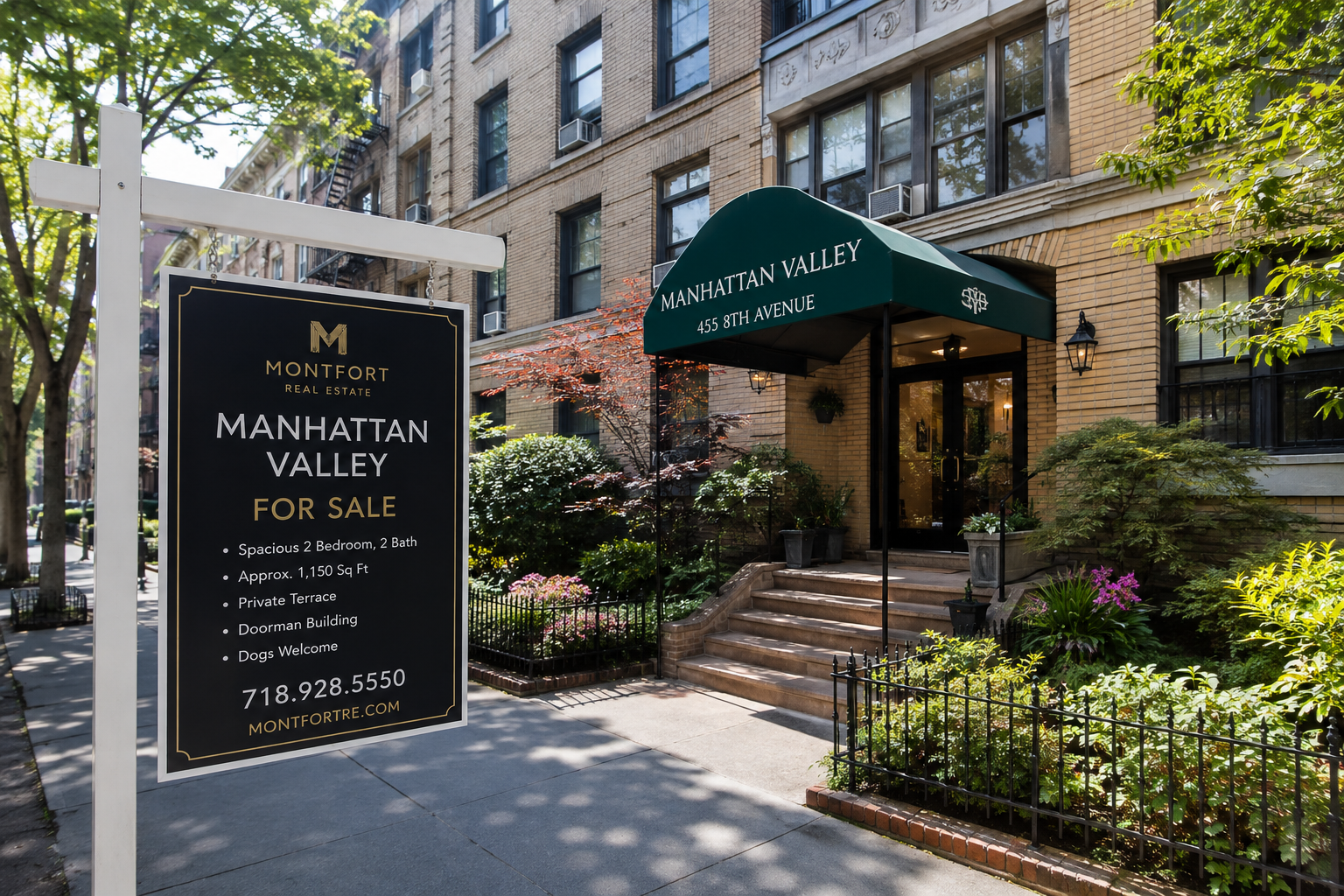
Stanley Montfort represents buyers and sellers across every block of the Upper West Side, from the Lincoln Square area at West 59th Street through the Columbia University neighborhood near West 110th Street. Coverage includes:
Each of these micro-neighborhoods has distinct building stock, buyer demand, and pricing dynamics. Networking and access to off-market properties can benefit buyers targeting Upper West Side apartments, and Stanley maintains relationships with building managers, landlords, and fellow agents across the neighborhood. Strong relationships with local professionals, including real estate attorneys, mortgage brokers, inspectors, and contractors, aid in coordinating smooth transactions.
Monthly costs depend on property type, building, and unit size. Co-op maintenance on the Upper West Side can range from $800/month for a studio to $5,000+ for a large three- or four-bedroom, and that figure typically includes property taxes. Condo common charges run lower (often $1,200-$3,000/month for comparable units) but property taxes are billed separately, often adding $1,000-$2,500/month. Always request the building's most recent financial statement and check for upcoming assessments before making an offer.
Co-ops outnumber condos on the Upper West Side, especially in the pre-war building stock. Co-ops generally trade at lower PPSF than condos but require higher down payments (25-50%), more extensive financial disclosure, and longer closing timelines (60-90+ days). Condos offer more flexibility for investors, subletters, and buyers with non-traditional income, and typically close in 30-60 days. Co-op boards can reject applicants for reasons beyond credit and finances.
Median days on market is 75 days. Once a deal is agreed upon, condo closings often take 30-60 days with financing and documents in order. Co-op closings typically take 60-90+ days because of the board review process, which includes package assembly, board meeting schedules, and interviews. If you are moving on a firm deadline, factor board timelines into your search strategy.
Strengths: rising median prices (up 4.55% year-over-year), shrinking inventory creating pricing power for sellers, and homes selling at 99% of asking price. Weaknesses: elevated interest rates squeezing buyer purchasing power, long co-op board timelines, rising carrying costs, and limited supply of large-format units in the most desirable buildings.
Request the building's audited financial statements for the last two to three years. Review the reserve fund balance relative to upcoming capital projects. Check the delinquency rate among shareholders or unit owners. Ask whether the building carries an underlying mortgage and when it matures. Review board meeting minutes for discussion of planned assessments, litigation, or code violations. Stanley performs this analysis for every building his clients consider purchasing in.
Typical commission rates are about 5% to 6% of the sale price, split between the listing agent and buyer's agent. Commission rates depend on property price and market conditions, and rates are negotiable between sellers and real estate agents. Stanley discusses commission structure, representation type, and scope of services before entering any engagement.
If you have questions about buying or selling on the Upper West Side, or need a property valuation based on your building, block, and unit specifics rather than neighborhood averages, contact Stanley Montfort for a consultation.
Upper West Side townhouses for sale
Educate yourself on these 15 costly mistakes — the difference between a successful purchase and a disastrous one.
Looking at a brownstone in Upper West Side? Taking the time to educate yourself on these 15 costly mistakes can make all the difference between a successful purchase and a disastrous one.

 Posted on Google
Stanley Montfort represented me in the sale of my home in Hamilton Heights. He is professional in his approach and brings his warm, personable demeanor into all his interactions. I selected Stanley to represent me after doing a thorough analysis of realtors in the Hamilton Heights area looking at number of closed tra…
 Posted on Google
Stanley was great to work with. He worked with our schedule, took the time to understand our priorities, showed us a range of properties in different areas that could suit our needs and helped us strategize our approach. He was also a great resource in helping us find local connections for inspections, repairs, etc.…
 Posted on Google
Thank you for a streamlined process from start to finish ensuring the right place was found and secured without haste!
 Posted on Google
We had a great experience working with Stanley. He taught us a lot about the specific market we were looking in, which enabled us to make a very good decision on purchase of a new home.
 Posted on Google
Stanley was the dream real estate agent we didn’t know we deserved! From the beginning he was attentive to our curiosity to help us figure out what type of property we wanted - and could afford. Throughout the process he was a calm and patient presence in our lives, offering us sincere and sage perspectives to keep u…
 Posted on Google
Stanley is amazing! No one knows the Harlem market better than him, and his deep expertise was a tremendous resource. He taught me along the way how to spot 'red flags' and talked me out of making an offer on a place that seemed amazing but had, upon his close inspection, evidence of poor workmanship and lots of cut co…
 Posted on Google
Stan is extremely knowledgeable and professional. He also has the utmost patience! He helped me sell my home and purchase a condo at the same time. My home had all types of special contingencies but he was able to find me a buyer and get me very close to the price I wanted. I was very specific in terms of the property…
 Posted on Google
Stanley is the consummate professional! He made sure my listing has excellent and consistent foot traffic and quality candidates for our showings. This sale had some challenges, but Stanley never wavered. Ultimately we were successful and I’ll use him again and again for future real estate transactions.
Practical guides from Stanley Montfort on buying, selling, and pricing NYC homes.
A step-by-step guide to inspections, renovation planning, and pricing a brownstone.
How to prepare, price, and sell a NYC brownstone.
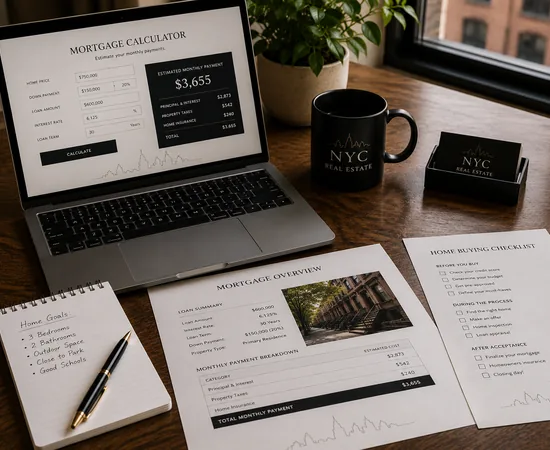
Estimate closing costs, compare renting and buying, and plan carrying costs.