The 2026 NYC mansion tax rates, who pays, how to calculate it, and how it fits with your other NYC closing costs.
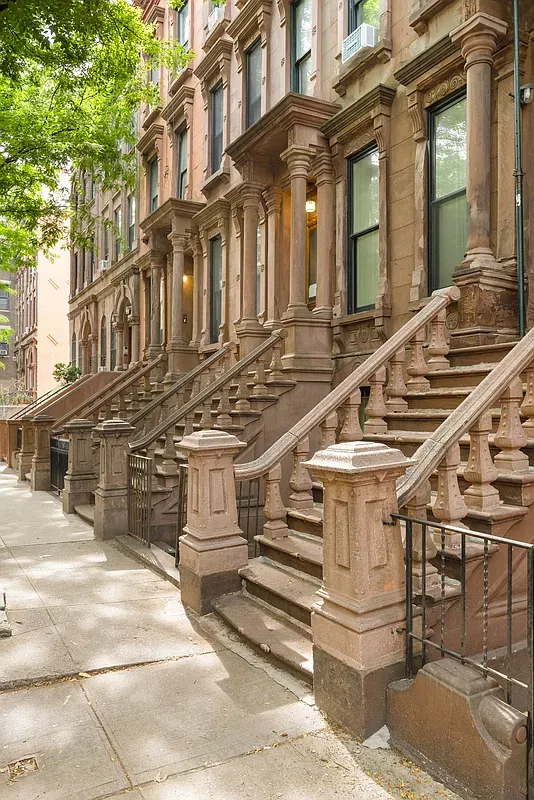
If you're buying a home in New York City for $1 million or more, the mansion tax is one of the biggest checks you'll write at closing. It isn't only for mansions. A two-bedroom condo, a co-op on the Upper West Side, a Harlem brownstone, or a townhouse in Brooklyn can all trigger it.
This guide covers the 2026 NYC mansion tax rates, who pays the mansion tax, how to calculate it, and how it fits with your other closing costs. Use the calculator below to see your number in seconds.
The NYC mansion tax is a New York State tax that the buyer pays on residential purchases of $1 million or more. The rate starts at 1% and rises to 3.9% in New York City, and it applies to the entire purchase price, not just the amount above $1 million.
New York State created the mansion tax in 1989 as a flat 1% on residential purchases of $1 million or more. In 2019, the state added a supplemental tax for New York City residential purchases of $2 million or more. That turned one flat rate into eight brackets. The $1 million threshold has never been raised for inflation, so far more buyers pay it today than when it started.
Outside New York City, the New York mansion tax is still a flat 1%. Inside the five boroughs, the higher brackets apply.
At $1,999,999 the tax would be $19,999.99 — $7,500.01 less.
Get this mansion tax breakdown plus a full closing-cost estimate for your price, from Stanley Montfort.
This calculator estimates the New York State mansion tax and NYC supplemental tax on a residential purchase in New York City. It's an estimate, not tax advice. Confirm your final number with your real estate attorney or title company.
These are the combined NYC mansion tax rates (the 1% state tax plus the NYC supplemental tax) for residential purchases in New York City:
| Purchase price | Mansion tax rate | Tax at the bottom of the bracket |
|---|---|---|
| Under $1,000,000 | 0% | $0 |
| $1,000,000 to $1,999,999 | 1.00% | $10,000 |
| $2,000,000 to $2,999,999 | 1.25% | $25,000 |
| $3,000,000 to $4,999,999 | 1.50% | $45,000 |
| $5,000,000 to $9,999,999 | 2.25% | $112,500 |
| $10,000,000 to $14,999,999 | 3.25% | $325,000 |
| $15,000,000 to $19,999,999 | 3.50% | $525,000 |
| $20,000,000 to $24,999,999 | 3.75% | $750,000 |
| $25,000,000 or more | 3.90% | $975,000 |
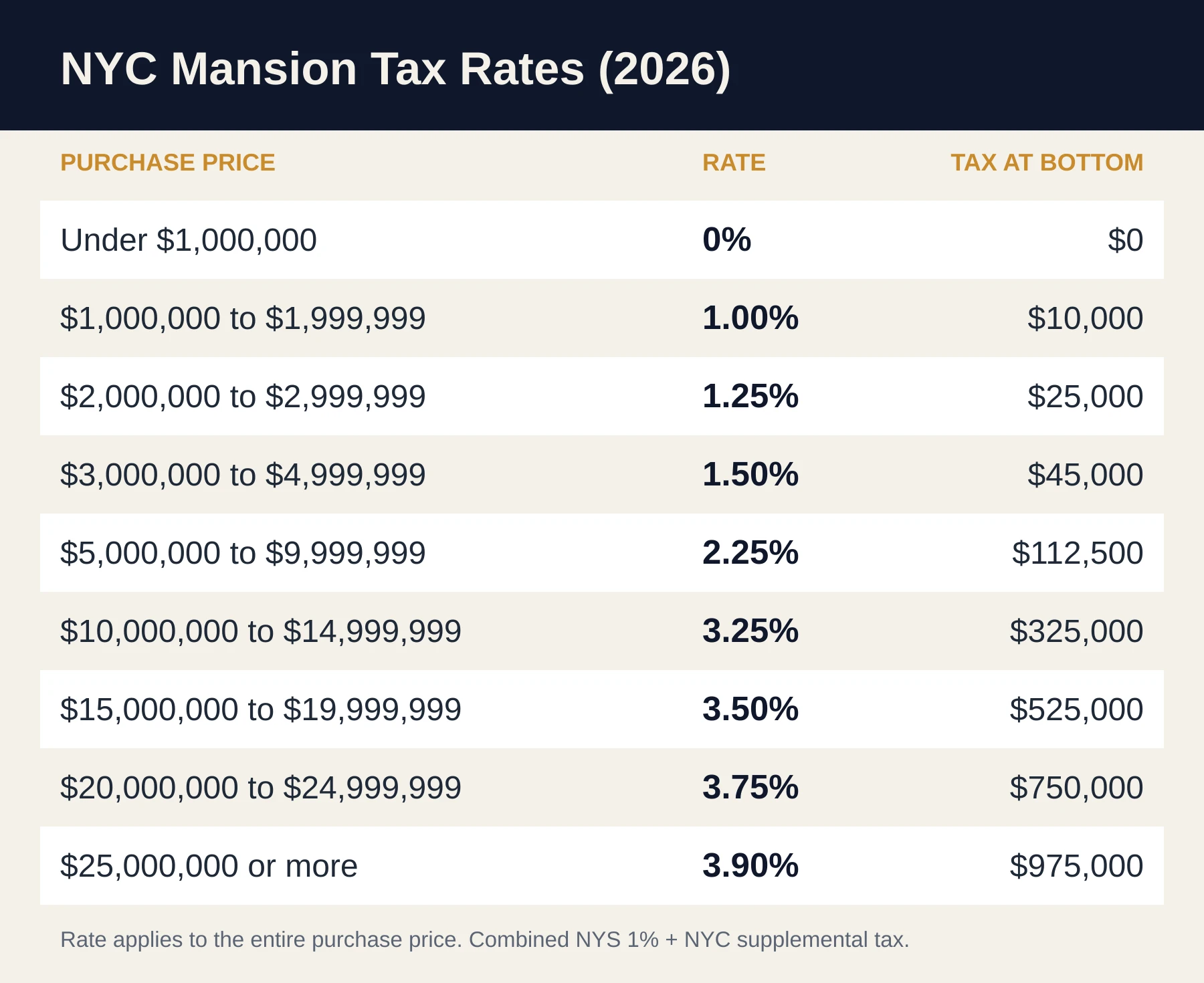
The rate applies to the entire purchase price. If you buy at $2.5 million, you pay 1.25% on all $2.5 million, not 1% on part of it and 1.25% on the rest.
The formula is simple: purchase price × the rate for your bracket = mansion tax.
Here are three examples at common price points for NYC brownstones, condos, and co-ops:
The purchase price used is the full consideration in your contract. If you take over the seller's existing mortgage as part of the deal, that amount counts toward the price too.
Because the tax applies to the entire purchase price, crossing a threshold by even a dollar raises the tax on the whole price. This is the cliff effect.
| Purchase price | Mansion tax |
|---|---|
| $999,999 | $0 |
| $1,000,000 | $10,000 |
| $1,999,999 | $19,999.99 |
| $2,000,000 | $25,000 |
| $2,999,999 | $37,499.99 |
| $3,000,000 | $45,000 |
| $4,999,999 | $74,999.99 |
| $5,000,000 | $112,500 |
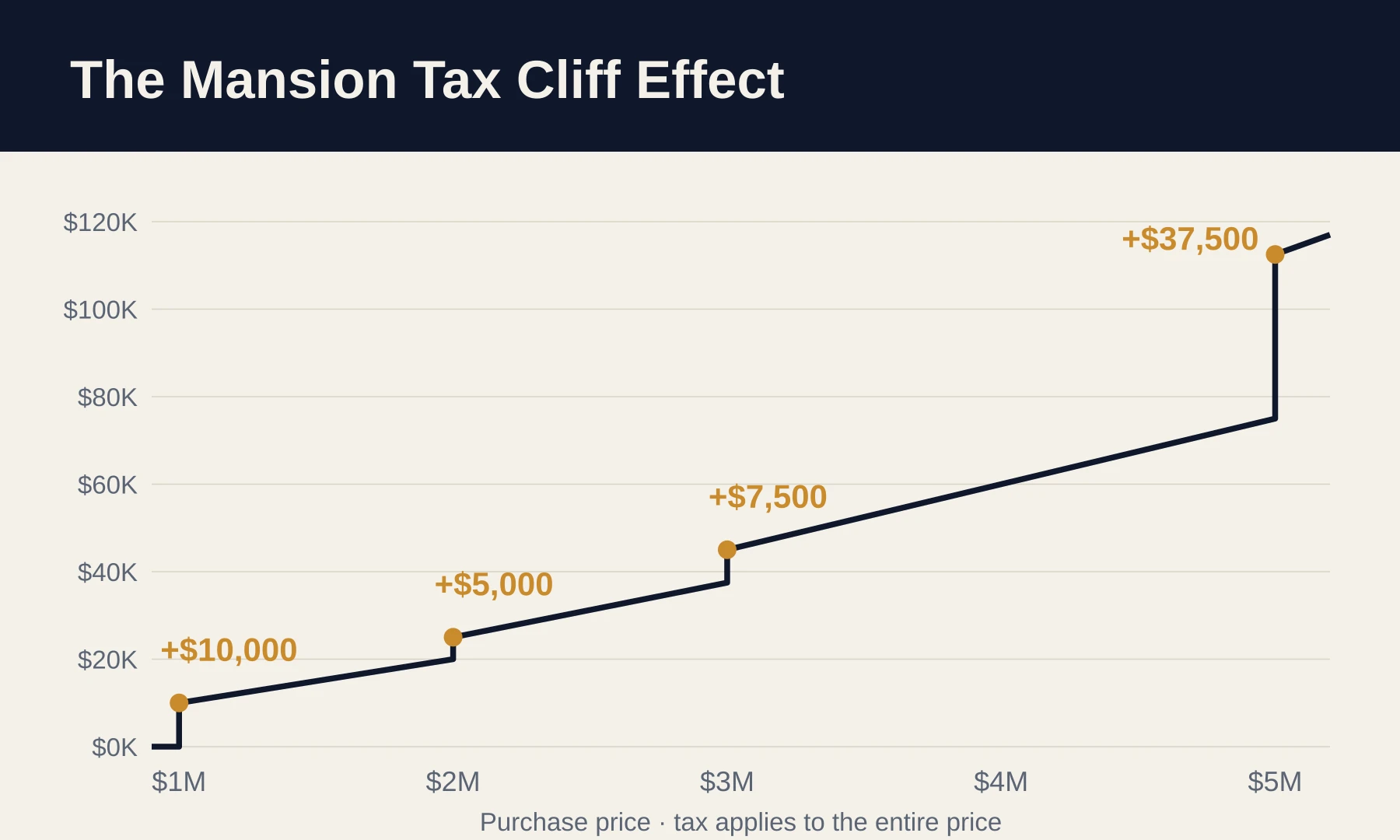
A one-dollar difference at $3 million adds $7,500 in mansion tax. At $5 million, it adds $37,500. That's why so many NYC listings are priced at $999,000, $1,995,000, or $2,995,000, and why buyers near a bracket often negotiate to land just under it.
The buyer pays the mansion tax in NYC. It's a buyer closing cost, collected at closing.
If the buyer is exempt (for example, a government agency), the seller must pay the mansion tax instead. Under New York tax law, the buyer and seller are both liable for it if it goes unpaid.
The buyer and seller can still negotiate who carries the cost. A seller paying part of it usually shows up as a seller credit or a price adjustment. A seller credit does not lower the mansion tax, because the tax is based on the contract price, not on what you net after credits. A true price reduction does.
The mansion tax applies to residential property: any premises used, or that could be used, in whole or in part as a personal residence. That includes:
It applies whether you pay cash or finance. It applies to co-ops even though co-ops are exempt from the mortgage recording tax.
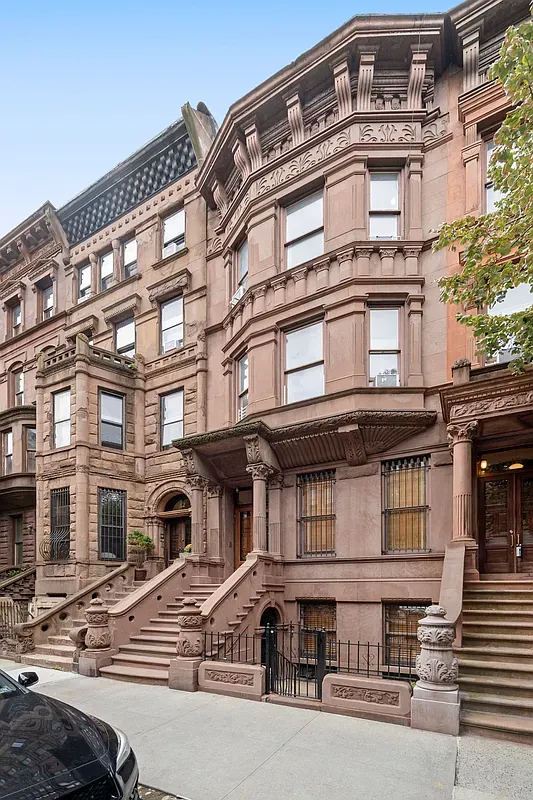
Here's a detail most mansion tax guides skip, and it matters in Harlem, Bed-Stuy, and Crown Heights, where many brownstones are multifamily.
New York State's guidance says a four-family house is not considered residential real property for the mansion tax. So the mansion tax generally doesn't apply to a building with four or more units, even when the buyer plans to live in one of them.
Compare two buildings at $2,200,000:
That doesn't make a four-family building cheaper overall. Other taxes are set differently for these buildings. The mortgage recording tax rate on a loan for a four-plus-unit building is higher, and the seller's transfer tax rates differ. Mixed-use buildings, such as a brownstone with a ground-floor store or office, need their own analysis.
If you're comparing a three-family and a four-family building, run the full closing cost picture for both and have your real estate attorney confirm how each one is classified. See our multifamily real estate agent page for how we help buyers compare 2–4 family and mixed-use buildings.
The mansion tax is one of four taxes that show up on most NYC residential sales. Buyers pay two of them, and sellers pay two.
| Tax | Who pays | Rate (residential, NYC) | Based on |
|---|---|---|---|
| Mansion tax | Buyer | 1% to 3.9% | Purchase price ($1M+) |
| NYC mortgage recording tax | Buyer (if financing) | 1.8% (loan under $500K) or 1.925% ($500K+) | Loan amount; co-ops exempt |
| New York State transfer tax | Seller | 0.4% (0.65% at $3M+) | Purchase price |
| NYC transfer tax (RPTT) | Seller | 1% (up to $500K) or 1.425% (over $500K) | Purchase price |
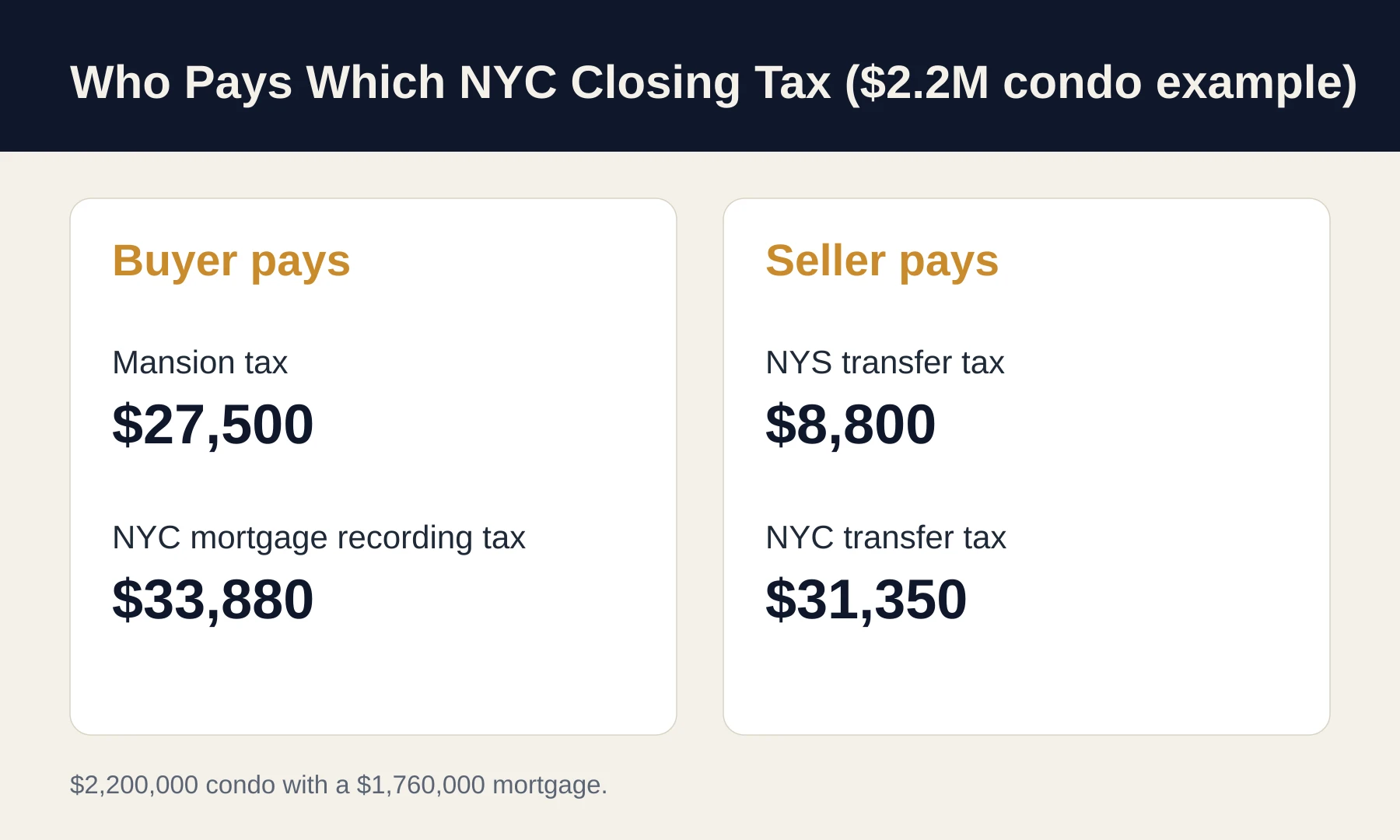
Mortgage recording tax rates shown are the borrower's share for a one- to three-family house or condo. The lender pays an additional 0.25%.
Here's how the taxes stack up on a $2,200,000 condo with a $1,760,000 mortgage:
The same purchase as a co-op would skip the $33,880 mortgage recording tax, which is one reason buyers in this price range weigh co-ops vs. condos carefully.
Buyer closing costs in NYC run roughly 1.5% to 6% of the purchase price, depending on the property type, the price, and whether you finance. The mansion tax is often the single largest buyer closing cost on a purchase of $1 million or more.
Other buyer closing costs include:
For a full estimate for your purchase, use our NYC buyer closing cost calculator. To see your monthly payment, use the NYC mortgage calculator.
There's no loophole that makes the NYC mansion tax disappear on a $1 million-plus home, but there are legitimate ways to manage it.
Negotiate below a threshold. If a home is listed at $1,025,000, an offer of $999,000 saves you $10,000 in mansion tax. That's a real negotiating point, and it's one a good buyer's agent will raise.
Allocate a fair value to personal property. If the sale includes furniture or other items that aren't part of the real estate, their fair market value can be listed separately. The allocation must be real, documented, and supported by fair value. Inflated allocations can trigger an audit.
Consider a four-plus-unit building. As covered above, buildings with four or more units generally fall outside the mansion tax. Run the full numbers first.
Budget for cash at closing. Lenders generally won't add the mansion tax to your loan, so plan to pay it with cash at closing. Make sure it doesn't drain the post-closing liquidity your lender or co-op board requires.
No. The mansion tax is not deductible on your federal income tax return. It is added to your cost basis in the home, which can reduce your taxable gain when you sell.
For example, if you buy for $1,250,000 and pay $12,500 in mansion tax, your cost basis starts at $1,262,500. Talk to a CPA about how this applies to your situation. For the selling side, see taxes when selling a home in New York.
The mansion tax is reported on Form TP-584-NYC and collected at closing.
The mansion tax is technically due within 15 days after closing, but in practice you'll pay it at the closing table. Your real estate attorney will show it on your closing statement.
Don't confuse the mansion tax with New York City's new pied-à-terre tax, which New York State enacted in 2026.
If you'll live in the home as your primary residence, the pied-à-terre tax generally won't apply. If you're buying a second home or an investment property you won't rent out on a lease of a year or longer, ask your attorney or CPA how it applies. The NYC Department of Finance has not yet issued its final rules.

The mansion tax rewards buyers who plan ahead. Know your bracket before you make an offer, build the tax into your cash-to-close, and negotiate around the thresholds.
Stanley Montfort is a licensed associate real estate broker who has closed 100+ transactions and over $100 million in sales across Manhattan and Brooklyn, with a background in law (JD, Fordham). We represent buyers of brownstones, townhouses, condos, and co-ops, and we'll help you understand every cost before you sign.
Buying your first brownstone? Start with our guide to buying a brownstone in NYC and NYC first-time home buyer mortgages.
This article is general information, not legal or tax advice. Tax rates, exemptions, and closing practices depend on the property, the transaction, and the closing date. Confirm your numbers with your real estate attorney, title company, or CPA.
Sources: New York State Department of Taxation and Finance (Real Estate Transfer Tax; additional tax on residential conveyances of $1 million or more); NYC Department of Finance (Real Property Transfer Tax).
The mansion tax in New York is 1% on residential purchases of $1 million or more. In New York City, the rate rises in brackets to 3.9% on purchases of $25 million or more. The rate applies to the entire purchase price, so a $1.5 million home in NYC carries $15,000 in mansion tax.
The buyer pays the mansion tax in NYC. If the buyer is exempt, the seller must pay it. Buyers and sellers can negotiate a credit or price change, but a seller credit doesn't reduce the tax itself.
The legitimate way to avoid the mansion tax is to buy below $1 million. Near the threshold, you can negotiate the price under $1 million or allocate fair value to genuine personal property. Buildings with four or more units generally fall outside the tax. Talk to your attorney before structuring any deal around it.
No, the mansion tax isn't deductible on your federal income tax return. It's added to your cost basis, which can lower your taxable gain when you sell. Ask a CPA how it applies to you.
Yes, the mansion tax applies to co-op purchases of $1 million or more, just like condos and houses. Co-ops are exempt from the mortgage recording tax, but not from the mansion tax.
It depends on the property, not just the price. NYC property tax is based on the Department of Finance's assessed value and the property's tax class, which can differ a lot from the sale price. Check the property's tax bill on the Department of Finance website, or ask us to pull it for any home you're considering.
Reach out for buyer representation, listing strategy, or a confidential valuation with Stanley Montfort.