Seller's balance carried over — not taxed again


NYC Purchase CEMA Savings Calculator
Estimate potential mortgage recording tax savings for buyers and transfer tax savings for sellers.
Illustrative example based on the values you entered.
Before lender, attorney and assignment fees. Actual net savings will be lower. Results are estimates based on current NYC tax rates.
 5.0 ★★★★★58+ Google reviews
How a Purchase CEMA works
A Purchase CEMA allows a buyer to take over the seller's existing mortgage, which can reduce mortgage recording taxes for the buyer and transfer taxes for the seller.
The buyer takes over the seller's current mortgage (subject to lender approval).
Mortgage recording tax is only paid on the additional financing amount.
Potential savings for the buyer and seller after taxes, fees and lender requirements.
Results are estimates based on current NYC tax rates (1.925% mortgage recording tax on loans of $500,000+ and 0.4% NYS transfer tax on most residential sales). Actual savings depend on lender approval, loan terms, property type, and final tax and fee treatment. This calculator is for educational purposes only and not a substitute for legal or tax advice.
Purchase CEMA
When the seller still has a mortgage, a Purchase CEMA lets your lender take over that existing balance instead of paying it off. You only pay New York's mortgage recording tax on the new money you borrow above it — often a five-figure saving on a brownstone or condo — and the seller skips NYS transfer tax on the assigned balance. Enter your numbers below to see what a CEMA could save you after fees.
Co-ops are not eligible — co-op loans are not recorded, so there is no recording tax to save.
Seller's balance carried over — not taxed again
At 1.925% recording tax
Before fees and any seller share
NYS transfer tax (0.4%) not due on the assigned loan
Buyer + seller, before fees
Lender, attorney & title processing
CEMA stands for Consolidation, Extension and Modification Agreement. In a purchase CEMA, the seller's lender assigns the seller's existing mortgage to the buyer's lender rather than satisfying it at closing. The buyer's lender then consolidates that assigned balance with any new money into one loan. Because recording tax was already paid on the assigned balance, it is only charged on the new portion.
In NYC, residential 1–3 family homes and condos pay 1.8% on loans under $500,000 and 1.925% at $500,000 and above. 4+ family and mixed-use buildings pay 2.05% or 2.8%.
The seller's remaining mortgage balance — up to your new loan amount — is carried over and not taxed again.
Anything you borrow above the assigned balance is taxed at the normal rate.
Lenders and attorneys charge extra to process a CEMA, and some sellers ask for part of the savings in exchange for cooperating.
No. Co-op financing is a share loan, not a recorded mortgage, so there is no mortgage recording tax to save.
Yes, a little. The seller does not pay New York State transfer tax on the mortgage balance that is assigned (0.4% on most residential sales, 0.65% at $3 million and up). The larger saving — mortgage recording tax — goes to the buyer, so many sellers ask for a share of it, often around half. Use the “seller's share” field above to model that.
Typically two to six weeks, depending on how quickly the seller's lender sends the original note and mortgage documents. Your attorney should request them as early as possible.
Yes. Both your lender and the seller's lender need to participate. Ask about CEMA early, before you lock your rate.
No. It is an educational estimate. Actual savings depend on your loan, the seller's payoff balance, and the fees your lender and attorneys charge. Stanley can review your numbers with you before you make an offer.
Explore the other calculators to pressure-test closing costs, rent vs buy, and ownership choices.
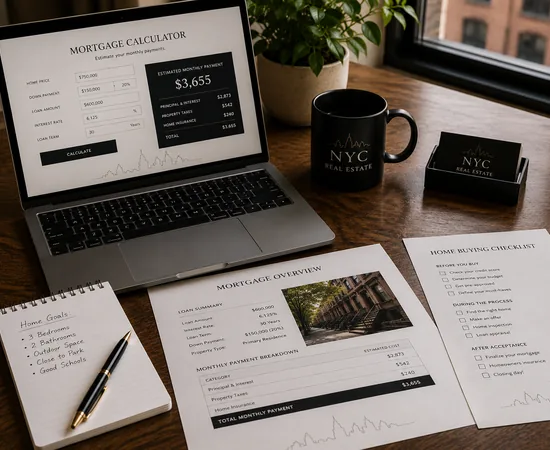
Estimate monthly payment, taxes, and carrying costs before you make an offer.
Open calculator →
Project transfer taxes, attorney fees, and total cash needed to close.
Open calculator →
See net proceeds after commissions, transfer taxes, and seller fees.
Open calculator →
Compare the long-term cost of renting versus owning a brownstone.
Open calculator →
Weigh monthly costs between a condo and an income-producing brownstone.
Open calculator →Reach out for buyer representation, listing strategy, or a confidential valuation with Stanley Montfort.