
Crown Heights Co-Ownership — Local Experts for Buying, Selling & Investing
We'll help you make a smart co-ownership investment in Crown Heights by structuring the purchase properly, reducing risk, and protecting everyone's interests.
SMOOTH TRANSACTION
With limited risk throughout the buying process.
NO PRESSURE
No pressure to overpay or purchase within a specific timeframe.
ONGOING SUPPORT
A dedicated team that remains available even after the transaction is complete.
Crown Heights Coownership Guide and Buyer Services
Expert Co-Ownership Advisory Services in Crown Heights
Buying property in Crown Heights has become increasingly challenging for many buyers. Rising home prices have made it difficult to purchase a home alone, which is why more people are exploring co-ownership as an alternative.
Co-ownership allows two or more buyers to purchase a property together, share expenses, and build equity that might otherwise be out of reach. When it's planned properly, it can be an excellent path to homeownership. When important conversations are skipped, it can quickly become complicated.
One of the first things I discuss with clients isn't the property itself—it's whether the people buying together have aligned expectations. That conversation often determines whether co-ownership will be successful long before anyone signs a contract.
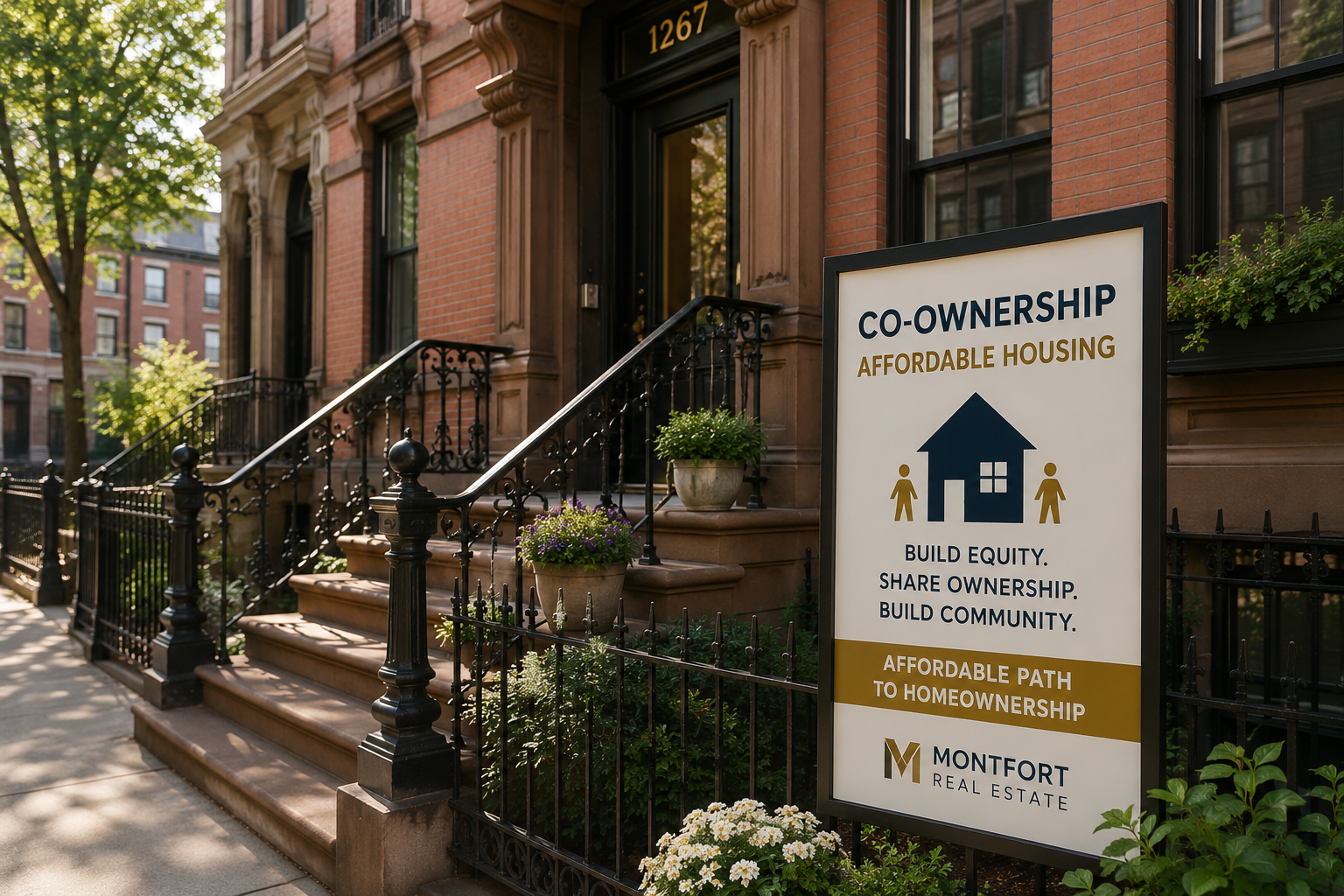
Why Co-Ownership Works for Affordable Housing in Crown Heights
Crown Heights is one of Brooklyn's most desirable neighborhoods. It's located between Prospect Park and the Brooklyn Museum, with easy access to Nostrand Avenue's thriving commercial corridor, everyday amenities, excellent transit connections, and a community that continues to grow. But desirability comes with a price tag that puts traditional solo homeownership out of reach for many buyers.
The homeownership rate in Crown Heights and Prospect Heights sits at roughly 19.3%-well below the city average of 32.7%. Owner-occupied median housing value in Crown Heights South has climbed to approximately $1,122,600. Crown Heights added 5,751 housing units from 2010 to 2024, yet demand continues to outpace what the market can deliver affordably. The neighborhood had a rental vacancy rate of just 2.7% in 2023, and median base rent in Crown Heights is $3,300 as of 2023-making it the 13th most expensive rental market in NYC.
Real median gross rent in Crown Heights rose from $1,300 in 2006 to $2,140 in 2023. Crown Heights rents rose 4.97% month over month in April 2026. For residents paying that kind of rent each month, the math on co-ownership starts to make a lot of sense.
Here's why co-ownership has become increasingly attractive in this neighborhood:
Lower barrier to entry: Shared down payment and closing costs reduce what each buyer needs upfront. Instead of one person coming up with $200,000+ for a down payment on a Crown Heights townhouse, two or three buyers can split that burden significantly.
Access to better properties: Pool resources to afford brownstones, multi-family buildings, and renovated properties that would be impossible to purchase solo. Many buyers I work with are surprised that co-ownership opens doors to three bedrooms or even entire multi-unit buildings they assumed were out of their price range.
Shared maintenance costs: Property taxes, insurance, utilities, and repairs are divided between co-owners-reducing the long-term carrying costs that make NYC homeownership so demanding.
Building equity together: Crown Heights has seen cumulative appreciation of roughly 125% across residential property types since 2009. Shared responsibilities in co-ownership can lessen the burden on individuals while everyone benefits from that equity growth.
Professional consultation ensures protection: Co-ownership can reduce the financial burden of purchasing high-priced properties, but only when proper legal agreements are in place. That's where experienced advisory services make the difference.
Our Co-Ownership Advisory Services
First-Time Buyers Co-Ownership
One of the first conversations I have with first-time buyers is about what each person actually wants from the property-not just cost savings, but lifestyle, occupancy expectations, and how long they plan to stay. Crown Heights attracts a wide range of buyers: young professionals who want to stop paying rent, friends who've been housemates and want to build equity together, and couples who aren't married but want to invest in a home.
I provide guidance for buyers who want to enter the Crown Heights market through shared ownership, including education on how co-ownership compares with buying a co-op apartment, a condo, or a traditional brownstone independently. Crown Heights properties commonly include co ops, condos, or brownstones-and the right ownership model depends entirely on your situation.
Investment-Focused Co-Ownership for Crown Heights Townhouse
For buyers seeking rental income through shared property ownership, Crown Heights offers real opportunities. The neighborhood's tight rental market-with that 2.7% vacancy rate and rising rents-means multi-family properties can generate meaningful cash flow.
I help investment-minded buyers analyze multi-family buildings and units suitable for co-ownership arrangements, evaluate expected rental income against carrying costs, and structure ownership agreements that account for property management responsibilities and profit distribution.
Essential Co-Ownership Considerations for Crown Heights Near Brooklyn Museum
Before entering a co-ownership agreement, every buyer needs to understand these ten critical elements. A mistake I frequently see buyers make is skipping several of these conversations because they feel awkward-especially when the co-owner is a friend or family member. These aren't optional discussions. They're the foundation of a successful partnership.
Ownership Percentage Agreements: How to fairly divide property based on each person's financial investment, including down payment, ongoing contributions, and sweat equity from construction or renovations. Tenancy in Common allows unequal ownership percentages and the right to sell shares independently, making it the most flexible option for co-owners contributing different amounts.
Financial Responsibility Allocation: Property taxes, insurance, maintenance costs, and utilities must be clearly divided. Define who pays what each month, how contributions are tracked, and what happens if someone can't pay.
Decision-Making Procedures: Major repairs, improvements, and property management choices need defined thresholds. Many buyers assume they'll just "figure it out"-until one co-owner wants to renovate the kitchen and the other doesn't.
Exit Strategy Planning: Co-ownership agreements should define buyout procedures and exit strategies before anyone signs a deed. This includes valuation methods, rights of first refusal, and timelines for departure.
Legal Documentation: A co-ownership agreement is recommended to outline financial responsibilities and dispute resolutions. This is separate from the deed itself and should be drafted with an experienced real estate attorney.
Financing Arrangements: Individual vs. joint mortgages carry very different implications for liability. All co-owners on a joint mortgage are personally responsible if anyone defaults.
Property Management Responsibilities: Who handles day-to-day operations-maintenance calls, tenant communications (if renting units or managing an open room in shared occupancy), scheduling repairs? Define roles clearly to avoid resentment.
Dispute Resolution Procedures: Clear protocols for handling disagreements, whether through mediation, arbitration, or other mechanisms. Without these, your only recourse may be an expensive partition action under RPAPL Article 9.
Insurance and Liability Coverage: All co-owners need adequate property insurance, and the agreement should specify who is responsible for maintaining coverage and how liability exposure is handled.
Tax Implications: Co-ownership affects how you deduct mortgage interest and property taxes, and the treatment may depend on how income and expenses are reported. Unequal shares require careful accounting, and rental income from units creates additional pass-through tax considerations.
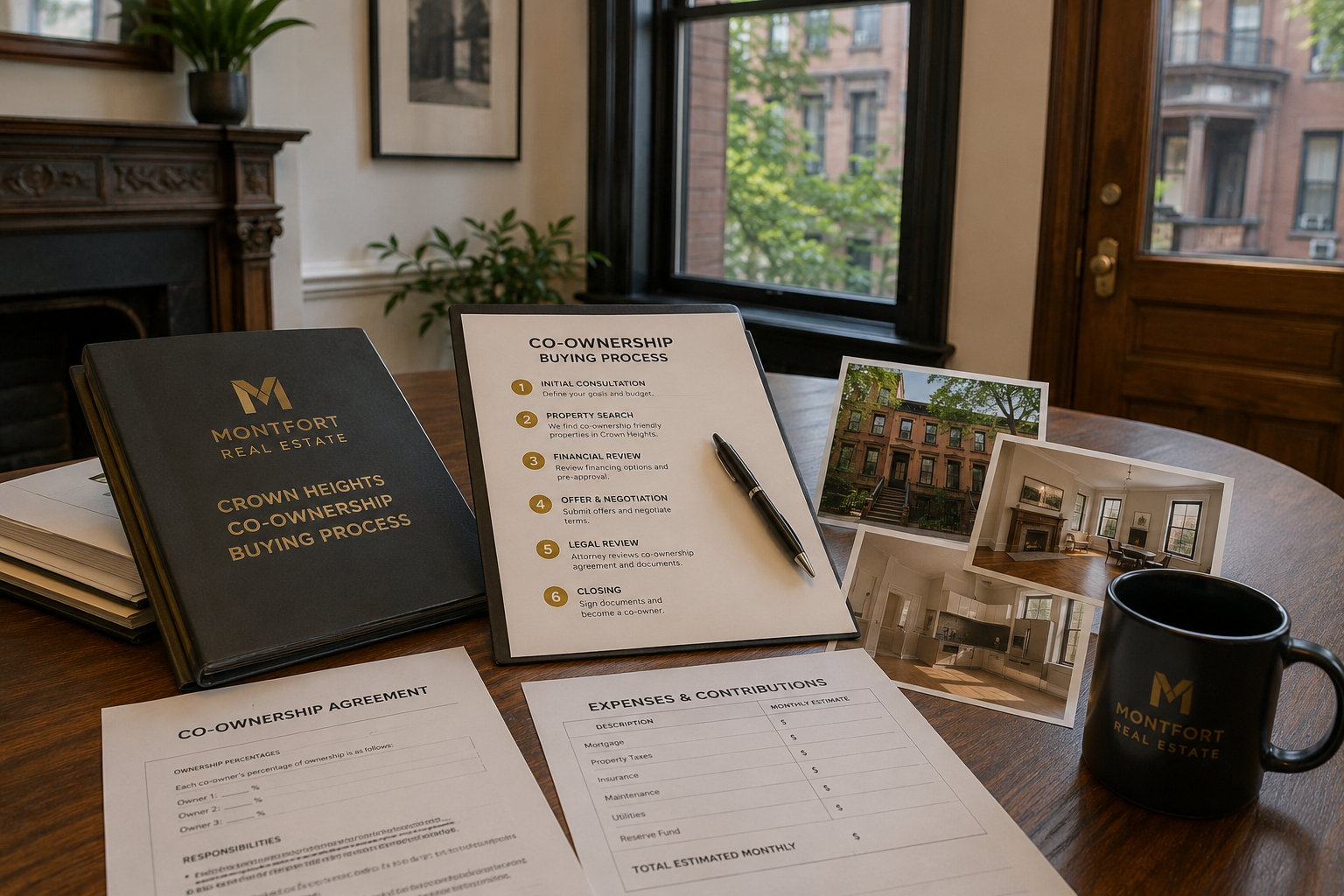
The Crown Heights Co-Ownership Process
Step 1: Initial Consultation and Financial Assessment
We start by evaluating each prospective buyer's financial situation: down payment capacity, credit scores, income stability, and expected ongoing costs, so you can confidently apply once the numbers and practical fit are clear. I also assess compatibility among potential co-owners-this includes honest conversations about occupancy plans (who will live in the property vs. treating it as an investment), expected hold period, and risk tolerance.
During this phase, we review Crown Heights market opportunities together. Current median sale price sits around $990,000 with price per square foot at approximately $918. Whether you're looking at a studio or one bedroom co-op on the north side or a multi-unit building in Crown Heights South near Prospect Park, understanding the range of what's available-and what it actually costs to carry-is essential.
Step 2: Legal Framework Development
This is where the real work happens. I always encourage clients to work with an experienced real estate attorney to draft a comprehensive co-ownership agreement. This document should cover ownership percentages, financial responsibilities, maintenance obligations, decision-making procedures, dispute resolution, refinancing rights, buyout procedures, resale rights, and exit strategies.
We also determine the form of title. Under New York's EPT §6-2.2, when property is conveyed to more than one person, the default is Tenancy in Common unless Joint Tenancy or Tenancy by the Entirety is expressly declared. Joint Tenancy provides equal ownership interests with right of survivorship-meaning if one co-owner dies, their share automatically passes to the surviving owners. This is a critical decision that affects inheritance, estate planning, and long-term flexibility.
Buying a co-op means purchasing shares in a corporation rather than owning real property outright. Co-ops require board approval and have specific rules regarding ownership and occupancy. If you're considering a co-op building for your co-ownership arrangement, the legal framework becomes more complex and requires additional documentation.
Step 3: Property Search and Evaluation
With your legal framework established, we identify suitable Crown Heights properties for shared ownership. This might be a brownstone with two or more units, a large single-family home that can accommodate multiple residents, or co ops and condos where shared purchasing makes financial sense.
I coordinate inspections and due diligence, including structural assessments (many Crown Heights brownstones require attention to façades, roofs, and aging plumbing), zoning verification, property tax assessment review, and-for historically designated properties-landmark preservation requirements. We analyze investment potential, evaluate the listing details carefully, and ensure every buyer understands the long-term carrying costs before moving forward.
Step 4: Closing and Ongoing Support
At closing, all co-owners review title work, sign documents, and confirm that financing is properly secured. I guide each party through the documentation to ensure everything aligns with the co-ownership agreement drafted in Step 2.
Post-closing, we establish property management procedures: setting up a joint bank account for shared costs such as utilities and WiFi, defining who handles day-to-day operations, creating a schedule for regular maintenance, and establishing communication protocols. I provide ongoing consultation to help co-owners navigate the inevitable questions that arise during the first year and beyond.
Client Success Stories
"We'd been paying $3,300 a month combined in rent for two separate apartments in Crown Heights. Stanley helped us structure a co-ownership deal on a two-family brownstone on a quiet block near the Brooklyn Museum. Our combined mortgage payment is less than what we were paying in rent, and we're actually building equity. The co-ownership agreement he recommended gave us both confidence that we were protected."
– Marcus T. & David L., First-Time Buyers
"Four of us pooled our resources to buy a multi-unit building in Crown Heights South. Stanley walked us through every detail-ownership percentages, how to handle rental income, what happens if one of us wants out. Two years in, the property has appreciated and the rental income covers most of our carrying costs. We couldn't have done this deal alone."
– Priya S., Investment Co-Owner
"When my co-owner needed to leave the arrangement after three years, the buyout process Stanley helped us create in our original agreement made everything smooth. We had a pre-agreed valuation method, a timeline, and a right of first refusal. What could have been a nightmare was handled in sixty days."
– Christine R., Crown Heights Homeowner
Frequently Asked Questions
How do we determine fair ownership percentages in Crown Heights co-ownership?
One question I always encourage clients to discuss early is what "fair" actually means in their specific situation. The standard approach calculates ownership share as a percentage of total capital investment: down payment contributions, ongoing mortgage payments, and any sweat equity from renovations or construction. For example, if two buyers contribute unequal down payments-say 60% and 40%-their ownership percentages should reflect that split. But what if one partner handles all maintenance and repairs? That labor has value, and it should be documented in your co-ownership agreement with a clear compensation mechanism. Tenancy in Common accommodates unequal percentages; Joint Tenancy requires equal shares.
What happens if one co-owner wants to sell before the others?
This is the single most important scenario your co-ownership agreement must address. A well-drafted agreement includes a right of first refusal giving remaining co-owners the opportunity to buy the departing owner's share before it's offered to outsiders. It also specifies the valuation method-typically an independent appraisal or a pre-agreed formula-and a timeline for completing the buyout. Without these provisions, your only legal option may be a partition action, which is expensive, time-consuming, and unpredictable. An experienced real estate attorney can draft these provisions to protect all parties.
Can we get financing for a co-ownership purchase in Crown Heights?
Yes, but expect more scrutiny from lenders. Joint mortgages require all co-borrowers to meet credit and income requirements, and lenders will evaluate the financial health of every person on the loan. Some banks are less familiar with TIC arrangements and may impose lower loan-to-value ratios or higher interest rates. For co-op purchases, specialist lenders experienced with proprietary lease submissions and board approval processes are often a better fit. I always advise clients to explore multiple financing options before committing.
How do we handle major repairs and property improvements?
When evaluating a shared ownership opportunity, this is an area where I see the most future conflict. Your co-ownership agreement should define thresholds-for example, any repair or improvement over a specific dollar amount requires unanimous agreement, while routine maintenance below that threshold can be approved by any single co-owner. Establish a reserve fund for unexpected costs (Crown Heights brownstones in particular require ongoing attention to roofing, plumbing, and exterior maintenance), and agree in advance on how emergency repairs are authorized and paid for.
Do you help with ongoing co-ownership management after purchase?
Absolutely. Co-ownership isn't a one-time transaction-it's an ongoing relationship that benefits from professional guidance. I offer continued consultation for co-owners navigating property management decisions, handling disagreements, planning for refinancing, or preparing for an eventual sale or buyout. When needed, that support can also include coordinating with a management company. Many of my clients schedule quarterly check-ins during the first year to address questions as they come up in real life, rather than waiting until small issues become major problems. We can also cover practical shared-house details such as furniture planning. I can advise on clear expectations around desk use in common areas. Support may also include resident workshops when that fits the household.
Start Your Crown Heights Co-Ownership Journey
Ready to Explore Co-Ownership Options?
Crown Heights is a neighborhood where housing opportunities continue to grow-but so do the costs. Over 660 affordable housing units have been developed since 1987, community programs like Crown Gardens offer 240 middle-income homes, and Mitchell-Lama apartments start at $19,222-but for many buyers, co-ownership represents the most realistic path to building real equity in this neighborhood.
Whether you're friends looking to buy your first home together, investors evaluating a multi-unit deal, or family members exploring shared property ownership, I can help you determine whether co-ownership makes sense for your financial goals and personal situation. Not every buyer is a fit for shared ownership, and understanding that before you commit is just as valuable as finding the right property.
The city's co-living market-with companies like Cohabs offering furnished bedrooms and shared common areas with monthly events like yoga classes and dinners, plus everyday comforts like coffee, or Common's co-living space with 19 bedrooms and four kitchens where residents pay between $1,800 and $1,950-shows that collaborative housing models are a growing part of life in Crown Heights and can offer a more sustainable approach to housing. Cohabs members are typically aged 21 to 35 years old, and many eventually look to transition from co-living to co-ownership as they learn the neighborhood and grow their savings.
Co-ownership is not for everyone. But for the right buyers with the right agreement, it opens doors that would otherwise stay closed.
If you'd like to meet in person to discuss options, contact me to request directions.
Phone: 1-646-970-1078 Email:[email protected]
Recent News & Realtor Advice
Stay in the loop on the latest events, news, & happenings in and around our community!
Upper West Side Townhouse Q2 2024 Market Report
On the Upper West Side, we observed a distinct trend that diverges from the citywide patterns. Speci…
Harlem Brownstone Q2 2024 Market Report
The Harlem brownstone market has seen an increase in sales activity since this time last year. In Q2…
Discover Your Dream Home: Explore Apartments for Sale on the Upper West Side
Are you searching for your dream home in one of New York City’s most sought-after neighborhoods? Loo…