
Chelsea Townhouses Realtor - Expert Representation for Buyers & Sellers
If you're buying or selling a townhouse in Chelsea, the property you're evaluating is not a standard Manhattan real estate transaction. Chelsea townhouses vary dramatically in width, legal configuration, renovation quality, and building condition - and two properties with nearly identical square footage can function and price very differently depending on whether one is 17 feet wide or 24 feet wide, whether it carries a single-family or multifamily Certificate of Occupancy, and whether a renovation addressed building systems or only cosmetic finishes. Purchasing a townhouse involves distinct structural, zoning, and historical considerations that most general agents never encounter. Stanley Montfort provides specialized Chelsea townhouse representation for buyers and sellers who need a realtor with direct experience evaluating these properties, coordinating due diligence, and negotiating in a market where inventory is limited and comparable sales require careful interpretation.
Contact Stanley Montfort to discuss your Chelsea townhouse search or sale →
Why Chelsea Townhouse Buyers and Sellers Trust Stanley Montfort
Deep experience with Chelsea townhouses, rowhouses, and brownstones - including single-family, multifamily, and mixed-use configurations
Direct knowledge of Certificates of Occupancy, legal use verification, and how property records affect financing, value, and resale
Track record coordinating physical inspections, structural assessments, and building systems evaluations that go well beyond a typical apartment showing
A network of specialized professionals for townhouse transactions - from structural engineers and façade consultants to landmark-qualified architects and real estate attorneys
Hands-on familiarity with Chelsea's historic districts, LPC rules for exterior changes and renovations, and how landmark status affects pricing and potential
Why Choose a Specialized Chelsea Townhouse Realtor
Most real estate agents in New York focus on condos and co-ops. Townhouse buyers face unique structural realities compared to condo or co-op buyers - full ownership of building and land means full responsibility for façade, roof, mechanicals, waterproofing, and foundation. A Chelsea townhouse realtor should be able to assess a property's zoning envelope, explain how unused floor area ratio or air rights affect value, and distinguish a comprehensive renovation from an expensive-looking cosmetic update.
Dimension-driven evaluation: Your agent should be able to explain how to value unique aspects of Chelsea townhouses. Width - whether 16 feet or 25 feet - directly influences room proportions, staircase placement, natural light penetration, and renovation flexibility. A listed townhouse at 334 West 20th Street, for example, offers a 25-foot width and 45-foot depth, producing a fundamentally different living experience than a narrower home with comparable reported square footage.
Renovation reality: Before assigning value to a renovation, I review permits, mechanical upgrades, and structural documentation. A kitchen with custom cabinetry tells you nothing about the condition of the plumbing behind the walls or whether the electrical panel can support modern loads.
Historic district expertise: Much of Chelsea falls within designated historic districts, and exterior alterations - façades, windows, cornices, rooftop additions - require Landmarks Preservation Commission authorization before any work begins. Understanding how that affects renovation planning, timeline, and cost is essential for both buyers and sellers.
Comparable sales precision: With only a handful of townhouse transactions closing in Chelsea each year, neighborhood-wide averages displayed across listing websites can be misleading. Your realtor needs to ensure a strong negotiation strategy tailored to Manhattan townhouse specifics, built on genuinely comparable properties rather than broad market filters.
Chelsea Townhouse Real Estate Services
Chelsea townhouses require a service approach built around the property itself - its physical dimensions, legal configuration, building condition, and the realistic alternatives available to its likely buyer. Here's how Stanley Montfort supports townhouse transactions from beginning to close.
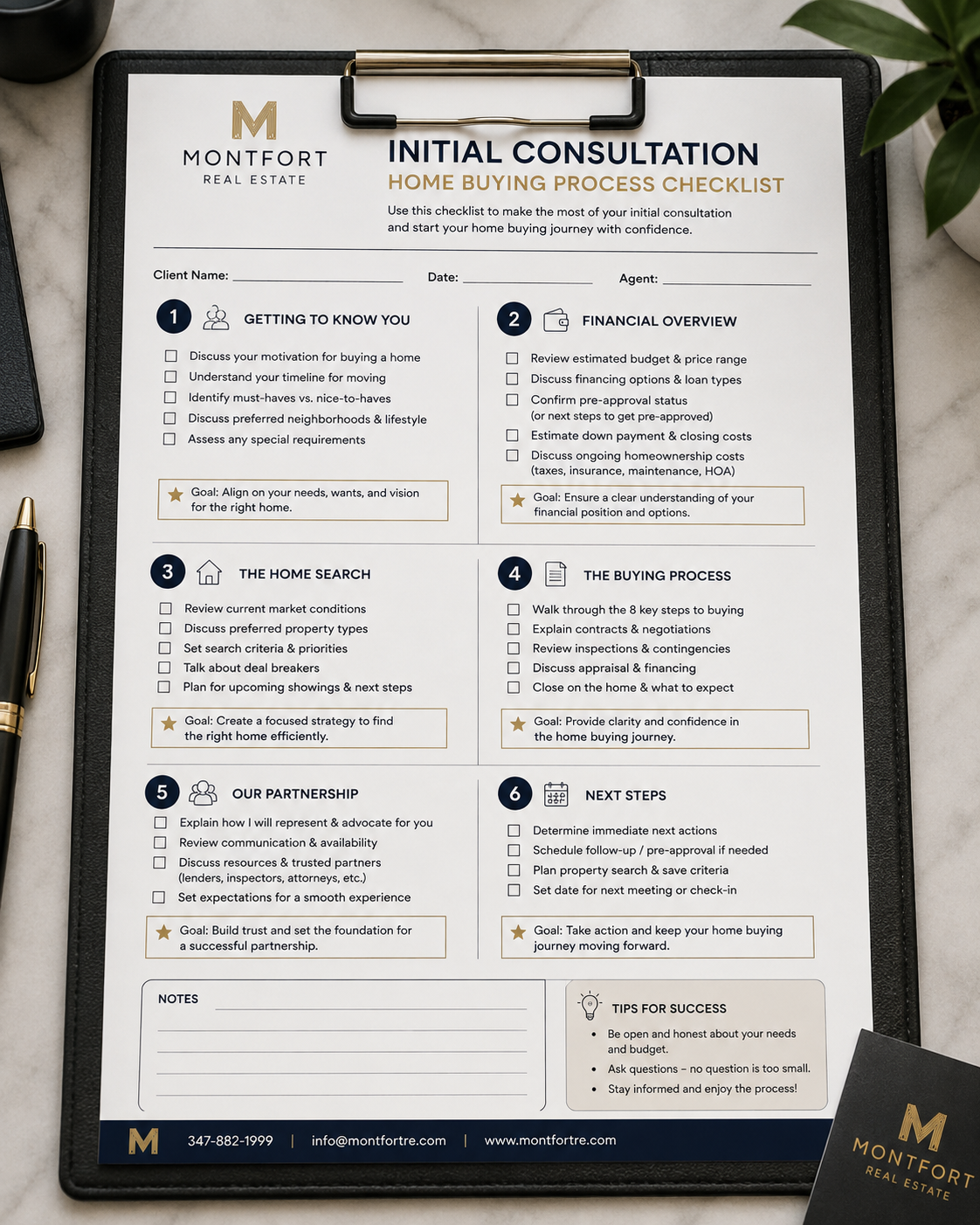
Buying a Chelsea Townhouse
One of the first things I review when evaluating a Chelsea townhouse is the property's legal configuration - not its staging or listing photography. A savvy agent should be able to assess a property's zoning envelope, confirm the Certificate of Occupancy matches the property's current use, and flag discrepancies that could affect financing, insurance, or resale.
Beyond asking price and square footage: Physical inspections for townhouses should be more extensive than for typical apartments. I coordinate structural, mechanical, and façade assessments that cover foundation condition, roof integrity, plumbing age, electrical capacity, HVAC performance, window condition, and waterproofing - areas where hidden costs routinely surprise unprepared buyers.
Legal configuration review: A townhouse that physically appears to be a single-family home may carry a multifamily or mixed-use CO. That distinction affects everything from mortgage terms to tax treatment to what you're legally permitted to do with the property.
Comparable sales analysis: There are currently 2 townhomes listed for sale in Chelsea, and new listings for townhouses appear frequently - but the transaction pool remains thin. According to recent Redfin data, active Chelsea townhouse listings have carried a median listing price near $3.2 million with approximately 97 days on market. I build negotiation strategy around highly comparable closed sales, not neighborhood medians that blend condos, co-ops, and townhouses together.
Competing alternatives: Chelsea townhouse buyers may also be considering large condos or lofts. I help you weigh private entrance, outdoor space, building control, and renovation flexibility against the amenities, lower maintenance burden, and potentially newer systems offered by condo alternatives.
Selling a Chelsea Townhouse
When selling a high-value property, expertise is essential. Positioning a Chelsea townhouse for sale requires understanding not just what it is, but what it competes against - and who the realistic buyer pool includes.
Accurate valuation from comparable townhouse transactions: In the Manhattan 2025 Mid-Year Townhouse Report, 151 townhouse transactions closed in the first half of 2025 - an 11% increase over 2024 - but average sale price declined 18% to $6.3 million, and price per square foot dropped roughly 6% to about $1,245 across Manhattan. Chelsea, however, saw average sale prices nearly double due to a few high-value trades. These swings illustrate why sellers need property-specific valuation, not headline averages.
Pre-listing preparation: Before recommending an asking price, I assess condition, documentation, and market competition. Resolving open DOB violations, producing final inspection records, confirming LPC compliance for any exterior work, and documenting permitted renovations all strengthen your position with qualified buyers.
Marketing to the right buyer pool: A significant portion of prime Manhattan townhouse sales occur off-market. Stanley Montfort's approach includes both public listing exposure and targeted outreach to buyers actively searching for Chelsea townhouses - including those who may not be monitoring standard search results.
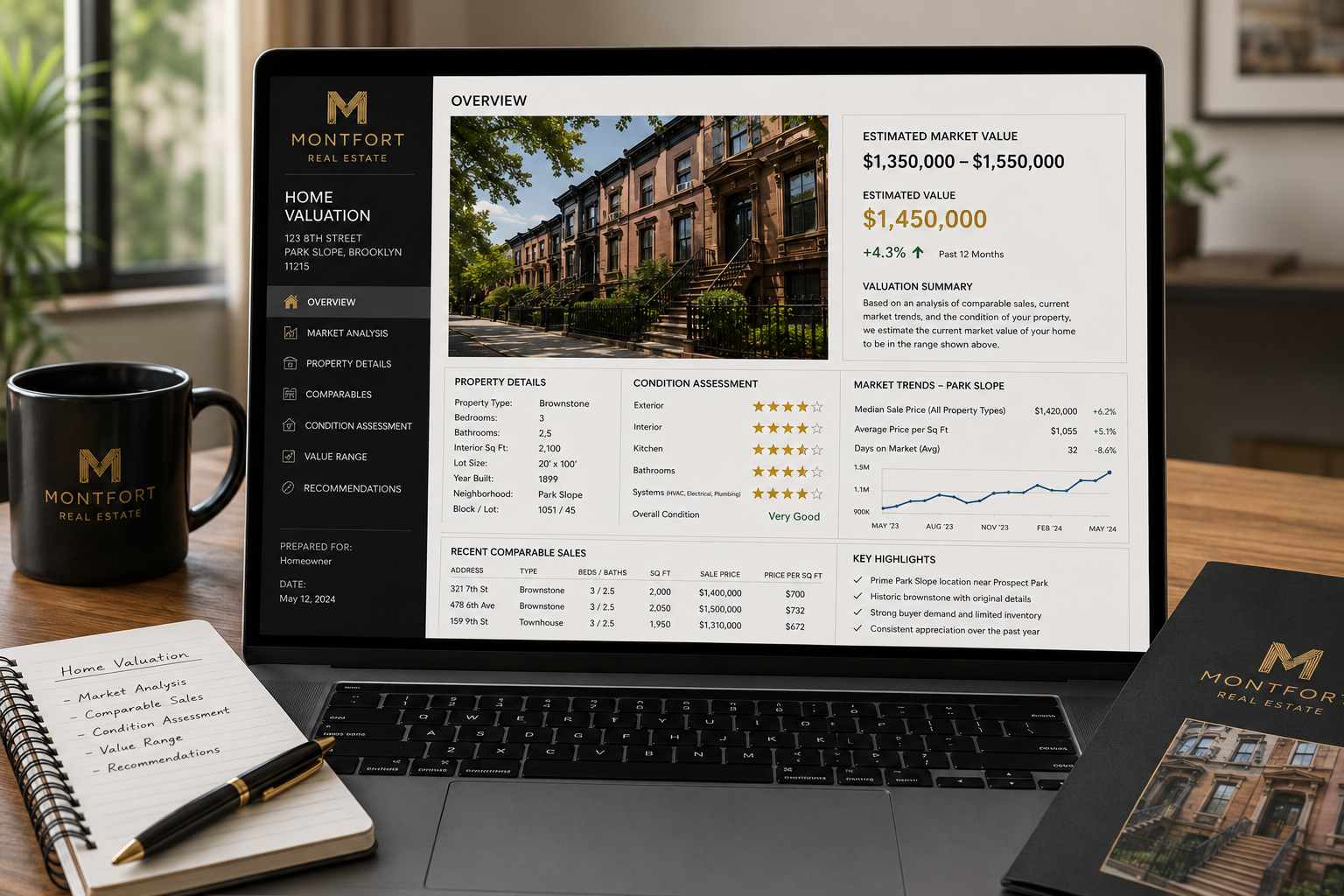
Chelsea Townhouse Valuation
Price per square foot is a useful reference point, but it should never serve as the primary valuation methodology for a Chelsea townhouse. Two properties reporting similar square footage can justify substantially different prices based on width, lot depth, legal configuration, renovation quality, outdoor space, and location within Chelsea.
Width, depth, and lot dimensions: A 20-foot-wide townhouse with 50 feet of depth functions very differently from a 16-foot-wide property with the same reported square footage. Width affects room scale, hallway circulation, staircase options, light from side exposures, and rear garden potential.
Legal use verification: Whether a property is documented as single-family, two-family, or mixed-use directly affects its buyer pool, financing options, income potential, and market value. I verify CO status before any valuation recommendation.
Renovation quality assessment: A qualified broker should help identify issues concerning aging infrastructure - including outdated plumbing, knob-and-tube wiring, compromised waterproofing, and deferred façade maintenance - that expensive interior finishes may obscure.
Air rights and buildable area: Chelsea townhouses often carry unused floor area ratio or air rights. The 462 West 23rd Street sale at $12.5 million illustrated this clearly: at roughly 5,808 built square feet the price equated to approximately $2,152 per square foot, but when total buildable area including air rights was considered, the effective cost dropped to approximately $1,917 per square foot. Understanding these calculations matters for both buyers evaluating potential and sellers positioning value.
Chelsea Townhouse Due Diligence Process
Due diligence on a Chelsea townhouse goes well beyond a standard home inspection. The process should cover legal records, physical condition, building systems, landmark status, and realistic market positioning. Due diligence should include checks for open permits, code infractions, and title searches before proceeding to contract.
Property Records and Legal Configuration Review
Certificate of Occupancy verification: NYC requires a CO for any building reflecting its legal use, number of dwelling units, and means of egress. Buildings constructed before 1938 may not have a CO unless subsequently altered - in which case a Letter of No Objection may be required. Without proper documentation, financing, insurance, and resale can all be negatively impacted.
Building permits and renovation documentation: I review permit history to confirm that renovations were properly filed, inspected, and signed off. Unpermitted work creates legal risk and lender complications.
Historic district and landmark status confirmation: Properties within the Chelsea Historic District or West Chelsea Historic District are subject to LPC controls. Your agent must understand LPC rules for exterior changes and renovations - and confirm whether any previous work received required approvals.
Building and Systems Inspection
Structural, mechanical, and façade condition: Foundation integrity, load-bearing walls, masonry condition, roof membrane, plumbing risers, electrical panels, boiler and HVAC systems, windows, and waterproofing all require evaluation. One mistake I frequently see townhouse buyers make is accepting a home inspection report designed for apartments or suburban houses - these rarely cover the full scope of townhouse-specific concerns.
Renovation quality evaluation: Distinguishing cosmetic renovation from comprehensive building modernization requires looking behind the finishes. Has the plumbing been replaced or just the fixtures? Are the electrical circuits rated for modern loads? Is the HVAC system centrally ducted or relying on window units hidden behind millwork?
Outdoor space and lot condition: Gardens, terraces, and roof decks can differentiate a Chelsea townhouse from apartment alternatives - but their value depends on privacy, accessibility from primary living areas, surrounding building heights, light exposure, and structural capacity for intended use.
Market Analysis and Negotiation
Comparable townhouse sales: At 304 West 18th Street, a single-family townhouse sold for $4,775,000 - 3,363 square feet at approximately $1,419 per square foot. Compare that to 462 West 23rd Street at $12.5 million and roughly $2,152 per built square foot. These transactions illustrate how location, width, condition, and scale produce dramatically different price points even within the same neighborhood.
Competition assessment: I analyze active townhouse competition alongside relevant condo and loft alternatives. If a buyer can acquire 3,000 square feet in a full-service Chelsea condo with amenities and no maintenance responsibility, the townhouse must justify its premium through private entrance, outdoor space, building control, and architectural character.
Negotiation and closing coordination: Your realtor needs to ensure a strong negotiation strategy tailored to Manhattan - one that reflects the specific property, its realistic buyer pool, and the leverage available based on competing inventory and market timing.
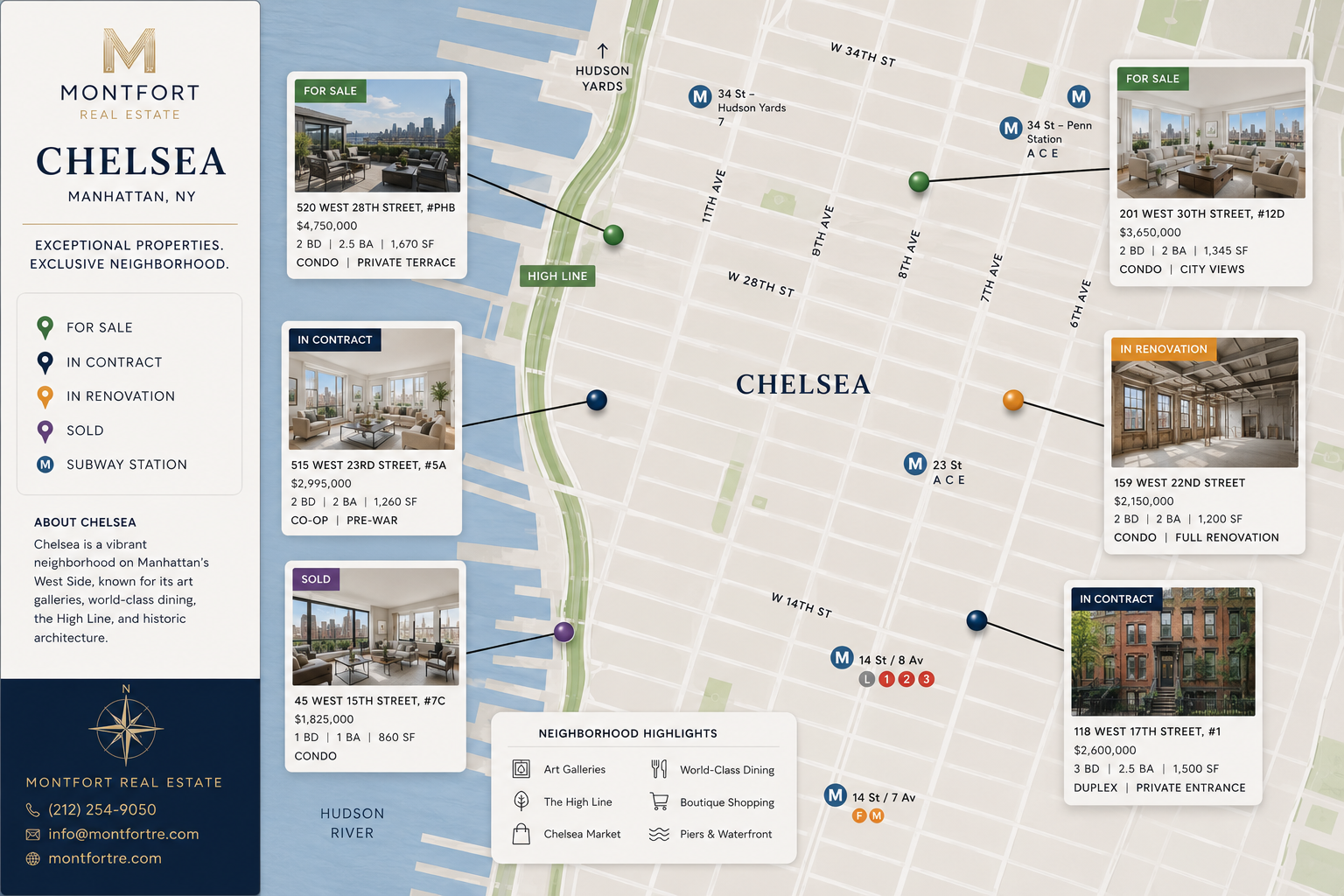
Chelsea Townhouse Market by Location
Chelsea is not one uniform townhouse market. In Chelsea, specific knowledge matters for differences in landmark status, pricing, and potential - and those differences can shift block by block.
East Chelsea - closer to Sixth Avenue and the Flatiron border - tends to feature older, sometimes narrower rowhouses on quieter cross-streets. Many of these properties sit within the original Chelsea Historic District designated in the 1970s, which places them under LPC exterior controls. Buyers here often find architectural integrity in original stoops, cornices, and ironwork, but should budget for landmark-compliant restoration and maintenance.
West Chelsea - extending toward Tenth and Eleventh Avenues - includes a broader mix of townhouse types. Chelsea has a mixture of townhouses and converted factories, and the western blocks reflect that variety. Proximity to the High Line - a popular elevated park in Chelsea - and Hudson River Park and Chelsea Piers has increased buyer interest and development pressure, which can affect both surrounding building heights and property values. The West Chelsea Historic District introduces additional landmark controls for properties within its boundaries.
Street-by-street patterns: Wider townhouses tend to appear on major cross-streets, while narrower rowhouses line some of the mews-style blocks. Demand generally clusters on quiet mid-block streets with rear gardens and strong rear light and air. Proximity to avenues can increase foot traffic and commercial energy - valuable for mixed-use properties, potentially less desirable for single-family buyers seeking privacy.
Chelsea is known for its vibrant dining and nightlife scenes. Chelsea Market features a variety of boutique shops and eateries. Chelsea is also a cultural hub for the arts and LGBTQ community. These neighborhood characteristics contribute to sustained buyer demand across property types - but as a Chelsea townhouse realtor, my job is to connect those qualities to specific property values and buyer expectations rather than treating them as generic selling points.
As of June 2026, the median home sale price in Chelsea broadly was approximately $1.5 million - up roughly 35% year-over-year - while median price per square foot was about $1,638, a decline of approximately 4.9% from the prior year. But those figures blend condos, co-ops, and townhouses. Chelsea townhouse sales frequently exceed these neighborhood-wide medians substantially, which is why I rely on townhouse-specific comparables rather than broad market results.
Single-Family vs. Multifamily Chelsea Townhouses
Not every Chelsea townhouse buyer wants the same configuration, and the distinction between single-family and multifamily use affects nearly every aspect of the transaction.
Single-family townhouses offer the greatest degree of privacy and floor-plan continuity. There's one entrance, one kitchen, one staircase connecting all floors - and the entire property functions as a unified home. Financing typically resembles a conventional residential mortgage. The buyer pool trends toward families, professionals, and end-users who value private outdoor space and full building control. These properties often command a premium per square foot because the buyer is paying for exclusivity and lifestyle rather than income potential.
Multifamily townhouses - legally configured as two-family, three-family, or more - include separate dwelling units that may be rented. Valuation must account for rental income, tenant history, rent regulation status, and legal unit documentation. Financing terms may differ, and lenders will evaluate income potential alongside the borrower's qualifications. Multifamily properties can be attractive to buyers seeking to offset carrying costs or to investors, but they require more complex due diligence around legal configuration and tenant rights.
Conversion considerations: Some buyers purchase a multifamily townhouse with plans to convert it to single-family use - or vice versa. Either direction requires CO amendments, permits, and potentially LPC approval if the property sits within a historic district. I help buyers understand realistic conversion costs, timeline, and regulatory requirements before they commit to a strategy that may not be feasible or cost-effective.
Resale positioning: When direct townhouse comparables are limited, understanding how single-family and multifamily properties compete against each other - and against large condos and lofts - becomes critical. A multifamily townhouse priced as a single-family home may sit on the market; a single-family townhouse marketed without emphasizing its privacy and layout advantages may lose buyers to newer condos with amenities.
Frequently Asked Questions About Chelsea Townhouses
How are Chelsea townhouses valued differently than condos?
Chelsea townhouses are valued through highly comparable townhouse transactions, not broad neighborhood averages or the PPSF metrics commonly applied to condos. Width, building depth, lot dimensions, legal configuration (single-family vs. multifamily vs. mixed-use), renovation quality, building systems condition, outdoor space, and landmark status all influence value in ways that don't apply to apartment sales. Because townhouse inventory is thin - there are currently only 2 townhomes listed for sale in Chelsea at any given time, and overall active listings have recently hovered around 17 - each comparable sale carries significant weight. Mechanically applying the neighborhood median of $1,638 per square foot to a townhouse would ignore the specific characteristics that drive its actual market value.
What should I look for when buying a renovated Chelsea townhouse?
Look past the finishes. A beautifully renovated kitchen means little if the plumbing behind the walls is 80 years old or the electrical service can't support central air conditioning. I evaluate building systems - plumbing, electrical, HVAC, roof, façade, windows, waterproofing - and verify that renovation work was properly permitted, inspected, and signed off. In Chelsea's historic districts, confirm that any exterior changes received LPC approval. Unpermitted work can result in fines, required remediation, or complications at the time of your own resale.
How long does it take to sell a Chelsea townhouse?
Market timing depends heavily on property condition, pricing accuracy, and legal clarity. Recent data shows Chelsea townhouse listings averaging approximately 97 days on market. Properties that are priced accurately based on comparable townhouse sales, present clean documentation (CO, permits, inspections), and show well-maintained systems tend to sell faster. Overpriced or poorly documented properties can sit considerably longer, especially when buyers can compare against move-in-ready condos or lofts with fewer unknowns.
What are the costs of owning a Chelsea townhouse?
Unlike condos and co-ops, a townhouse owner bears 100% of building maintenance - there are no common charges or shared reserves. Property taxes, building insurance, façade maintenance (especially critical for older brownstones), roof replacement, boiler service, plumbing repairs, electrical upgrades, window restoration, garden upkeep, and potential landmark-compliant exterior work all fall on the owner. These carrying costs can be substantial, and I help buyers model realistic annual expenses before making an offer. Comparing total ownership cost against a comparable condo - where monthly common charges cover many of these items - is an important step in determining which property type fits your budget and lifestyle.
Get Expert Chelsea Townhouse Representation
Whether you're beginning a search for Chelsea townhouses for sale, preparing to list your brownstone or rowhouse, or need a realistic valuation before making any decisions, Stanley Montfort provides the specialized townhouse expertise this market demands. Every Chelsea townhouse is different - and your representation should reflect that.
Phone: 1-646-970-1078 Email:[email protected] Address: 8 West 126th Street, New York NY 10027
Recent News & Realtor Advice
Stay in the loop on the latest events, news, & happenings in and around our community!
Upper West Side Townhouse Q2 2024 Market Report
On the Upper West Side, we observed a distinct trend that diverges from the citywide patterns. Speci…
Harlem Brownstone Q2 2024 Market Report
The Harlem brownstone market has seen an increase in sales activity since this time last year. In Q2…
Discover Your Dream Home: Explore Apartments for Sale on the Upper West Side
Are you searching for your dream home in one of New York City’s most sought-after neighborhoods? Loo…