
Crown Heights SROs — Expert Guidance for Buyers, Sellers & Investors
We'll help you invest in the right Crown Heights SRO by identifying properties with strong potential while avoiding compliance, maintenance, and violation issues.
SMOOTH TRANSACTION
With limited risk throughout the buying process.
NO PRESSURE
No pressure to overpay or purchase within a specific timeframe.
ONGOING SUPPORT
A dedicated team that remains available even after the transaction is complete.
Crown Heights SRO Buying Guide: Expert Investment Strategies for Brooklyn's Single Room Occupancy Properties
Expert SRO Investment Guidance from Brooklyn's Premier Buyer's Agent
Buying an SRO property in Crown Heights is very different from buying a traditional townhouse, condo, or multifamily building. Before you even think about purchase price or rental income, you need to understand how the property is legally classified, what restrictions apply, and whether your long-term plans are actually possible.
One of the biggest mistakes I see investors make is assuming every SRO offers the same opportunities. In reality, each property has its own regulatory history, tenant situation, and renovation limitations. That's why due diligence is far more important than simply finding a good price.
I'm Stanley Montfort, and I help real estate investors and owner-occupants evaluate SRO opportunities throughout Brooklyn. If you're considering a Crown Heights SRO as an investment, a live-in purchase, or a house hacking strategy, you need a clear read on property type, regulatory compliance, financing hurdles, tenant rights, legal restrictions, common buying mistakes, and how to judge whether a building is actually viable before you make an offer. My role is straightforward: I help you find legitimate opportunities, navigate NYC's layered housing regulations with confidence, and avoid the costly mistakes that catch unprepared buyers off guard in one of Brooklyn's most dynamic and tightly regulated neighborhoods.
Ready to explore SRO investment opportunities in Crown Heights?
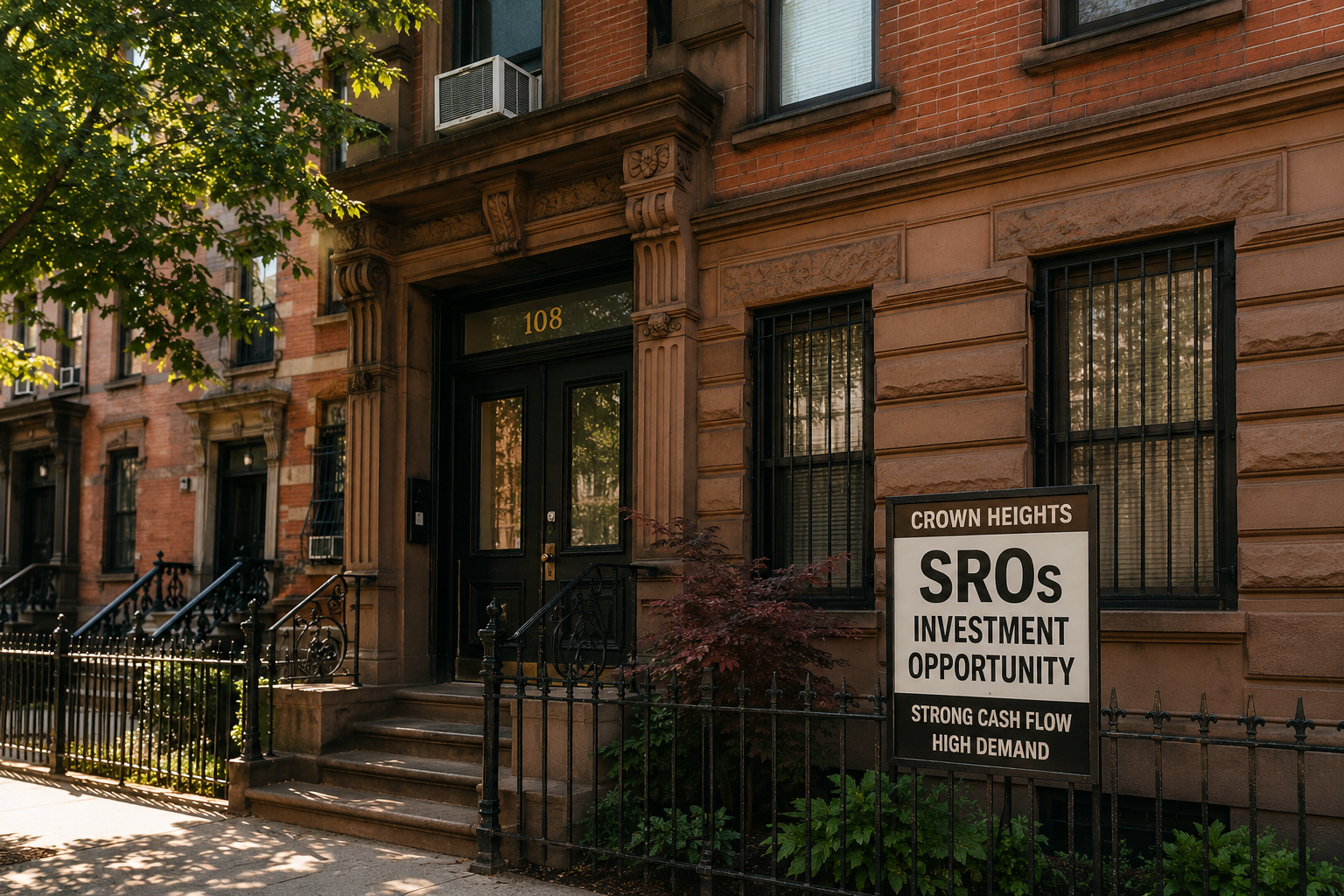
Why Crown Heights SROs Are Attractive Investment Opportunities
Single Room Occupancy properties have a long standing history in New York City's housing ecosystem. Under NYC Administrative Code § 28-107.2, an SRO Multiple Dwelling is defined as a Class A multiple dwelling used as a rooming house or for single room occupancy under the state's Multiple Dwelling Law, or a Class B multiple dwelling. These aren't transient hotel rooms - they're residences for permanent occupancy, typically stays of 30 days or more, governed by strict regulations covering everything from minimum room sizes to fire safety systems.
SROs exist because New York City has always needed affordable housing options for individuals - students, service workers, people in transition. Many SRO seekers are looking for affordable private rooms with shared common areas, and Crown Heights has Single Room Occupancy supportive housing options that serve specific populations. Many existing SRO units are operated by nonprofits or supportive housing organizations, and SROs often include housing designated as supportive housing for specific populations. Supportive housing offers low-income families stable living conditions, though waiting lists for supportive housing are currently closed.
Why Crown Heights Specifically?
Crown Heights offers a combination of factors that make SRO properties particularly interesting:
Transit Accessibility: With access to the 2, 3, 4, and 5 subway lines, Crown Heights connects residents to Manhattan in under 30 minutes - close enough that some tenants head to a broadway show after work without a second thought. This transit access drives consistent rental demand.
Neighborhood Evolution: Crown Heights is undergoing significant gentrification, with median sale prices for residential properties reaching approximately $990,000 and price per square foot running $900–$1,000. Rental demand is strong, with rent growth of approximately 13.6% year-over-year.
Multiple Income Streams: When multiple small units are rented individually, you have less vulnerability to complete vacancy. One tenant leaving doesn't eliminate your entire rental income.
Owner-Occupant Potential: Some buyers live in one unit (or a portion of the building) and rent out the rest - a legitimate house-hacking strategy, provided you understand the legal restrictions around occupancy, common spaces, and mixed-use rules.
Demand for Affordable Housing: Young professionals, students, and people in transition consistently need lower-cost single-occupancy housing in transit-rich neighborhoods. Traditional SROs often face long waiting lists due to high demand and limited supply, which speaks to the depth of demand in this market.
That said, Crown Heights has limited availability of legal SRO units. Traditional unregulated SROs are generally prohibited from being newly built in NYC, which means the existing inventory is finite and protected under multiple layers of regulation.
Our SRO Buyer Advisory Services
Crown Heights Investment Property Evaluation
When evaluating an SRO property, I conduct a comprehensive analysis that goes well beyond what you'd do for a standard Brooklyn townhouse or condo purchase. This includes:
Regulatory Compliance Review: Verifying SRO classification through DOB and HPD records, confirming Certificate of Occupancy status, and checking whether the building falls under any exceptions to SRO designation (such as buildings erected after May 5, 1983, or those lawfully altered to no longer meet SRO criteria).
Financial Projections: Building realistic cash flow models that account for rent stabilization limits, shared facility maintenance costs, higher tenant turnover, compliance expenses (sprinkler maintenance, permit fees, inspections), and vacancy constraints under applicable rent regulations.
Market Comparables and Pricing: SRO properties rarely appear on MLS - many are off-market or listed under different zoning classifications. I help buyers identify opportunities through community referrals, HPD portfolios, and distress sales, then develop competitive pricing strategies based on actual SRO-specific factors rather than generic residential comparables.
Owner-Occupant SRO Guidance
For buyers interested in living in a Crown Heights SRO while renting out remaining units, I provide guidance on:
House Hacking Strategies: How to structure your living arrangement legally while maximizing rental income from remaining units.
Tenant Rights and Landlord Responsibilities: SRO residents often have rent stabilization or similar protections. Understanding your obligations - from maintaining shared bathrooms and kitchens to meeting sanitation standards - is essential before you buy, not after.
Long-Term Ownership Planning: Including realistic assessments of potential conversion considerations, which are far more restricted than most buyers realize.
Types of Crown Heights SRO Properties and Opportunities
Crown Heights offers a range of SRO property types, each with distinct characteristics:
Historic Brownstones Converted to SRO Use: Many of Crown Heights' most architecturally significant buildings have SRO histories. For example, 859 St. Marks Avenue was built in the 1890s and the property was converted to a multiple dwelling in 1954. Henry B. Moore built five limestone dwellings on St. Marks Avenue, and the original architect was Herbert R. Brewster. The house was sold for $865,000 in 2011 - a figure that offers perspective on how dramatically Crown Heights property values have shifted.
Multi-Family Buildings with Established Tenant Base: Properties with existing SRO certificates and long-term tenants provide immediate income but require careful review of lease agreements, rent stabilization status, and interior condition of shared facilities.
Mixed-Use Properties: Some SRO buildings combine residential units with commercial space on the ground floor, offering diversified income streams along corridors like Nostrand Avenue or near broadway-adjacent commercial strips.
Owner-Occupied SRO Buildings: Properties where the buyer can live in one unit while renting the rest - though this requires understanding both residential and SRO-specific landlord obligations.
Properties Requiring CONH Compliance: Buildings where any planned renovation, conversion, or alteration triggers Certificate of No Harassment requirements. One of the first things I review is whether CONH will apply to a buyer's intended plans.
Buildings with HPD Oversight: Properties in the Alternative Enforcement Program or with appointed Article 7-A administrators require heightened scrutiny and affect both financing and future renovation options.
Transit-Adjacent Properties: SRO buildings near Crown Heights' major subway stations command premium rents and lower vacancy rates - critical factors in a property type where per-unit income is already modest.
Properties with Potential Legal Conversion Opportunities: Some buildings may qualify for legal conversion or expansion, but this depends entirely on applicable NYC laws, HPD requirements, DOB approvals, and zoning compliance. I never encourage clients to assume conversion is possible without thorough legal analysis. Legally existing SROs require a Class B Certificate of Occupancy to be recognized, and any change to that classification triggers extensive regulatory review.
Our SRO Property Buying Process
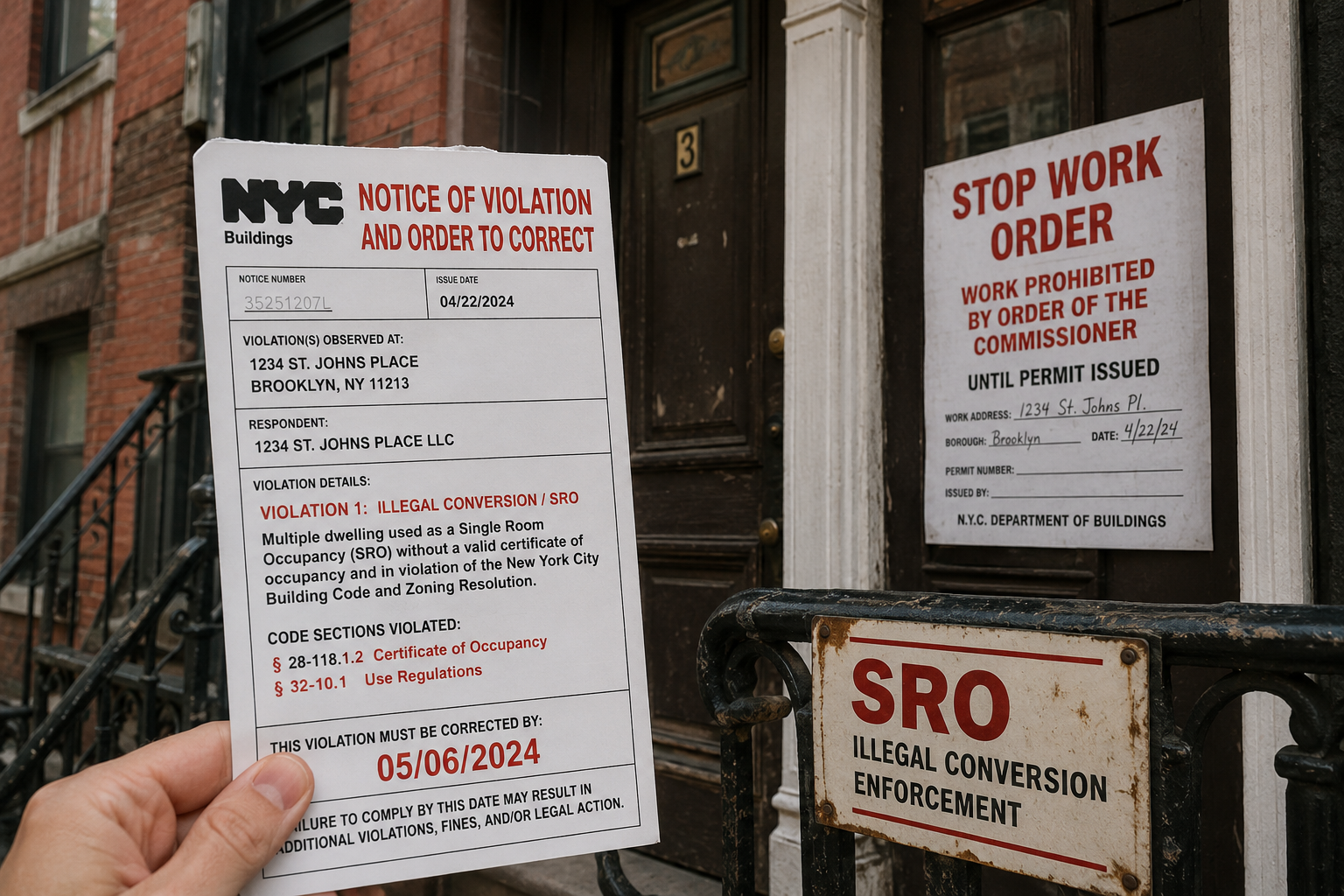
Step 1: Initial Property Assessment and Regulatory Review
Before spending a day analyzing financials, I start with the regulatory foundation:
Verify SRO Status: I review DOB and HPD records to confirm the building's legal classification - whether it's a Class A multiple dwelling used for SRO purposes or a Class B multiple dwelling. I check whether the building was lawfully altered after 1983 and whether it falls under any statutory exceptions.
Evaluate Tenant Protections: SRO units are often subject to rent stabilization under the Hotel Orders administered by the NYC Rent Guidelines Board. These orders set lease terms, allowable increases, and vacancy rules that directly impact your investment returns. One question I always encourage clients to ask is whether the units are rent stabilized or under RGB hotel order, and what the vacancy allowance is.
Assess CONH Requirements: Under NYC law, a Certificate of No Harassment is required before the DOB approves permits for certain categories of work in SRO multiple dwellings - including demolition, conversion from SRO to other occupancy, adding or removing kitchens or bathrooms, altering unit configuration, or changing the number of dwelling units.
Step 2: Financial Analysis and Due Diligence
Rental Income Analysis: I analyze current rental income against realistic expense ratios. Pro forma models must factor in higher maintenance for common areas, heavier usage of shared bathrooms and kitchens, compliance costs, and potential vacancy constraints under rent stabilization.
Financing Review: Lenders are wary of SRO financing due to regulatory risk and cash flow variability. Terms are often stricter - larger down payments, reserves for compliance, and proof of legal SRO status. I help clients explore traditional banks, alternative lenders, and subsidized housing programs including Section 8 / CoC Mod SRO programs where utility allowances can improve net cash flow.
Building Inspection: SRO-specific inspections focus on fire safety (sprinklers in halls and rooms per § 29-01 of NYC Rules), plumbing and electrical systems, HVAC (shared water heaters), windows, mold, pests, and the condition of shared kitchens and bathrooms. A mistake I frequently see investors make is failing to budget for shared facility infrastructure - if kitchens or bathrooms are shared, usage is heavier, cleaning or upgrades cost more, and compliance must meet stricter code.
Step 3: Legal and Regulatory Compliance Verification
Attorney Coordination: Before making an offer on an SRO, I engage with an attorney familiar with MDL § 248 and HPD's CONH rules, along with a DOB-specialist architect to map out required alterations.
Documentation Review: I verify all required permits, certificates, and regulatory documentation - including checking for any HPD violations via HPDOnline, 311 complaints, prior code enforcement actions, or 7-A involvement. These histories directly affect CONH eligibility.
Tenant Lease Review: Are rents legal under existing regulations? Are tenants paying utilities? What are turnover rates? These details apply directly to your investment returns and management obligations.
Step 4: Offer Strategy and Closing Support
Competitive Offer Development: SRO pricing follows different logic than standard residential sales. I develop offer strategies based on SRO-specific market factors - regulatory burden, tenant composition, compliance costs, and realistic income projections.
Protective Contract Terms: I negotiate contingencies tied to zoning, Certificate of Occupancy verification, and code compliance to protect buyers from regulatory surprises that could surface after closing.
Closing Coordination: The closing process for an SRO property involves regulatory considerations that don't apply to conventional purchases. I coordinate with attorneys, lenders, and city agencies to ensure nothing is overlooked.
Common SRO Buying Mistakes and How to Avoid Them
Many buyers assume they can purchase an SRO building in Crown Heights and freely convert, renovate, or reconfigure units. Here are the most expensive mistakes I see:
Assuming Conversion Is Straightforward: Converting SRO units to regular apartments is heavily scrutinized and often blocked unless all building, zoning, safety, and CONH requirements are met. A Crown Heights landlord attempted to remove kitchens in some units to convert entire floors to common space; DOB flagged it as a covered category under CONH for SRO MDs, and without an approved CONH, permits were denied. Supportive SROs often require referrals through city agencies or nonprofits, adding another layer of complexity.
Underestimating Tenant Protections: SRO tenants often have protected status under rent stabilization or RGB hotel orders. Expecting to raise rents aggressively after purchase will lead to frustration and potential legal liability.
Ignoring CONH Requirements: HPD's updated CONH rules for SRO MDs have increased scrutiny. Buildings with histories of distress or high turnover face tougher review. HPD may determine "reasonable cause to believe harassment occurred" during the applicable inquiry period, which can deny the certificate entirely - blocking your renovation plans.
Overlooking HPD Violations: When evaluating an SRO property, I always order the HPD and DOB violation history for the last 5–10 years. Patterns of harassment complaints, vacate orders, or Alternative Enforcement Program inclusion will affect both CONH eligibility and financing.
Inadequate Financing Preparation: Some lenders will reject loans if there's any appearance of violation or non-conformity. Others charge penalties or require escrowed reserves. A buyer inspected an SRO building that lacked proper sprinkler heads in shared halls; during financing due diligence, the bank required full installation per § 29-01, costing tens of thousands of dollars.
Not Budgeting for Ongoing Compliance: Annual lease renewals, occupancy verification for subsidized tenants, shared facility maintenance, fire safety system inspections, and HPD reporting requirements create administrative burdens that standard landlords don't face. The Arches rental starts at $4,000 for 15 hours and adding the Courtyard costs an additional $750 - pricing varies by day and season for event spaces - which illustrates how even commercial uses within Crown Heights properties involve layered cost considerations.
Client Success Stories
"Stanley helped us find and purchase a multi-unit SRO on Nostrand Avenue that other buyers had passed on because of its regulatory complexity. His due diligence process identified that the building had a clean CONH history and stable rent-stabilized tenants - exactly what we needed for predictable cash flow. We closed with confidence."
- Marcus T., Crown Heights Investor
"As first-time buyers in Brooklyn, we wanted to house-hack an SRO property but had no idea how the regulations worked. Stanley walked us through every step - from verifying the Certificate of Occupancy to understanding our responsibilities as landlords of shared-facility units. We now live in one unit and rent out four others."
- Dana & Chris R., Owner-Occupants, Crown Heights
"We nearly purchased an SRO building near the Franklin Avenue site without realizing it had been in HPD's Alternative Enforcement Program. Stanley's violation history review uncovered the issue before we made an offer, saving us from a property where CONH approval would have been nearly impossible."
- Alicia P., NY Real Estate Investor
"Our SRO purchase near the Crown Heights 2/5 train station has been one of our best investments. Stanley's financial modeling was realistic about rent stabilization limits and shared facility costs, so we knew exactly what to expect from day one."
- James & Lori K., Brooklyn Property Investors
Frequently Asked Questions
Can I convert an SRO property to regular rental apartments?
Many buyers assume an SRO purchase comes with conversion potential. In reality, converting SRO units is one of the most heavily regulated processes in NYC real estate. Any alteration that changes unit configuration, adds or removes kitchens or bathrooms, or modifies the number of dwelling units requires a Certificate of No Harassment from HPD before DOB will approve permits.
A property owner in Crown Heights sought to upgrade an SRO to luxury micro-apartments; plans were rejected due to community board zoning resolution, the definition of permanent residency under MDL § 248, and failure to secure CONH. Before assuming any conversion is possible, work with an experienced real estate attorney and DOB-specialist architect who can view the property's specific regulatory constraints.
What financing options are available for SRO properties?
Financing an SRO is more challenging than financing a conventional multi-family property. Traditional banks require certified SRO status, a clean Certificate of Occupancy, stable income documentation, and often prior experience with regulated housing. Down payment requirements are typically larger, and lenders may require escrowed reserves for compliance costs.
Alternative lenders and private equity sources are more willing to finance smaller SROs but charge higher interest rates with shorter terms. Subsidized housing programs - including HPD payment standards and Section 8 / CoC Mod SRO programs - can improve net cash flow through utility allowances for heat, hot water, gas cooking, and electricity. Equity partners or syndication structures may also make sense given higher initial compliance and upgrade costs.
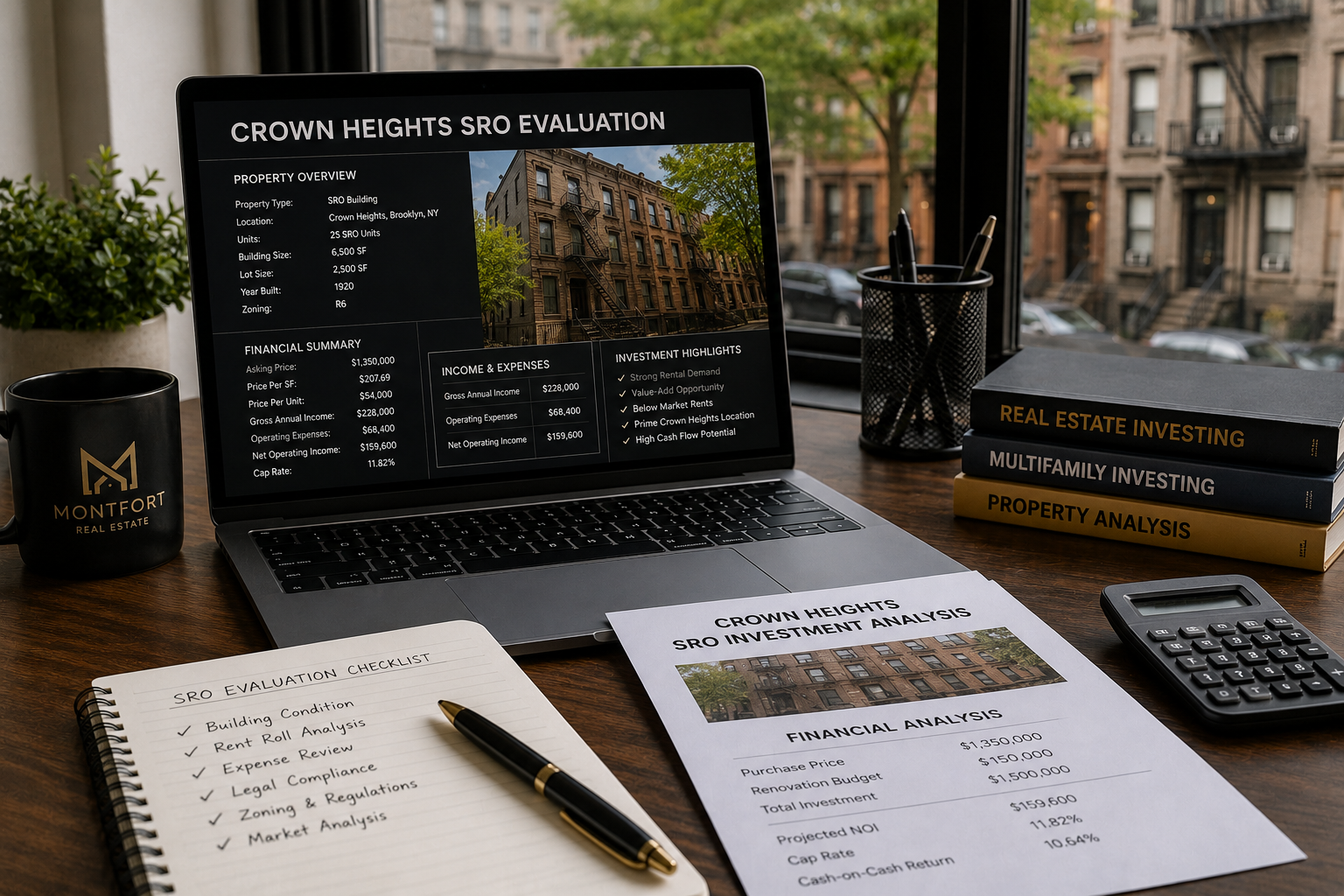
How do I evaluate the income potential of an SRO property?
Start by understanding whether units are rent stabilized or governed by RGB hotel orders. Stabilized units have legally limited rent increases - there have been proposals to permit vacancy increases of approximately 20% upon vacancy of SRO units, but these rules change. Your cash flow model must account for:
Rent stabilization caps on annual increases
Higher tenant turnover typical in SRO buildings
Shared facility maintenance costs (bathrooms, kitchens, common areas)
Compliance expenses (sprinkler maintenance, inspections, permit fees)
Potential vacancies limited by leasable unit constraints
Median rents across Crown Heights hover around $3,750/month for standard apartments. SRO units command less individually but can generate competitive building-level income when fully occupied.
What are my responsibilities as an SRO property owner?
SRO ownership carries obligations that go beyond standard landlord duties. Under MDL § 248, you must maintain compliance with regulations covering light and ventilation, minimum room sizes, hygiene and sanitation standards, property management practices (including maintaining a register of occupants), and fire safety systems including automatic wet sprinkler systems in halls and rooms.
You must also maintain shared facilities - bathrooms, kitchens, common areas - to code standards, respond to HPD inspections and enforcement actions, and comply with applicable rent stabilization or hotel order requirements. Violations can carry civil and administrative penalties, and patterns of non-compliance can affect your ability to obtain CONH for any future building work.
Contact Us
Start Your Crown Heights SRO Investment Journey Today
Purchasing an SRO property in Crown Heights requires significantly more due diligence than buying a traditional Brooklyn residential property. The regulatory complexity, tenant protections, financing requirements, and building code obligations demand expert guidance at every stage.
I help buyers evaluate SRO opportunities with clear-eyed analysis of both the potential and the risks. Whether you're an experienced investor looking to add regulated housing to your portfolio or an owner-occupant exploring house-hacking strategies in one of Brooklyn's most dynamic neighborhoods, I'll guide you through every step.
Schedule a consultation to discuss your SRO investment goals and strategy
Receive personalized market analysis for Crown Heights SRO opportunities
Access my network of SRO-experienced attorneys, inspectors, and financing professionals
Phone: 1-646-970-1078 Email:[email protected]
Recent News & Realtor Advice
Stay in the loop on the latest events, news, & happenings in and around our community!
Upper West Side Townhouse Q2 2024 Market Report
On the Upper West Side, we observed a distinct trend that diverges from the citywide patterns. Speci…
Harlem Brownstone Q2 2024 Market Report
The Harlem brownstone market has seen an increase in sales activity since this time last year. In Q2…
Discover Your Dream Home: Explore Apartments for Sale on the Upper West Side
Are you searching for your dream home in one of New York City’s most sought-after neighborhoods? Loo…