
We’ll help you find the right Harlem co-ops while avoiding overpaying, excessive fees, and properties that don't fit your long-term goals
Smooth transaction with limited risk
No pressure to over pay and buy within a certain time period
A team of people that will be with you even after the transaction is complete
Live listing data provided by OLR IDX. Need help? Contact us or log in to your customer account.
Buying or selling a cooperative apartment in Harlem requires more than finding the right unit. Co-op transactions involve board approval, building financial analysis, maintenance charge evaluation, and buyer qualification review before a deal can close. With 419 homes currently for sale in Harlem, NY, and co-ops ranging from around $230,000 to $3,200,000, the range of buildings, board policies, and financial requirements varies block by block. Buying a co-op means purchasing shares in a corporation rather than real estate, and that distinction affects every stage of the transaction.
Stanley Montfort provides dedicated co-op buyer and seller representation across Harlem's cooperative market. His work centers on evaluating both the apartment and the cooperative corporation: maintenance charges, reserve funds, board requirements, sublet policies, flip taxes, financing limitations, and comparable sales data specific to each building. Whether you are a first-time buyer assembling a board package or a seller pricing a unit in a building with particular financial characteristics, Stanley's representation is built around the details that determine whether a Harlem co-op transaction succeeds.
Specialized experience in cooperative apartment transactions across Central Harlem, South Harlem, Hamilton Heights, Sugar Hill, and East Harlem
Stanley has never had a co-op board application rejected.
Building-level financial analysis covering reserve funds, maintenance trends, assessments, and underlying mortgage obligations
Comparable sales analysis calibrated to specific co-op buildings rather than broad neighborhood averages
Most real estate agents in Manhattan, NY treat co-ops like any other property sale. Stanley Montfort does not. His representation starts with the cooperative corporation itself, because a building's financial condition, board policies, and ownership rules shape both the purchase experience and long-term resale value.
Board-ready buyer preparation. Before recommending an offer, Stanley reviews each building's published financial requirements against the buyer's profile. Harlem co-op boards often require down payments of 20% or more, and many buildings expect gross household income at least 3 to 4 times the combined mortgage and maintenance payment. Stanley identifies buildings where a buyer's financial profile is competitive, reducing the risk of pursuing apartments that don't fit.
Building financial evaluation. One of the first things Stanley reviews when evaluating a Harlem co-op is the building's audited financial statements. Reserve fund benchmarks matter: buildings with less than 3 months of operating expenses in reserves are considered financially weak, while those with 6 to 12 months are strong. Stanley examines maintenance increase history, special assessment records, underlying mortgage liability, and capital project pipelines to give buyers a complete picture.
Sublet and ownership policy analysis. Sublet restrictions are common in Harlem co-ops. A building with a two-year ownership requirement before subletting and a cap on the number of units that can sublet at any time may be ideal for an owner-occupant but poorly suited for a buyer seeking rental flexibility. Stanley evaluates these policies as part of the ownership proposition.
Seller pricing grounded in building-specific data. Before recommending an asking price, Stanley reviews recent same-building sales, competing units, the building's maintenance charges, board financial requirements, and the financial profile of the likely buyer pool. Pricing a co-op based solely on neighborhood-wide price-per-square-foot averages can misrepresent value when the building itself has characteristics that narrow or expand demand.
Stanley Montfort provides co-op representation structured around the specific requirements of cooperative ownership in Harlem. Harlem has a mix of conventional co-ops and income-restricted HDFC co-ops, and each building type carries different board rules, financing requirements, and buyer qualification standards.
Many buyers focus on the apartment before looking closely at the building's requirements. Stanley reverses that sequence. Before a buyer makes an offer, he evaluates:
Financial pre-qualification against building standards. Co-op boards typically require evidence of post-closing liquidity equal to 1 to 2 years of maintenance and mortgage payments. For a $1.5 million co-op with 25% down, a buyer might need $300,000 to $375,000 in gross annual household income to satisfy board and lender expectations. Stanley reviews these thresholds building by building.
Building financial health. Maintenance charges in co-ops cover building staff, property taxes, insurance, utilities, and sometimes underlying mortgage payments. Monthly maintenance fees are not uniform; two buildings on the same block can differ by hundreds of dollars per month based on staffing levels, capital needs, and financial management. Stanley reviews audited financials across multiple years to identify trends.
Board package preparation. A board package is necessary for co-op application approval. It includes tax returns, pay stubs, bank statements, proof of assets, and personal references. A realtor can assist with navigating the complexities of board packages in Harlem, and Stanley coordinates the assembly and submission process to present the buyer's financial profile as clearly and completely as possible.
Negotiation and due diligence. Co-op approval often includes a detailed financial review and interview process. Stanley's negotiation strategy accounts for building-specific factors: flip tax responsibility, assessment timing, closing cost allocation, and any conditions the board may impose.
When comparing two Harlem co-ops with similar square footage, Stanley identifies the specific factors that justify pricing differences. A seller's marketing strategy should account for:
Same-building and comparable building sales. Recent closed sales in the same co-op carry more weight than area averages. Two units with identical layouts in the same building may be priced differently based on floor level, exposure, natural light, condition, and renovation status.
Building-level factors that affect buyer pool size. Restrictive sublet policies, high flip taxes, strict financing requirements, or low reserve funds reduce the number of qualified and interested buyers. Stanley reflects these factors in pricing to avoid extended days on market.
Targeted marketing to qualified buyers. Harlem co-ops may impose strict maximum income caps based on the Area Median Income, particularly in HDFC buildings. Stanley identifies the buyer pool that meets each building's financial and eligibility criteria, then markets accordingly rather than casting a wide net that generates unqualified interest.
Transaction management through board approval. The sale does not close at contract signing. Stanley manages the process through board package review, interview scheduling, and approval, anticipating documentation requirements so that delays and surprises are minimized.

Co-op valuation is less about price per square foot and more about what buyers will pay given the total carrying cost and building characteristics. Stanley's valuation approach includes:
Building-specific comparable sales analysis weighted by recency, unit similarity, and building financial condition
Maintenance charge comparison against buildings of the same typology (prewar walk-up vs. postwar elevator, HDFC vs. market-rate)
Board policy evaluation: how sublet restrictions, flip taxes, financing requirements, and renovation rules affect resale demand
Assessment history and capital project pipeline review to identify costs that may affect near-term value
Co-op transactions involve steps that do not exist in condo or townhouse purchases. Navigating co-op boards requires specialized local expertise, and the process from first search to closing typically takes longer than other residential transactions because of board review.
Stanley begins with a review of the buyer's financial profile: income, assets, debt, and post-closing liquidity. He compares this against the requirements of buildings in the buyer's target price range and neighborhoods. Some Harlem co-op buildings require 25% down with two years of post-closing reserves; others accept 10% down but impose income restrictions. This review narrows the search to buildings where the buyer's application has a realistic chance of approval.
He also discusses maintenance charge affordability. A unit with a low purchase price but high monthly maintenance may cost more over time than a higher-priced apartment with moderate charges. Stanley models these scenarios based on the buyer's financial situation and ownership timeline.
Experienced agents know block-by-block differences in Harlem real estate, and Stanley applies that knowledge to the co-op search. For each building under consideration, he reviews:
Audited financial statements, including reserve fund balance and trend
Maintenance charge history and any current or pending special assessments
Board policies on subletting, renovation, financing, and minimum financial qualifications
Building condition: facade compliance status, elevator age, boiler system, roof condition
Unit-specific factors: apartment condition, layout efficiency, floor level, window exposure, natural light, and noise
There are currently 31 co-ops for sale in Harlem out of 102 total homes listed. Stanley helps buyers evaluate not just listing information but the underlying cooperative corporation behind each available unit.
Stanley prepares offers that account for building-specific factors. If a building has a flip tax, the offer reflects who bears that cost. If the building has an upcoming assessment, the negotiation addresses timing and responsibility.
Once an offer is accepted, Stanley coordinates the board package. This includes organizing financial statements, drafting the application narrative, reviewing reference letters, and preparing the buyer for the board interview. Each building's application format and documentation requirements differ; Stanley tailors the package to match.
Harlem's cooperative apartment market is not one market. It is dozens of individual building markets, each with its own financial profile, board culture, and ownership rules.
In Central Harlem, many buildings are prewar walk-ups, often HDFC co-ops with income restrictions, sometimes in less serviced condition but offering lower entry prices. Harlem features original architectural buildings and working fireplaces in many of these prewar structures, which attract buyers looking for character and space.
Hamilton Heights has more landmarked buildings with prewar architectural detail and strong transit access via the 1, A, C, and D lines. Co-op maintenance costs in these older structures tend to be higher per square foot due to antiquated systems, including older boilers and single-pane windows.
Sugar Hill offers large, historic residential buildings with high ceilings and architectural value, though maintenance charges sometimes reflect the cost of maintaining these features. East Harlem includes more affordable co-ops and more buildings converted under regulatory programs like the Affordable Neighborhood Cooperative Program (ANCP), which require minimum 2% annual maintenance increases and mandate third-party property management during the regulatory period.
Columbia University is located around 125th Street, and proximity to the university drives rental and purchase demand in South Harlem co-ops. Harlem has excellent subway and bus transportation systems, with the A, B, C, D, 1, 2, and 3 lines providing access to Midtown Manhattan and Downtown.
Stanley tracks sales activity, maintenance trends, and board policy changes across these areas to provide clients with building-level market intelligence rather than generic neighborhood summaries.
Central Harlem: Prewar walk-ups and HDFC co-ops, often with lower entry prices and income restrictions; inventory includes buildings with historic architectural features
South Harlem: Proximity to Columbia University drives demand; co-ops here attract buyers and investors, though sublet restrictions in many buildings limit rental use
Hamilton Heights: Landmarked prewar buildings with strong transit access; higher maintenance costs in older structures are common, offset by architectural appeal and neighborhood stability
Sugar Hill: Large residential co-ops with high ceilings and period details; maintenance charges reflect building scale and staffing
East Harlem: More affordable co-op options, including ANCP-converted buildings with regulatory requirements; strong first-time buyer demand
Co-op boards in Harlem typically require that buyers show gross household income at least 3 to 4 times the combined mortgage payment and monthly maintenance. Boards also expect post-closing liquidity equal to 1 to 2 years of housing costs. The board package includes tax returns, bank statements, pay stubs, employer verification, personal and professional references, and a completed application form. Timeline varies by building; most boards take several weeks from package submission to interview to decision. HDFC and ANCP buildings may add regulatory review, extending the timeline further. Stanley reviews each building's specific requirements before a buyer commits to an offer.
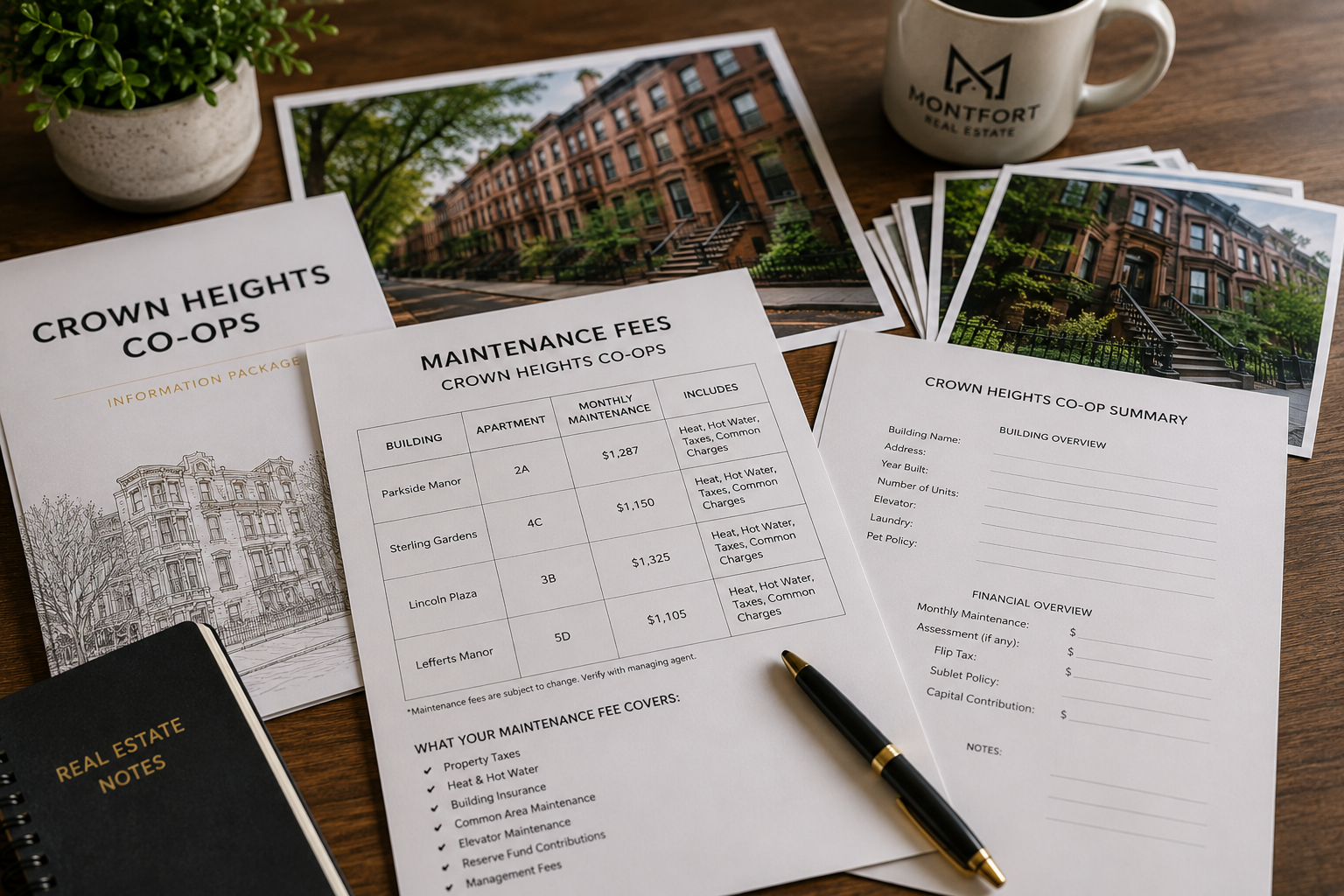
Maintenance charges directly affect monthly affordability, which determines the buyer pool size for any unit. A co-op with a $2,500 monthly maintenance payment requires a buyer who can carry that cost on top of a mortgage, so fewer buyers qualify compared to a similar unit with $1,200 maintenance. Lower maintenance does not automatically indicate a better building; it may reflect deferred capital work, underfunded reserves, or minimal staffing. Stanley compares maintenance charges against buildings of the same type (prewar walk-up, postwar elevator, HDFC) and reviews what the charges include: some buildings bundle heat, hot water, and gas into maintenance while others do not.
Most co-op purchases in New York require a co-op mortgage (technically a share loan). Lenders evaluate both the buyer and the building: buildings with weak reserve funds, pending assessments, or high ratios of sponsor-owned units may face difficulty securing favorable financing for buyers. Harlem co-op boards often require down payments of 20% or more, and some buildings cap the loan-to-value ratio at 75% or 80%. For HDFC co-ops, financing can be more restricted because lenders must accept the regulatory agreement terms, including income restrictions and resale limitations. Stanley works with lenders experienced in Harlem co-op underwriting and helps buyers identify buildings where their financing structure is compatible with board requirements.
Co-op prices generally appear lower than condo prices in the same area, but direct comparison requires accounting for maintenance charges (which include property taxes in a co-op, unlike condo common charges), financing restrictions, board approval requirements, and resale limitations. A co-op with a $400,000 purchase price and $1,800 monthly maintenance may cost more per month than a condo at $550,000 with $600 common charges and separate property taxes. Flip taxes, which are transfer fees authorized by the co-op's governing documents, reduce seller net proceeds in many Harlem co-ops and should be factored into any pricing comparison. Stanley models the total cost of ownership for each property type so buyers can compare realistically.
Stanley Montfort represents co-op buyers and sellers across Harlem with a focus on building-level analysis, board preparation, and transaction-specific strategy. If you are considering buying a co-op in Harlem or selling one, contact Stanley to discuss your specific property, financial profile, and real estate goals.

 Posted on Google
Stanley Montfort represented me in the sale of my home in Hamilton Heights. He is professional in his approach and brings his warm, personable demeanor into all his interactions. I selected Stanley to represent me after doing a thorough analysis of realtors in the Hamilton Heights area looking at number of closed tra…
 Posted on Google
Stanley was great to work with. He worked with our schedule, took the time to understand our priorities, showed us a range of properties in different areas that could suit our needs and helped us strategize our approach. He was also a great resource in helping us find local connections for inspections, repairs, etc.…
 Posted on Google
Thank you for a streamlined process from start to finish ensuring the right place was found and secured without haste!
 Posted on Google
We had a great experience working with Stanley. He taught us a lot about the specific market we were looking in, which enabled us to make a very good decision on purchase of a new home.
 Posted on Google
Stanley was the dream real estate agent we didn’t know we deserved! From the beginning he was attentive to our curiosity to help us figure out what type of property we wanted - and could afford. Throughout the process he was a calm and patient presence in our lives, offering us sincere and sage perspectives to keep u…
 Posted on Google
Stanley is amazing! No one knows the Harlem market better than him, and his deep expertise was a tremendous resource. He taught me along the way how to spot 'red flags' and talked me out of making an offer on a place that seemed amazing but had, upon his close inspection, evidence of poor workmanship and lots of cut co…
 Posted on Google
Stan is extremely knowledgeable and professional. He also has the utmost patience! He helped me sell my home and purchase a condo at the same time. My home had all types of special contingencies but he was able to find me a buyer and get me very close to the price I wanted. I was very specific in terms of the property…
 Posted on Google
Stanley is the consummate professional! He made sure my listing has excellent and consistent foot traffic and quality candidates for our showings. This sale had some challenges, but Stanley never wavered. Ultimately we were successful and I’ll use him again and again for future real estate transactions.
Practical guides from Stanley Montfort on buying, selling, and pricing NYC homes.

How the co-op sale process works, including board review and the documents to prepare.

Request a free valuation that considers board requirements, building trends, and the market.

Estimate monthly payments and closing costs before you start your search.
Reach out for buyer representation, listing strategy, or a confidential valuation with Stanley Montfort.