
NYC Co-Op Free Valuation — Expert Market Analysis for NYC Co-Op Owners
Receive a professional co-op valuation that takes board requirements, building trends, and market conditions into account, helping you make informed selling decisions
SMOOTH TRANSACTION
With limited risk throughout the buying process.
NO PRESSURE
No pressure to overpay or purchase within a specific timeframe.
ONGOING SUPPORT
A dedicated team that remains available even after the transaction is complete.
Free NYC Co-op Home Valuation
If you own a co op apartment in New York City and you're wondering what your property is actually worth, the answer is more complex than any online tool can provide. Automated valuation tools often miss crucial co-op factors-building financials, board policies, flip taxes, maintenance fees, and the cooperative corporation's overall health-that experienced buyers evaluate before making an offer. I'm Stanley Montfort, and I provide free, no-obligation co-op valuations across Manhattan, Brooklyn, Queens, and the Bronx that account for every building-specific factor driving your home's true market value.
Why NYC Co-op Owners Trust Stanley Montfort
Licensed NYC real estate agent specializing in cooperative apartment sales across all major boroughs
Deep building-specific knowledge of co op buildings throughout Manhattan, Brooklyn, Queens, and the Bronx-including individual building financials, board requirements, and pricing history
Proven track record of accurate valuations that help owners make informed selling decisions based on real data, not algorithmic guesses
Personalized consultation approach that evaluates both the apartment's condition and the cooperative corporation's strength before recommending an asking price
Why Choose Stanley for Your Co-op Valuation
Most homeowners start by checking online estimates, and that's a reasonable first step. But home value estimates can differ significantly across websites, and none of them can see what's happening inside your building's balance sheet or boardroom. As a top local agent focused on co-op sales, I go far beyond square footage and bedroom count to deliver an accurate estimate grounded in the factors that actually move buyers.
Understands cooperative corporation dynamics: Co-ops are owned through shares in a corporation, not through a deed to a specific unit like a condo. That distinction changes how value is determined, how buyers finance purchases, and what restrictions apply. I analyze these differences for every building I evaluate.
Analyzes building financials and board policies: Before recommending an asking price, I always review building financial statements, reserve fund adequacy, maintenance fees, and board requirements-because buyers and their lenders will do the same.
Provides strategic guidance on timing and positioning: Current market trends, inventory levels, interest rates, and neighborhood demand all influence when and how to list. I help owners understand whether now is the right time to sell and how to position their apartment for maximum value.
Reviews comparable sales within the same building and similar co-ops: Co-op valuation is driven by recent sales of similar units-ideally in the same building or nearly identical buildings in the specific neighborhood. I pull and adjust these comps manually, not through an algorithm.
Our Co-op Valuation Services
A comprehensive co-op valuation goes well beyond what any online tool can offer. Here's what my free consultation covers-and why each component matters to your bottom line.
Complete Property Assessment
One of the first things I review is the apartment itself. During a walkthrough (or detailed photos and video when an in-person visit isn't feasible), I assess:
Condition and renovations: Updated kitchens, bathrooms, flooring, and layout improvements can swing value by tens of thousands of dollars. I evaluate which renovations buyers in your specific neighborhood and building type are willing to pay a premium for.
Layout, exposure, and views: Higher floors with better views generally command higher prices. Corner units with multiple exposures, ceiling height, natural light, and outdoor space all factor into pricing. These unique features cannot be captured by automated tools.
Curb appeal and presentation: Even in a co-op, curb appeal can increase home value by 1%–10%. Staging, minor cosmetic improvements, and overall presentation influence buyer perception and offer strength.
The result: a clear, honest assessment of your apartment's strengths and any areas where targeted improvements could increase value before listing.
Building Financial Analysis
Many co-op owners are surprised to learn that buyers look beyond the apartment and consider building finances as closely as the apartment itself. Here's what I review:
Underlying mortgage and debt: If the co-op corporation carries significant debt on the building, shareholders bear that cost through maintenance fees. A large or high-interest underlying mortgage discounts value because it inflates monthly carrying costs for every owner.
Reserve funds and upcoming assessments: A well-funded reserve signals strong building management. Deferred maintenance-facade work, elevator replacement, roof repairs-that hasn't yet triggered assessments creates risk that buyers will price in. I review the building's financial statements and recent assessment history to identify any red flags.
Maintenance fees relative to comparable buildings: Higher maintenance fees can lower a co-op's resale price because they reduce what buyers can afford to borrow and pay monthly. I compare your building's maintenance per square foot against similar properties in the area to determine whether fees are competitive or a potential obstacle.
How maintenance affects financing: Most lenders factor maintenance into debt-to-income calculations. A building with unusually high fees can shrink the buyer pool, especially for financed purchases.
Market Positioning Strategy
Pricing a co-op correctly requires understanding both what comparable sales tell us and what current buyer demand looks like. My market positioning analysis includes:
Comparable sales research: I pull recent sales within your building and in comparable co op buildings in the neighborhood-adjusting for condition, floor, exposure, renovations, and amenities. Researching recent sales helps determine the market value of a co-op far more reliably than automated estimates.
Current NYC co-op market conditions: In Manhattan during Q2 2026, the median co-op sale price hit $895,000, up 8.5% year over year, outperforming condos in price growth. Demand has strengthened as condo inventory dropped, pushing up co-op median prices. I track these trends at the borough and neighborhood level to provide context for your valuation.
Recommended asking price range: Based on building policies, flip tax structure, financing requirements, and current market timing, I provide a realistic low-to-high value range-not a single number that might leave money on the table or cause your listing to sit.

How the Valuation Process Works
From first contact to completed analysis, the entire process is designed to be straightforward and educational-with no pressure to list or sell.
Step 1: Initial Consultation and Property Review
You reach out by phone, email, or through the contact form below. We schedule a walkthrough of your apartment where I assess condition, layout, renovations, exposure, views, and any unique features. I also gather information about your building's board policies, financing requirements, subletting rules, and flip tax structure. If you have your building's most recent financial statements or annual report, that accelerates the process.
Step 2: Building and Market Analysis
This is where the real work happens. I review your building's financial health-reserve funds, underlying mortgage, assessment history, operating expenses-and compare maintenance fees against similar buildings. Simultaneously, I research comparable sales in your building and neighborhood, adjusting for differences in condition, floor, exposure, and renovations. I also factor in current market conditions: inventory levels, buyer demand, interest rate environment, and pricing momentum in your area.
Step 3: Valuation Report and Strategy Discussion
You receive a detailed valuation covering your estimated market value range and every factor supporting that range. We discuss timing-whether current conditions favor listing now or waiting-and I provide recommendations on any improvements or staging that could meaningfully increase your sale price. The entire process typically takes one to two weeks from initial contact, depending on how quickly building documents are available.
This consultation is completely free, with no obligation to list or sell.
What Makes Co-op Valuations Different
One mistake I frequently see is homeowners treating a co-op valuation like a condo or single family homes appraisal. The differences are fundamental, and understanding them protects you from costly pricing errors.
Co-ops vs. Condos: A Different Ownership Structure
| Factor | Co-op | Condo |
|---|---|---|
| Ownership | Shares in a cooperative corporation with a proprietary lease | Deeded ownership of an individual unit |
| Board Approval | Required for purchases, subletting, and most renovations | Generally fewer restrictions and no purchase interview |
| Subletting | Board approval is required; many buildings impose strict rental limits | Most condos allow subletting after a one- to two-year ownership period |
| Financing | Most lenders require 20–25% down; luxury co-ops may require 50% down or an all-cash purchase | Standard mortgage financing is widely available |
| Maintenance Fees | Typically include property taxes, building mortgage, insurance, staff, and common-area utilities | Usually lower; property taxes are billed separately |
| Pricing | Typically 20–30% less expensive than comparable condos | Higher per-unit purchase prices |
| Typical Buyer Pool | More limited due to board approval and financial requirements | Broader buyer pool, including investors |
NYC property values can vary widely by neighborhood and building type. 85% of Manhattan's housing stock consists of co-ops, which means co-op-specific valuation expertise isn't optional-it's essential.
Building-Specific Factors That Influence Value
When evaluating a co-op, I'm looking at the same factors that experienced buyers and their agents will scrutinize:
Board strictness: Restrictions on subletting or renovations can lower co-op value by shrinking the buyer pool. Buildings that prohibit pieds-à-terre or investor purchases eliminate entire buyer categories.
Flip tax: A high flip tax can impact the net proceeds from a sale. Typical flip taxes range from 1–3% of the sale price, though some buildings-particularly HDFC co-ops-impose rates as high as 10–30%. The structure matters too: percentage of gross price, percentage of profit, per-share fixed fee, or sliding scale based on length of ownership. The flip tax is usually paid by the seller, directly reducing net proceeds.
Down payment requirements: Standard co-ops require 20–25% down. Some prestige pre-war buildings on Park Avenue or the Upper West Side demand 50% down or all-cash purchases. Post-closing liquidity requirements-often many months of combined mortgage and maintenance-further narrow the buyer pool.
Building age and condition: Pre-war buildings offer charm but may carry deferred maintenance costs. Post-war buildings may have lower maintenance but fewer architectural details. The building type directly affects who wants to buy and what they'll pay.
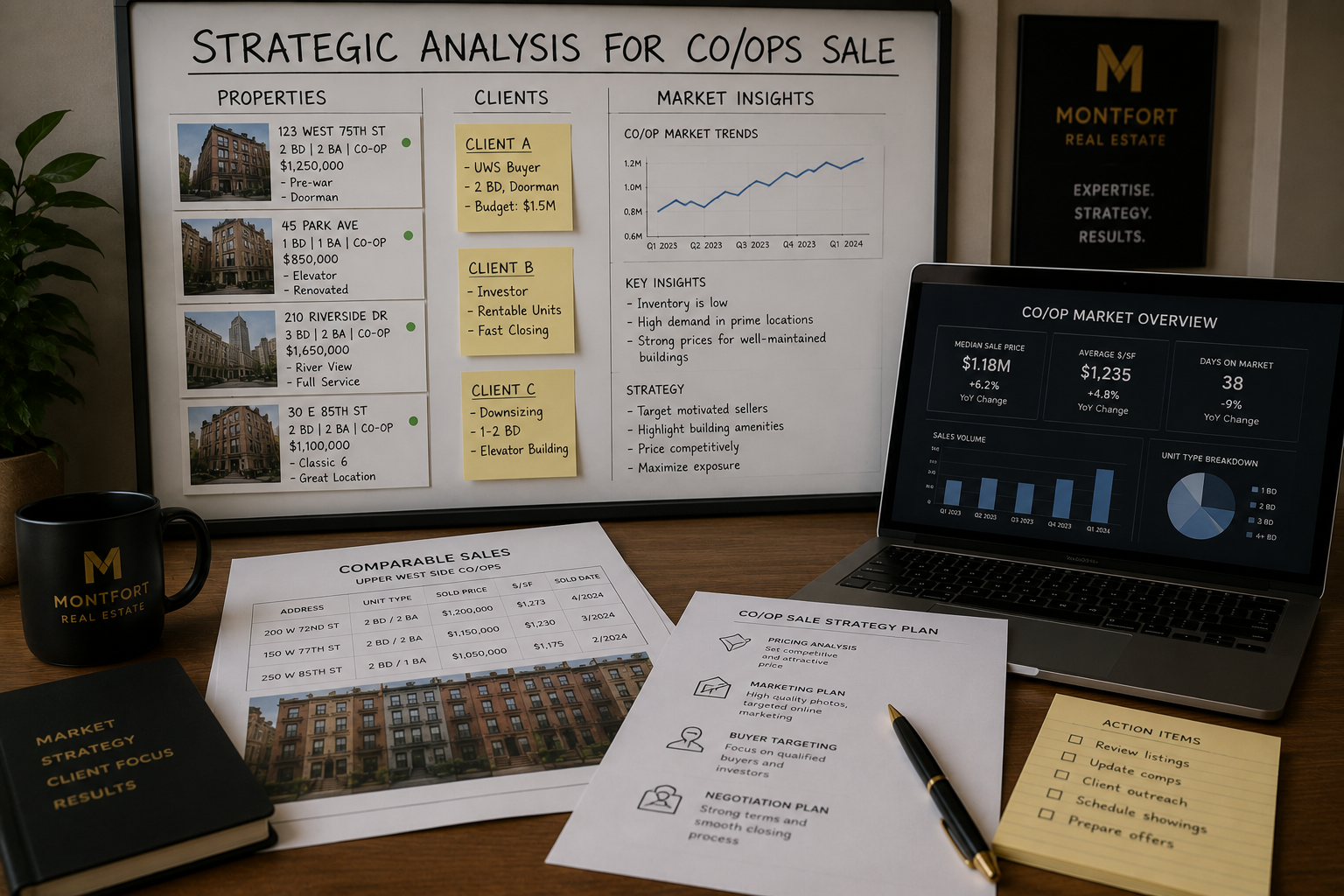
Common Valuation Mistakes That Cost Co-op Owners Money
Relying on automated online estimates: Automated tools provide a quick baseline for home valuation, but they cannot account for board restrictions, building financials, or cooperative corporation dynamics. City assessments do not reflect actual market value for co-ops-the NYC Department of Finance treats co-ops like rental apartment buildings for tax purposes, using income data from comparable rental buildings and capitalization rates that often severely understate market value.
Ignoring maintenance fees: Maintenance per square foot varies dramatically across buildings. A co-op with maintenance 30% above comparable buildings in the neighborhood will attract fewer buyers and lower offers.
Comparing to the wrong buildings: One question I always discuss with homeowners is whether their comps are truly comparable. Comparing your unit's value to recent sales in a white-glove doorman building when yours is a walk-up without amenities leads to overpricing-and months of sitting on the market.
Forgetting the flip tax: Sellers who don't account for their building's flip tax overstate their net proceeds, sometimes by tens of thousands of dollars.
NYC Tax Assessments vs. Actual Market Value
The NYC Department of Finance provides tax assessment data for properties, but these assessments systematically undervalue co-ops. For co-ops sold in 2025, the median difference between the DOF's estimate and the actual sale price was approximately $849,667. The disparity is even more extreme for luxury units: for co-ops priced above $10 million, the DOF market value captures only about 10% of the sales-based market value. Your tax assessment is not your market value-not even close.

What Our Clients Say
Testimonials from co-op owners who have received valuations will appear here. Each testimonial will include the owner's name, neighborhood, and building type to provide specific, local context.
If you've worked with Stanley and would like to share your experience, your feedback is welcome.
NYC Areas We Serve
I provide co-op valuations across New York City's major co-op markets, with building-specific knowledge in each borough:
Manhattan: Upper West Side, Upper East Side, Midtown, Murray Hill, Gramercy, Greenwich Village, Chelsea, Financial District, Harlem, Washington Heights, and Inwood. Manhattan apartments average $1,200 per square foot, though prices vary significantly by neighborhood, building, and floor.
Brooklyn: Park Slope, Brooklyn Heights, Carroll Gardens, Bay Ridge, Flatbush, Prospect Heights, Kensington, and Sunset Park. Brooklyn townhouses average $800 per square foot, and co-op values reflect a different market dynamic.
Queens: Astoria, Jackson Heights, Forest Hills, Rego Park, Kew Gardens, Flushing, and Bayside.
Bronx: Riverdale, Kingsbridge, Pelham Parkway, and Co-op City.
Whether your co-op is in a pre-war elevator building on the Upper West Side or a post-war complex in Queens, I understand the building-level nuances that determine accurate pricing in each location. Home values fluctuate based on local supply and demand, and I track these shifts at the neighborhood level.
Note: While I focus primarily on Manhattan, Brooklyn, Queens, and the Bronx, I'm happy to discuss property types in Staten Island or connect you with a trusted colleague if your building falls outside my core service area.
Frequently Asked Questions
How accurate are online co-op value estimates?
Home value estimates can differ significantly across websites. Tools like Zillow, Redfin, and others use algorithms based on square footage, property address, neighborhood averages, and public data from recent sales. HomeLight's estimator provides results in under 2 minutes, which gives you a sense of how quickly these tools operate-and how little building-specific analysis they perform.
The problem is that these tools cannot evaluate the factors that matter most in a co-op valuation: building financial health, maintenance fees, board policies, flip taxes, financing restrictions, or reserve fund adequacy. Requesting a Comparative Market Analysis (CMA) from a licensed agent who understands co-op buildings is a far more reliable approach. The most accurate free valuations come from licensed real estate agents who can evaluate both the apartment and the cooperative corporation.
Appraisals typically use the comparable sales approach for valuation-and appraisers use comparable sales to determine property value-but even a professional appraisal can fall short if the appraiser lacks experience with co-op-specific factors in your market.
What building factors affect my co-op's value?
The cooperative corporation's financial health is one of the most significant factors. Specifically:
Underlying mortgage: Large building debt increases maintenance and discounts value
Reserve fund adequacy: Low reserves signal deferred maintenance risk and potential future assessments
Maintenance fees: How your building's cost per square foot compares to similar properties matters enormously to buyers
Flip tax structure and rate: Whether it's 1% or 10%-and who pays-directly affects net proceeds and buyer interest
Board policies: Strict requirements around subletting, renovations, down payments, and post-closing liquidity reduce the buyer pool
Assessment history: Past special assessments and anticipated future capital needs (facade, elevator, roof) factor into buyer calculations
Income and operating expenses: How efficiently the building is managed affects long-term carrying costs
The valuation process includes building-specific financial health considerations that go well beyond what any automated tool can capture.
How long does a professional valuation take?
From initial contact to completed analysis, expect approximately one to two weeks. The timeline depends primarily on how quickly building financial documents-annual reports, audited financials, board minutes regarding upcoming capital projects-are available. The apartment walkthrough itself typically takes 30–60 minutes. I handle all the market research, comparable sales analysis, and building financial review after that initial visit.
Do you charge for the initial valuation consultation?
No. My co-op valuation consultation is completely free with no obligation. You'll receive a thorough analysis of your apartment's estimated market value, the building factors influencing that value, and strategic guidance on timing and preparation-whether you decide to sell now, later, or not at all. I believe every co-op homeowner deserves to understand their equity position, and this free consultation is designed to educate, not pressure.
How is a co-op valuation different from a condo valuation?
A condo buyer receives a deed for their specific unit and owns real property. Co-ops are structured differently-you own shares in a corporation that owns the building. This means valuation must account for the corporation's financial health, the building's debt, board governance, and restrictions that don't exist in condo sales. Co-ops typically cost 30–50% less than comparable condos in the same neighborhood, but that discount isn't uniform-it varies based on building quality, policies, and financial strength.
What improvements increase a co-op's value the most?
Kitchen and bathroom renovations consistently deliver the strongest returns in NYC co-op sales. Updated flooring, improved lighting, and layout modifications that maximize usable square footage also add measurable value. However, the return on any renovation depends on the building, the neighborhood, and the price point. One of the first things I review during a walkthrough is whether any planned or completed renovations align with what buyers in your specific neighborhood are willing to pay for.
Get Your Free Co-op Valuation
Whether you're planning to sell this year or simply want to understand your property's worth, a professional co-op valuation gives you the clarity that online estimates cannot. Every co-op should be evaluated individually based on the apartment's condition, building financials, board policies, comparable sales, and current buyer demand-and that's exactly what my free consultation delivers.
Stanley Montfort · NYC Licensed Real Estate Agent · Specializing in Co-op Sales Across Manhattan, Brooklyn, Queens & the Bronx
Phone: 1-646-970-1078 Email:[email protected] Address: 8 West 126th Street, New York NY 10027
Recent News & Realtor Advice
Stay in the loop on the latest events, news, & happenings in and around our community!
Upper West Side Townhouse Q2 2024 Market Report
On the Upper West Side, we observed a distinct trend that diverges from the citywide patterns. Speci…
Harlem Brownstone Q2 2024 Market Report
The Harlem brownstone market has seen an increase in sales activity since this time last year. In Q2…
Discover Your Dream Home: Explore Apartments for Sale on the Upper West Side
Are you searching for your dream home in one of New York City’s most sought-after neighborhoods? Loo…