
DUMBO Co-Ops Realtor
If you're searching for a co-op in DUMBO, you're looking at one of the most limited housing segments in all of Brooklyn. Dumbo's housing market is dominated by luxury condominiums and loft conversions, with only a handful of cooperative apartments changing hands in any given year. Locqube recorded just three co-op sales in the last 12 months across the entire neighborhood, compared with roughly 110 condo transactions. That scarcity means buying or selling a DUMBO co-op requires a broker who can locate rare inventory, evaluate properties without relying on a deep pool of comparable sales, and navigate board approval requirements that vary building by building. Stanley Montfort at eXp Realty works with buyers and sellers of DUMBO co-ops, providing property-specific analysis, board-package coordination, and transaction guidance built around the realities of this market.
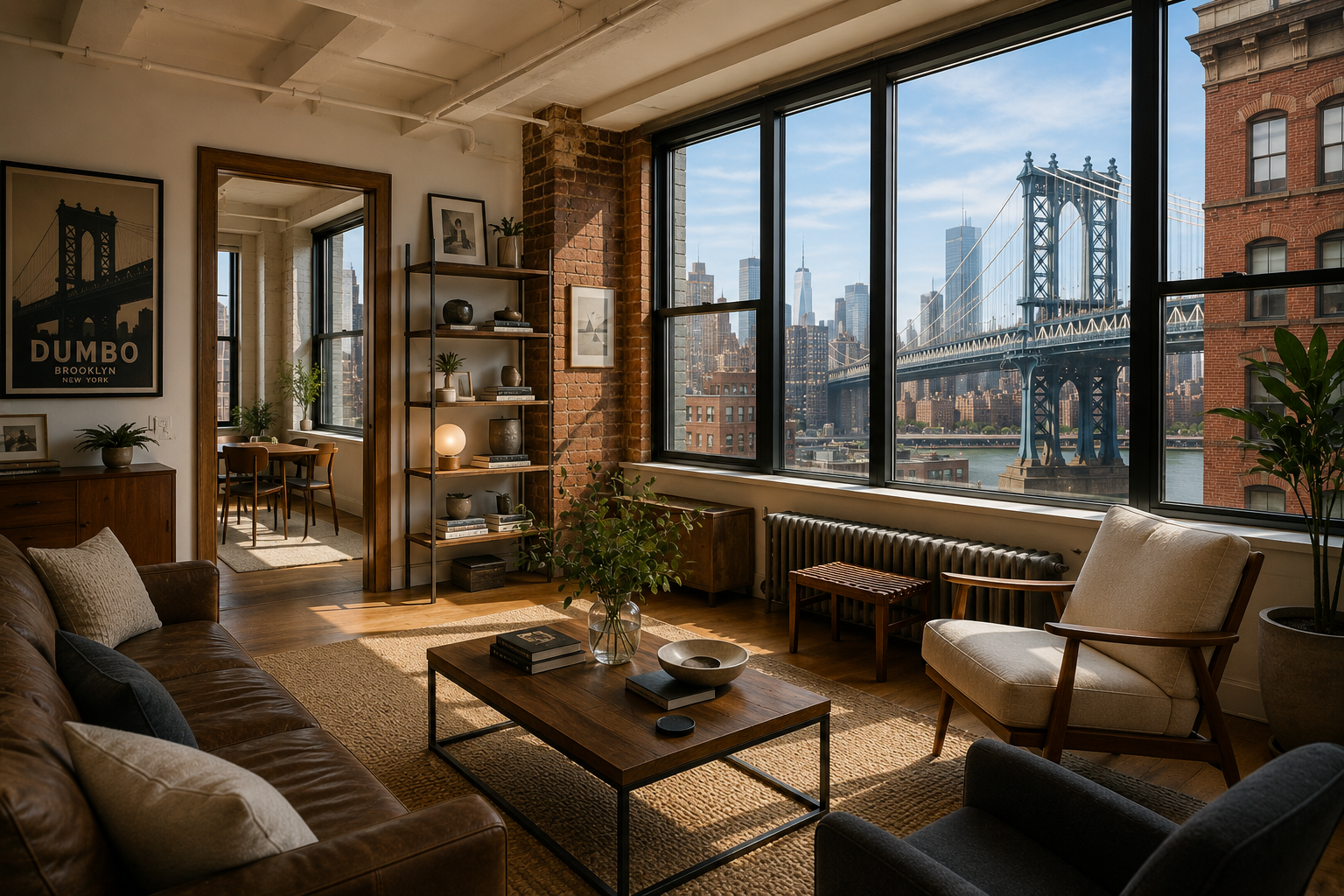
DUMBO Co-Op Real Estate Expertise You Can Trust
Licensed broker with eXp Realty specializing in Brooklyn cooperative and condominium transactions
Direct experience with DUMBO's converted industrial buildings, loft-style apartments, and cooperative board processes
Track record of preparing buyers for co-op board approval, including financial qualification, documentation, and interview coordination
Building-level due diligence covering reserve funds, maintenance history, capital projects, and sublet policies
What Sets Stanley Apart as Your DUMBO Co-Op Realtor
Most DUMBO real estate activity centers on condos. When a co-op comes to market, the typical neighborhood pricing data and broad averages that work for condo buyers become unreliable. Stanley Montfort brings property-specific analysis to every DUMBO co-op engagement, evaluating the apartment, the cooperative corporation's financial position, the buyer's qualification profile, and competing alternatives at similar price points.
Building financials review: Before recommending that a buyer pursue a DUMBO co-op, Stanley examines the cooperative's reserve fund ratio, outstanding obligations, recent assessments, and upcoming capital needs. These factors directly affect monthly maintenance, future costs, and lender willingness to finance the purchase.
Loft and conversion expertise: Many DUMBO co-ops are in converted industrial buildings with ceiling heights above 12 feet, oversized factory windows, and deep floor plates. Stanley evaluates how those architectural features translate into usable living space, natural light distribution, and renovation potential rather than treating them as automatic value-adds.
Inventory strategy for a thin market:PropertyShark data shows approximately one co-op unit among roughly 1,971 residential units in DUMBO's total inventory. Finding the right property often means monitoring off-market opportunities, pre-market conversations, and evaluating whether a condo might better serve a buyer's goals at a comparable price.
Board-requirement fluency: Dumbo's co-op market has strict board requirements and an intense vetting process. Stanley helps buyers understand each building's published financial thresholds before they commit time and money to an offer.
DUMBO Co-Op Real Estate Services
Stanley Montfort provides buyer and seller representation for DUMBO cooperative apartments, covering every phase from initial search or pricing through board approval and closing.
Buying a Co-Op in DUMBO
Co-op apartments in Dumbo require a different buying approach compared to condos. The process begins with financial qualification: most NYC co-ops require a minimum 20% down payment, with some buildings mandating 30% to 50%. Post-closing liquidity requirements commonly equal one to two years of combined maintenance and mortgage payments. Stanley helps buyers assess these thresholds early so they focus on properties where board approval is realistic.
Once a property is identified, Stanley coordinates:
Property evaluation covering layout efficiency, ceiling height, window configuration, floor level, exposure, views, and renovation condition
Financial reviews of the cooperative corporation, including reserves, maintenance trajectory, and capital obligations
Board package preparation with tax returns, asset documentation, employment verification, references, and lender coordination
Timeline management through the approval process; co-op purchases typically take 90 to 120 days to close
Selling a DUMBO Co-Op
For sellers, Stanley builds pricing strategy around same-building comparable sales when available, adjusting for unit-level differences in floor, layout, ceiling height, exposure, and renovation quality. When direct comparable co-op transactions are limited, he carefully expands to relevant condo alternatives while clearly explaining how ownership structure, monthly costs, and building policies affect the comparison.
A properly priced co-op typically sells in 90 to 120 days. Co-op sales involve detailed approval processes and financial reviews, so Stanley pre-qualifies prospective buyers against the building's published requirements before advancing offers. This reduces the risk of a deal collapsing after weeks of board review.
Seller services include:
Comparative market analysis using property-specific methodology rather than broad neighborhood averages
Marketing tailored to the apartment's architectural character, views, and cooperative ownership value proposition
Buyer screening against building financial requirements and policies
Negotiation that accounts for the cooperative's approval timeline and documentation demands
DUMBO Co-Op Valuation and Market Analysis
DUMBO's median sale price reached approximately $1.9 million in Q2 2026, driven almost entirely by condo transactions. The median sale price for NYC homes was $900,000 in June 2026, placing DUMBO well above citywide norms. Co-ops, when they appear, often trade at a discount to neighborhood condo medians due to financing restrictions, board-approval requirements, and sublet limitations.
Stanley provides valuation that accounts for:
The cooperative apartment's specific characteristics rather than neighborhood-wide price-per-square-foot figures
The building's financial health and its impact on buyer perception and lender confidence
Current active listings (both co-op and condo) that represent a buyer's real alternatives
DUMBO is known for its strong long-term property value, but 12.4% of Brooklyn homes had price cuts in June 2026; pricing must reflect current conditions, not assumptions about appreciation
How DUMBO Co-Ops Are Valued
Valuing a DUMBO co-op starts with same-building sales. If a unit in the same cooperative sold within the past 12 to 18 months, that transaction provides the strongest baseline, adjusted for differences in apartment size, layout, floor level, exposure, ceiling height, window count, renovation condition, and timing.
When same-building evidence is unavailable, Stanley expands carefully to comparable cooperative properties in similar converted buildings, then to relevant condo transactions with clear adjustments. Price per square foot is used only as supporting context. In loft-style apartments, a 2,400-square-foot unit with 13-foot ceilings and three exposures functions differently from a 2,800-square-foot unit on a lower floor with limited natural light. Volume, usable layout, and daylight penetration matter more than raw square footage.
Building-level factors directly affect value:
Maintenance charges: Maintenance fees in co-ops cover property taxes and building staff costs, along with insurance, utilities, and common-area upkeep. A higher maintenance charge that funds healthy reserves and well-maintained systems is not inherently worse than a lower charge that defers capital work.
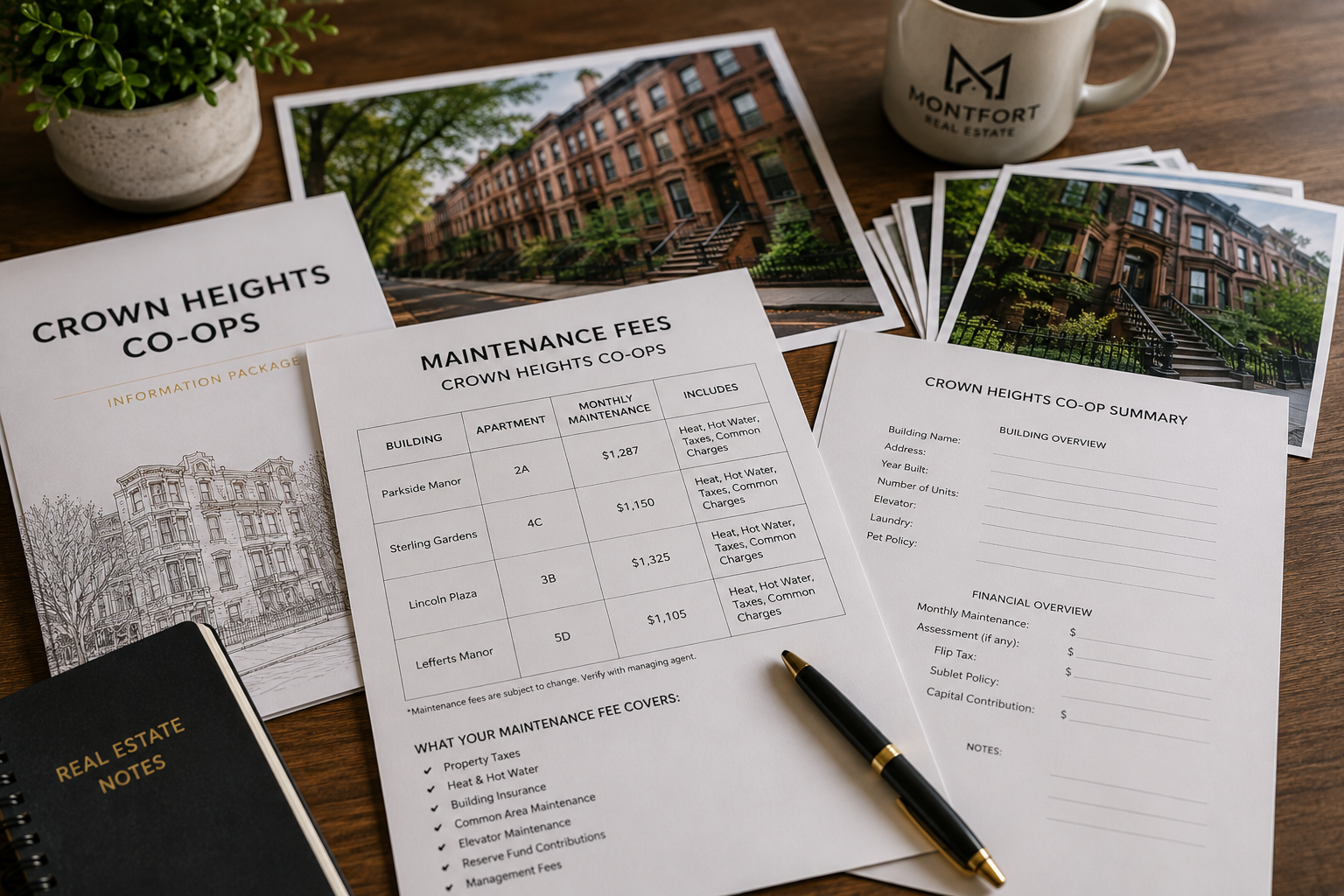
Assessments: Current or upcoming assessments reduce net buyer appeal. Stanley reviews the amount, purpose, duration, and buyer responsibility for any active assessment, plus the building's capital plan for future needs.
Reserve fund adequacy: Low reserves relative to the annual budget and upcoming capital expenditures increase the probability of future assessments or maintenance increases.
DUMBO Co-Op Board Approval Process
DUMBO co-ops require board approval for purchases. The timeline from accepted offer to board decision typically spans six to eight weeks, though some buildings take 10 to 12 weeks if the board meets infrequently or requests additional documentation.
Co-op board approval often requires extensive financial documentation and references. A standard board package includes:
Two to three years of federal tax returns and W-2s
Statements of liquid assets (bank accounts, investment accounts)
A loan commitment letter if financing the purchase
Employment verification and income history
Personal and professional references
Photo identification
Co-op boards require rigorous financial packages for approval. Debt-to-income ratios, post-closing liquidity, and income consistency are all scrutinized. Some buildings expect combined housing expenses plus debt servicing to remain below 25% to 35% of gross income.
Stanley coordinates the entire package assembly, works with the buyer's attorney and lender to ensure documentation is complete, and prepares clients for the board interview. He does not guarantee approval; no broker can. But a well-organized, complete submission that meets the building's published requirements gives the buyer the strongest possible position.
Loft-Style and Converted Co-Ops in DUMBO
DUMBO co-ops are located in historic converted warehouse buildings. The neighborhood's industrial past produced structures with heavy timber framing, brick bearing walls, large casement windows, and deep floor plates. DUMBO co-ops feature high ceilings and oversized windows; ceiling heights of 12 to 14 feet are common in many conversions.
Architectural character alone does not determine value. Stanley evaluates:
Ceiling height and volume: Higher ceilings increase perceived and usable space, but also affect heating costs and renovation complexity.
Window configuration and exposure: DUMBO co-ops offer stunning skyline views and waterfront living in many buildings, with sightlines toward Manhattan, the Brooklyn Bridge, or the Manhattan Bridge. But lower floors may face obstructions, and surrounding development can alter views over time. Buyers should verify current sightlines and check zoning or landmark protections rather than assuming permanence.
Apartment depth: Converted warehouses can have floor plates 60 to 80 feet deep. Units far from exterior walls may have limited natural light in rear portions. Buildings like 185 Plymouth Street addressed this by inserting interior courtyards; not all conversions did.
Column placement and layout efficiency: Structural columns in former industrial spaces can interrupt furniture placement and room configuration. An open floor plan with columns may look spacious but function awkwardly for bedrooms or defined living areas.
Conversion quality: Buyers should assess whether building systems (HVAC, plumbing, electrical, windows, sprinklers) were upgraded during conversion or retrofitted minimally. Older conversions without modern infrastructure updates may carry higher maintenance and renovation costs.
DUMBO co-ops often include amenities like rooftop spaces and fitness centers, though amenity packages vary building by building and are less uniform than in newer condo developments.
DUMBO Co-Op Building Analysis
Stanley reviews cooperative building financials before recommending that a buyer make an offer. Key indicators include:
Reserve fund ratio: The relationship between cash reserves and the annual operating budget. Buildings with thin reserves and looming capital projects (roof replacement, facade restoration, elevator modernization, window upgrades) are more likely to levy assessments.
Maintenance charge composition: Co-op maintenance costs include property taxes and debt service in addition to operating expenses. Understanding how much of the monthly charge covers the building's underlying mortgage or tax obligation helps buyers compare true occupancy costs across properties.
Capital project history and pipeline: Recent audits, if available, reveal completed and planned work. In DUMBO's landmarked historic district (designated in 2007), facade and exterior work must comply with preservation requirements, which can increase project costs.
Sublet policies: Co-op lifestyle rules can include restrictions on pets and subletting. Many co-ops limit the percentage of units that can be sublet at any time, require board approval for tenants, and cap sublet duration. Buyers who want flexibility should weigh these restrictions against their goals. Sellers should understand how restrictive policies may narrow the future buyer pool.
Renovation and alteration rules: Loft-style apartments may appear flexible, but cooperative boards often require approval for any structural change, plumbing modification, or window replacement. Landmark restrictions in DUMBO can add another layer. Buyers should investigate the building's alteration agreement and approval process before assuming they can reconfigure a space.
Comparing DUMBO Co-Ops With Condo Alternatives
DUMBO co-ops are highly desirable due to unique features, but most buyers exploring this neighborhood will also consider condos. Here is how the two ownership structures differ in practice:
Purchase approval: Co-ops require board approval with financial documentation, references, and an interview. Condos typically require only a waiver of the building's right of first refusal, with no personal interview.
Financing: Co-op boards may limit loan-to-value ratios, restrict certain lender types, or require higher down payments. Condo financing follows more standardized guidelines, and lenders generally offer more flexible terms.
Monthly costs: Co-op maintenance and condo common charges are not directly interchangeable. Maintenance typically bundles property taxes, building insurance, staffing, and debt service into one payment. Condo owners pay common charges plus a separate property tax bill. The total monthly obligation depends on building-specific factors, not ownership type alone.
Resale flexibility: Condos generally attract a broader buyer pool because there is no board interview, fewer financing restrictions, and more permissive sublet rules. In a market like DUMBO where median listing price reached $2,025,000 in June 2026, co-op sellers face a smaller subset of qualified and willing buyers.
When a co-op makes sense: A DUMBO co-op may offer a lower purchase price for comparable space, distinctive architectural character, and a building community with more owner-occupancy. Buyers whose financial profile is strong, who plan to live in the apartment long-term, and who do not need sublet flexibility may find co-op ownership well sorted for their goals.
Stanley helps buyers weigh these trade-offs against their specific financial position, timeline, and lifestyle needs rather than defaulting to one ownership type.
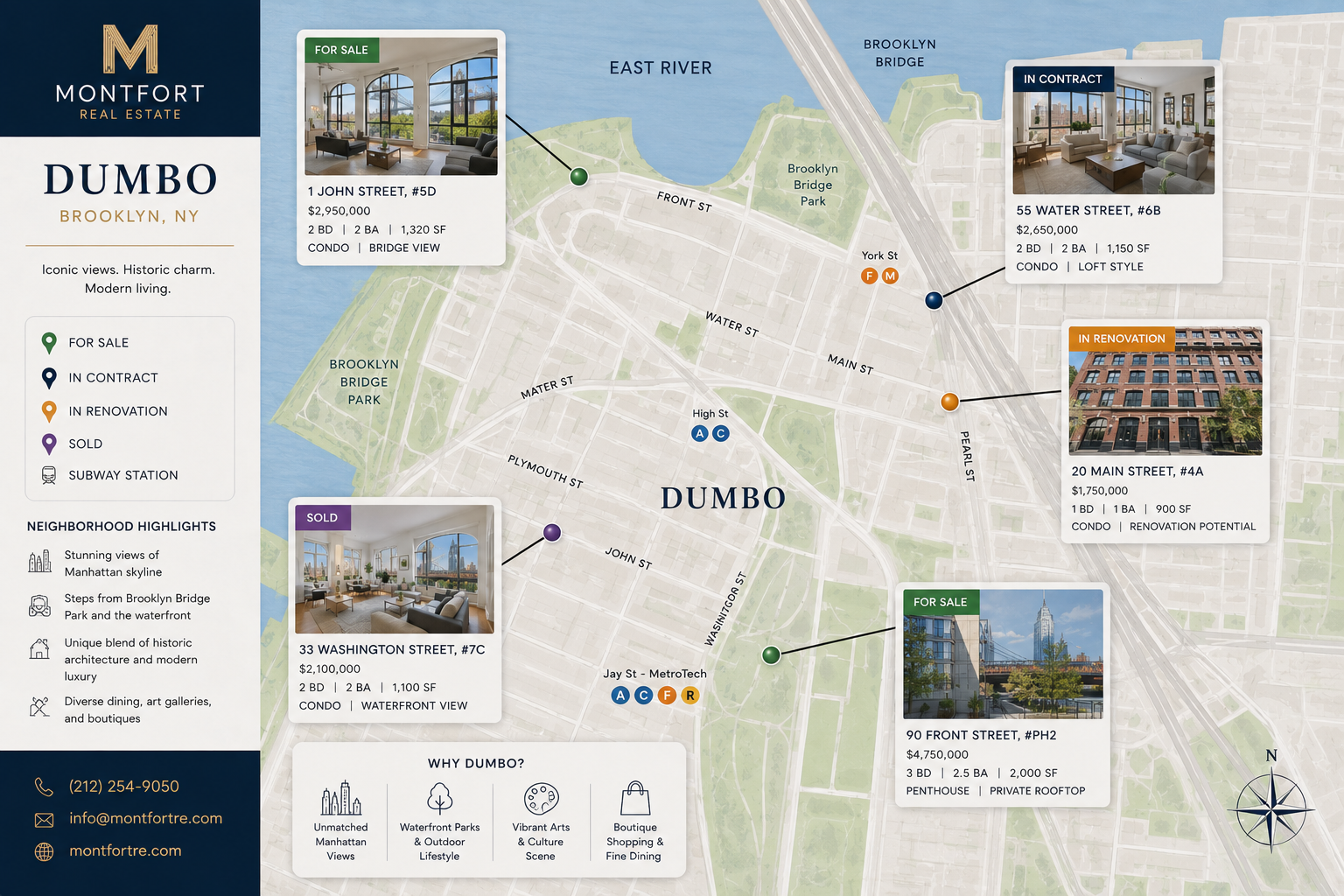
DUMBO Locations We Serve
Stanley Montfort works with buyers and sellers across DUMBO's compact neighborhood footprint, including properties along:
Water Street, Front Street, and Washington Street
The Brooklyn Bridge Park vicinity and waterfront addresses
Plymouth Street, Main Street, and Jay Street
Manhattan Bridge corridor buildings with bridge and skyline views
The DUMBO historic district, where converted warehouses like 192 Water Street (a former tea warehouse converted into eight lofts with approximately 2,450 square feet per unit) represent the neighborhood's architectural heritage
DUMBO sits between the Brooklyn and Manhattan bridges, bounded by the East River waterfront. Homes here look toward Manhattan, the bridges, or the neighborhood's cobblestone streets. Stanley's local knowledge helps buyers find properties with the exposure, floor level, and sightlines that match their priorities.
Frequently Asked Questions About DUMBO Co-Ops
How limited is DUMBO's co-op inventory compared to condos?
DUMBO's residential inventory is almost entirely condominiums. PropertyShark's current data shows roughly one co-op unit among approximately 1,971 total residential units. In the last 12 months, only three co-op sales closed versus about 110 condo sales. Buyers interested in a DUMBO co-op should expect a longer search and be prepared to act quickly when a property appears.
What are typical maintenance charges for DUMBO co-ops?
Reliable maintenance data for DUMBO co-ops is limited because so few exist. In comparable Brooklyn co-ops, maintenance often runs $3.50 to $6.00 or more per square foot per month, depending on building services, age, staffing, and capital needs. Maintenance fees in co-ops cover property taxes and building staff costs, so direct comparison with condo common charges requires adding the condo owner's separate tax bill.
How do DUMBO co-op board requirements compare to other Brooklyn neighborhoods?
Local agents should know specific co-op board requirements and application processes, because these vary by building. Some DUMBO co-ops may require 30% or more as a down payment and post-closing liquidity equal to one to two years of carrying costs. Others may follow more standard 20% down-payment norms. The building's published rules, not neighborhood generalizations, determine what a buyer must demonstrate.
What financing restrictions apply to DUMBO co-op purchases?
Financial reviews are part of the DUMBO co-op buying process. Many co-ops restrict loan-to-value ratios, limit approved lenders, or prohibit certain loan types. Some buildings require all-cash purchases. Stanley helps buyers confirm a building's financing policies before they invest time in an application.
How do views and location affect DUMBO co-op values?
Floor level, window orientation, and exposure directly influence pricing. Units with unobstructed Manhattan skyline, East River, or bridge views command premiums. But views in DUMBO depend on surrounding development and zoning; buyers should verify current sightlines and check what protections (landmark designation, zoning restrictions) exist rather than treating a view as guaranteed.
What should buyers expect during the board approval process?
The board approval timeline typically runs six to eight weeks from package submission to decision, though some buildings take longer. Buyers submit financial documentation, references, and a lender commitment letter, then attend an interview. Co-op purchases typically take 90 to 120 days to close when including the full transaction timeline from accepted offer through board approval and closing.
Schedule Your DUMBO Co-Op Consultation
Whether you're a buyer trying to find a rare DUMBO co-op or a seller preparing to bring one to market, Stanley Montfort provides the property-specific analysis, board-approval coordination, and market knowledge this specialized segment requires. Every DUMBO co-op transaction involves the apartment, the building, the buyer's financial profile, and the competing alternatives. Stanley evaluates all four.
Phone: 1-646-970-1078 Email:[email protected] Address: 8 West 126th Street, New York NY 10027
Recent News & Realtor Advice
Stay in the loop on the latest events, news, & happenings in and around our community!
Upper West Side Townhouse Q2 2024 Market Report
On the Upper West Side, we observed a distinct trend that diverges from the citywide patterns. Speci…
Harlem Brownstone Q2 2024 Market Report
The Harlem brownstone market has seen an increase in sales activity since this time last year. In Q2…
Discover Your Dream Home: Explore Apartments for Sale on the Upper West Side
Are you searching for your dream home in one of New York City’s most sought-after neighborhoods? Loo…